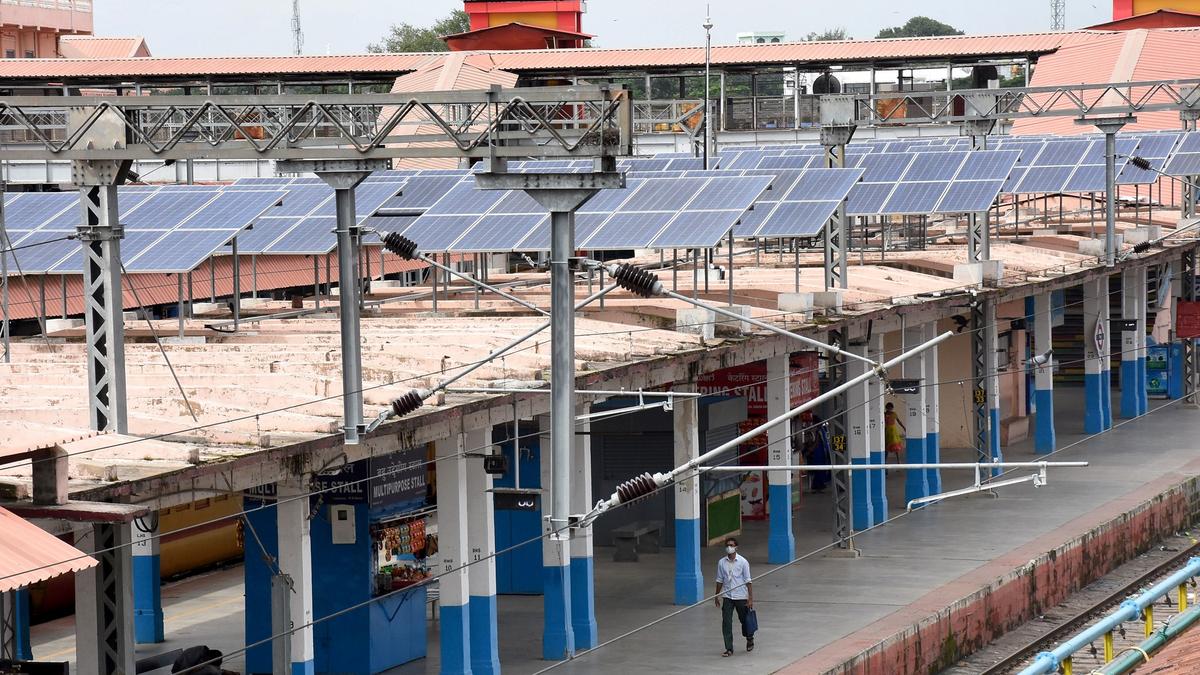
Explained | India’s solar push augurs a looming waste management challenge Premium
The Hindu
India is expected to produce 4 million tonnes a year of waste from solar photovoltaic installations but is not prepared to handle it. It must begin now, otherwise, it will be too late.
There has in the last few years been a concerted push from policymakers and thought leaders in India to transition to a circular economy to, among other things, enable effective waste management. However, waste management in the solar photovoltaic sector still lacks clear directives.
At the same time, there have been interesting policy announcements and initiatives vis-a-vis photovoltaic waste management, especially since last year. For example, the Ministry of Environment, Forests and Climate Change’s revised electronic waste (e-waste) management Rules in 2022 brought solar photovoltaic cells, panels, and modules under its ambit. Similarly, the Green Credit Programme under the Environmental Protection Act, announced in the 2022-2023 Union Budget, aimed to promote green growth and sustainable practices. While these measures are noteworthy, have we thought through the effective handling of photovoltaic waste in India?
Globally, India stands fourth in solar photovoltaic deployment. India’s solar power installed capacity had reached nearly 62 GW by November 2022. While this is certainly encouraging, it also augurs a colossal amount of solar photovoltaic waste in future. According to a 2016 report by the International Renewable Energy Agency, India could generate 50,000-3,25,000 tonnes of cumulative photovoltaic waste by 2030 and more than 4 million tonnes by 2050. In fact, India is expected to become one of the top five leading photovoltaic waste producers globally by 2045-2050.
India’s solar photovoltaic installations are dominated by crystalline silicon (c-Si) technology. A typical photovoltaic panel is made up of 93% of c-Si modules and 7% of cadmium telluride (CdTe) thin film modules. A c-Si module mainly consists of a glass sheet, an aluminium frame, an encapsulant, a backsheet, copper wires, and silicon wafers. The metals used to manufacture c-Si modules are silver, tin, and lead. The CdTe thin film module is made of glass, encapsulant, and compound semiconductor.
As these photovoltaic panels reach their end of lives, some portions of the frame are extracted and sold as scrap; junctions and cables are recycled according to e-waste guidelines; the glass laminate is partly recycled; and the rest is disposed of as general waste. Silicon and silver can be extracted by burning the module in cement furnaces. According to a 2021 report, approximately 50% of total materials can be recovered through such waste management and recycling processes.
India’s challenge is the growing informal handling of photovoltaic waste. Only about 20% of the waste is recovered in general; the rest is treated informally. As a result, the waste often accumulates at landfills. Landfill disposal in turn causes acidification, leaching of toxic metals (such as lead and cadmium) into the soil, and contaminates the local water. Gradual incineration of the panel encapsulant also releases sulphur dioxide, hydrogen fluoride, and hydrogen cyanide into the atmosphere.
This is why it’s unclear whether the environment ministry’s guidelines to include solar photovoltaic waste as e-waste could lead to an actual ban on landfills in India or offset the adverse impact on the environment.


Bajaj Electricals acquires Morphy Richards brand rights in India and South Asia, enhancing innovation and market strategy.

CPI(M) insists on contesting more seats in the 2026 Tamil Nadu Assembly elections amid ongoing seat-sharing negotiations with DMK.

Kerala's Film Policy recognizes cinema as an industry, promoting gender justice and sustainable growth through various strategic reforms.

Bengaluru airport launches Connections by BLR for a seamless transfer experience, enhancing passenger convenience and airport efficiency.

Telangana focuses on enhancing public transport and electric vehicle adoption at the National Mobility Summit 2026.

Supreme Court rules adoptive mothers entitled to 12 weeks maternity leave, regardless of child's age, and calls for paternity leave recognition.

Karnataka II PU students in Belur receive incorrect question papers, raising concerns about their exam results and fairness.

Food supply jitters could trigger WFH, impact hostel occupancy, warns IT corridor hostel association
Hyderabad's IT Corridor Hostels Association warns food supply issues may prompt firms to shift to remote work, impacting hostel occupancy.

Prismforce Skill Management Platform Now Available on SAP® Store

ECI orders immediate transfer of officials in Kerala for April Assembly polls, restricting their involvement in election-related tasks.

South Western Railway introduces special express trains for Ugadi festival to manage increased passenger demand and ease travel congestion.

Udupi's Sri Lakshmi Express bus service halts after owner’s death, disrupting travel for hundreds, including students during II PUC exams.

Madras High Court defers ruling on tender disputes for live webcasting in Tamil Nadu Assembly elections 2026, affecting surveillance companies.