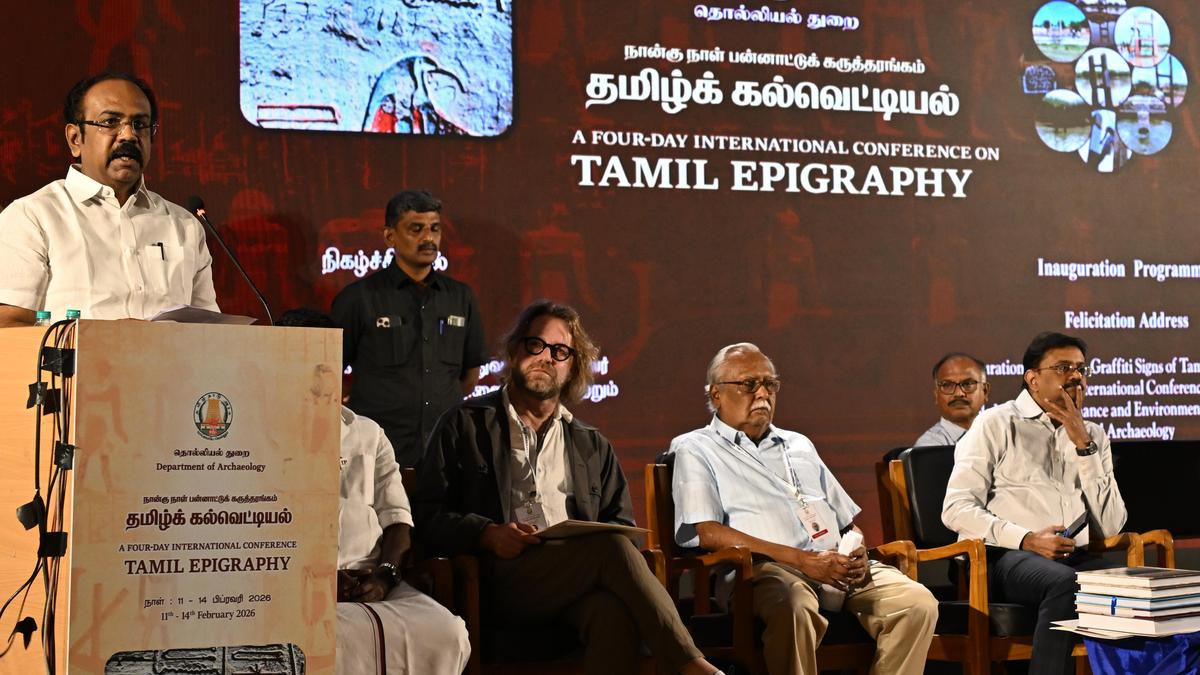
Epigraphy plays a vital role in tracing socio-political, cultural history: Thangam Thennarasu
The Hindu
Epigraphy reveals vital insights into Tamil Nadu's socio-political and cultural history, highlighting its significance in historical reconstruction.
Epigraphy is much more than the study of ancient inscriptions and is a vital discipline that enables us to understand the evolution of society across political, social, economic, cultural, and technological dimensions, said Minister for Finance and Archaeology Thangam Thennarasu in Chennai on Wednesday (February 11, 2026).
Speaking at the inauguration of a four-day International Conference on Tamil Epigraphy organised by the Tamil Nadu State Department of Archaeology (TNSDA), Mr. Thennarasu said, unlike literary sources, inscriptions possess a unique authenticity. Being engraved on permanent materials such as stone or metal, they are largely free from later interpolations and biases, offering us an unfiltered and reliable reflection of the realities of the past.
In the Indian context, epigraphy has played a foundational role in historical reconstruction. With over one lakh inscriptions documented across South India, Tamil Nadu alone accounts for approximately 30,000 inscriptions, providing an unbroken chronological record from the 6th century BCE to the colonial period, he said.
This vast body of evidence allows historians to continually reassess and refine our understanding of the region’s long and complex cultural evolution. To ensure the preservation and continuity of Tamil Nadu’s rich heritage, the TNSDA has undertaken several ambitious, technology-driven, long-term projects. These initiatives extend well beyond traditional documentation and adopt advanced scientific methods, he said.
The 20-year Vision Project on the cultural history of Tamil Nadu aims to document archaeological monuments at the village level across all districts, with active fieldwork currently under way in Dharmapuri, Krishnagiri, the Nilgiris, Erode, and Tiruppur. The theme-based epigraphy project uses modern digital technologies to record inscriptions based on specific themes such as trade guilds and hero stones, he said.
Beyond field research, the TNSDA is modernising museums, conducting new excavations, expanding collaborations with national and international research institutions, and strengthening human resources to adapt to emerging scientific technologies. Forthcoming publications will include comprehensive studies on Tamil Nadu’s rock art, ancient symbols, and pottery inscribed with Tamil-Brahmi characters, he added.


Erode's smart roads fail to protect pedestrians as footpaths remain encroached by shopkeepers, compromising safety and accessibility.

Assam CM Himanta Biswa Sarma claims lakhs of 'doubtful voters' deleted based on BJP complaints during electoral roll revision.

Government dismisses proposals for constitutional recognition of denotified tribes, despite their push for a separate Census classification

Raichur MP G. Kumar Naik urges stable policies to protect domestic cotton growers amid rising imports and declining production.

Vande Bharat AC chair car fares are significantly lower than those in China, Japan, and France, says Railway Minister Vaishnaw.

Epigraphy reveals vital insights into Tamil Nadu's socio-political and cultural history, highlighting its significance in historical reconstruction.

Rupee falls 14 paise to 90.70 against the U.S. dollar amid dollar demand, geopolitical tensions, and rising crude oil prices.

Explore Chennai's vibrant cosplay scene as enthusiasts gather for a workshop ahead of Comic Con India, fostering community and creativity.

Join our free webinar on February 13 to explore epilepsy management, treatment options, and raise awareness about this condition.

UBS opens a global capability center in Hyderabad, planning to hire 3,000 professionals over two years

GCDA plans to host non-sporting events at Kaloor stadium while preserving the turf, accommodating Kerala Blasters' ISL matches.

40 world chefs’ broke bread and boundaries at the IIHM International Young Chef Olympiad

Assam's CM praises Supreme Court ruling on forest evictions, aiming to enhance anti-encroachment efforts and streamline processes.