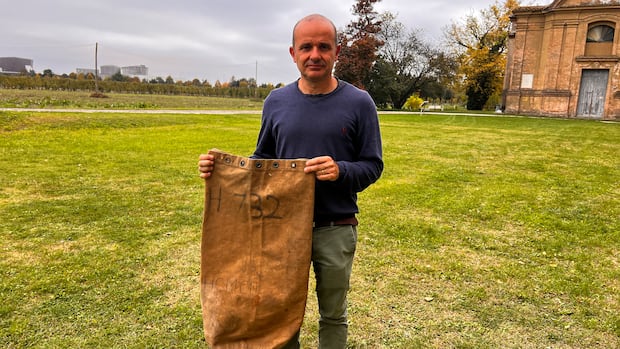
Dusty duffel bag found in Italy revives story of Cape Bretoner killed in WW II
CBC
On most summer Sunday afternoons, Michele Facchini would be nowhere near the sweltering hot, low, flat fields northwest of Ravenna, Italy, with a metal detector.
However, it was here he made an unexpected connection to Cape Breton's Hector McDonald, a soldier who died in action in 1944.
The 49-year-old Facchini, a Second World War researcher and educator, usually spends summer weekends at home, reading diaries of Canadian soldiers and tracing battle maps.
On July 6, he took advantage of some cool weather, heading to the outskirts of the town of Russi, near the Lamone River.
There, in December 1944, nearly 10,000 Canadian troops advanced to push Nazi forces out of northern Italy. His research suggested a platoon had fought in the field, dodging bullets and bombs, side-stepping landmines, as the men pushed toward the river on frigid, water-logged terrain.
Facchini’s metal detector was set off by remnants of bullets and shrapnel from high-explosive bombs. Then the farmer whose land he was on brought him a few objects that had been collecting dust in a small warehouse on his land.
“That’s when I saw the duffel bag, the kind soldiers kept their personal effects in,” said Facchini. “It was covered in dirt, but underneath I could make out letters that spelled a name and numbers of a regiment.”
The accidental discovery would revive a story untouched for 81 years — and reconnect McDonald with a family that had never forgotten him.
No photograph of Hector Colin McDonald survives, but wartime documents sketch a portrait.
He was wiry at five-foot-nine and 137 pounds. He had hazel eyes and light-brown hair. His bearing is noted as “fair” and “correct.” He was the third of six children.
He was a young man who left school in New Aberdeen, Cape Breton at 15 to work in the Dominion Coal Company mines, as most of the men in his family did, hoping one day to become a welder.
Instead, in late 1941, at age 25, McDonald enlisted to fight in the Second World War, like thousands of young Canadians, because, as noted in his file, it was “the right thing to do.”
He joined the North Nova Scotia Highlanders and went on to fight his way through some of the grimmest battles of the Italian Campaign.
They included the Allied invasion of Sicily, the landing at Reggio Calabria mainland Italy, the brutal street-to-street combat in Ortona, and the grinding effort to break through at Monte Cassino.


The government of Saskatchewan has announced plans to reduce the length of non-resident game bird hunting licences to combat illegal guiding.

An 87-year-old Alberta man is fighting extradition to the United Kingdom to stand trial for historical allegations of physical and sexual assault involving minors.

Eight casinos across southwest B.C. have been sold to First Nations in the last two years, with the province's gambling scene set to be reshaped as a result.

Hamilton hosts the Junos Sunday, and the musical awards show is bringing tourists, musicians, concerts and a ton of themed events to the city this week.

The multi-million-dollar deal at the heart of a high-profile fight between the Canadian government and one of the world’s biggest carmakers contains multiple clauses about the company’s footprint in Ontario, according to a copy obtained by CBC Windsor.

In recent months, Calgary police have carried out three day-long safety blitzes, parading out dozens of officers to flood an area with their increased presence — at least, temporarily.

A national organization is seeking people with experience in Canada's forestry sector as they put together a working group that will examine ways to improve forest recovery following wildfires.

Ella Heyder is bracing for a breakup, even though she already moved out decades ago.

Shawne Hopkins never saw it coming.

Politicians return to Queen’s Park Monday for a shortened spring session, as Premier Doug Ford prepares to unveil his eight budget amid heightened global economic uncertainty.

Despite a recent announcement that a water supply pipeline will be build in Oneida Nation of the Thames, some members of the community say that's no excuse for taking water for granted.

As scandal has swirled around former prince Andrew Mountbatten-Windsor, questions and curiosity have also focused on his ex-wife, Sarah Ferguson, and their daughters, Princesses Beatrice and Eugenie.

Friday may have been the first day of spring, but winter storms are not over yet for Newfoundland.