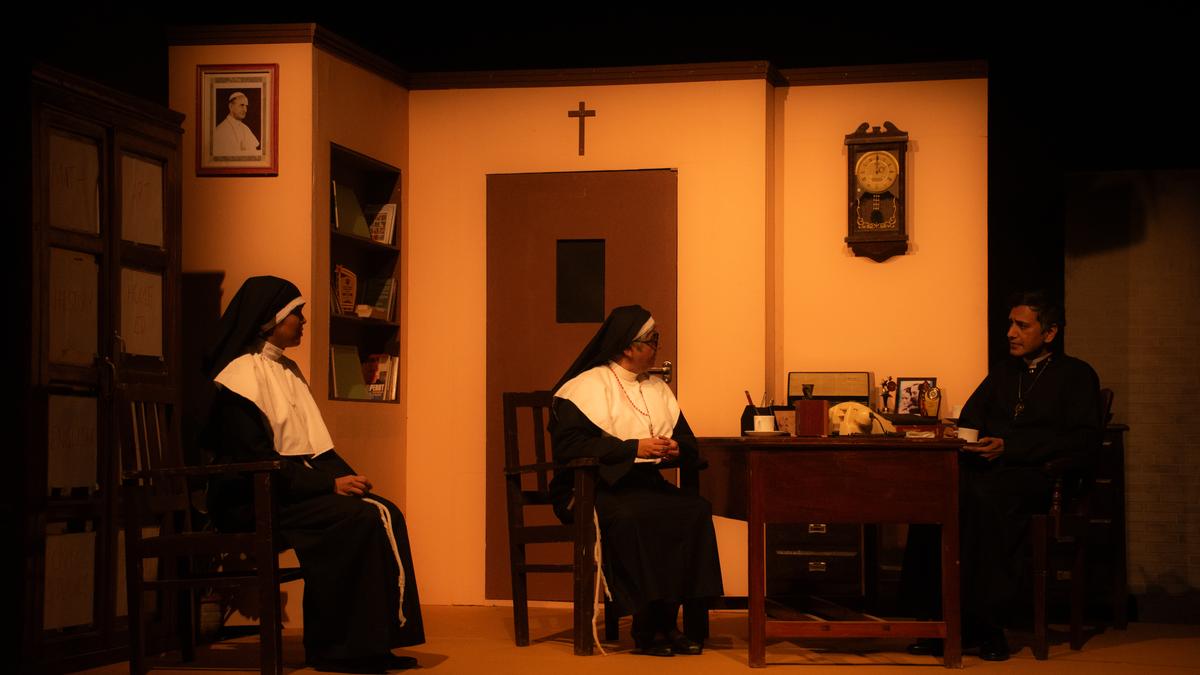
Doubt comes to Bengaluru, courtesy Poochu’s Productions
The Hindu
Chennai-based Poochu’s Productions brings Doubt to Bengaluru this weekend
Have you ever been beset by uncertainty over what you have always known to be true? Doubt written by John Patrick Shanley in 2004, puts human relationships and emotions under an unforgiving microscope, and this weekend, Chennai-based Poochu’s Productions brings this play to Bengaluru.
Set in Chicago in 1964, Doubt is centred around accusations of an inappropriate relationship between a Catholic priest and a child. Denver Anthony Nicholas, who has directed this adaptation, says the reason this play was chosen was, “the way it allowed the audience to make their own decision.”
He adds that Doubt does not tell you who is right or wrong, “it just leaves you in the grey area of assumptions and accusations.” “What makes Doubt different is that it not only brings about the awareness of an issue, but also an awareness of the people involved.”
Denver elaborates how the mother of the child in the play ponders if the priest is at fault or “if it was in her son’s nature”. It is an interesting, insightful take on human behaviour and perception, says the director.
Though there are layers to the script crafted around the Civil Rights Era, Denver says it is the mother’s observation that cemented the choice of play for him and lead actor Karthik TM. The duo, who pored over scores of scripts, decided against an Indian adaptation or contextualisation of Doubt when they finally settled on it.
With Doubt set in a certain time period, other iterations of this play have seen adaptations of Indian characters to fit the narrative. “This was something I didn’t want to do because I believe 99 out of 100 theatre-goers are sensible people who will understand the setting in which the script was penned,” says Denver.
And even though Doubt is positioned in the context of a Catholic setup, the questions it throws up are applicable to any human circumstance and situation. “It makes you doubt everything about human relationships,” he adds.


Acclaimed actor-director Basil Joseph, who was recently seen in a cameo appearance in Sivakarthikeyan’s Parasakthi, is all set to make his Tamil debut as a lead in the upcoming Tamil-Malayalam bilingual film Raawadi

Vijay Deverakonda and Rashmika Mandanna star in the epic Telugu film 'Ranabaali,' releasing on September 11, 2026.

Ace director Lokesh Kanagaraj has spoken about the future of LCU, how ‘AA23’ happened, what criticisms on ‘Coolie’ taught him, exiting the much-awaited Rajinikanth-Kamal Haasan project and debuting as an actor in Arun Matheswaran’s ‘DC’

Filmmaker Lokesh Kanagaraj confirmed that he has a cameo in superstar Vijay’s much-awaited final film, Jana Nayagan.

Ravi Teja’s next film with director Shiva Nirvana has been titled Irumadi, the Telugu superstar made the announcement today (January 26, 2026) on his birthday

Written and directed by Sooriyaprathap S, ‘Root’ marks Aparshakti Khurana's Tamil debut

Mammootty and Mohanlal's Patriot finally has a release date. Directed by Mahesh Narayanan the film also stars Fahadh Faasil, Kunchacko Boban, Nayanthara and Darshana Rajendran

A double bill performance Your Symptoms, and Flight, will premiere in Bengaluru on January 25

A commemorative lec-dem by Madurai T.N. Seshagopalan in Chennai revisited the enduring musical legacy of Harikesanallur Muthiah Bhagavatar

The release date of Shah Rukh Khan's King, directed by Siddharth Anand and also starring Deepika Padukone, was unveiled on Saturday

Hamstrung by pacing and VFX issues, Anurag Singh’s standalone sequel to J.P. Dutta’s Border is affecting but predictable and generic in parts.

Yamaha launches India-focussed keyboards with riyaz mode and Carnatic music

Karsh kale will showcase a good chunk of "Dust' at his performance at Lollapalooza in Mumbai on January 24 and 25.