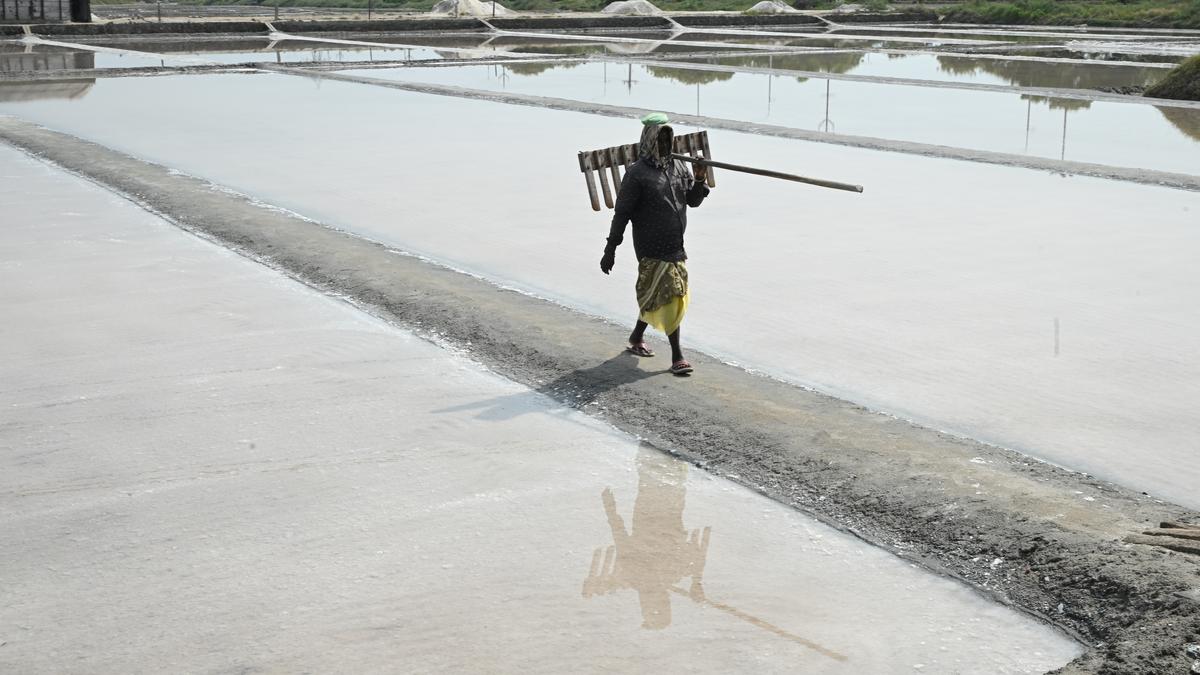
Distress in the salt pans
The Hindu
Chef Koushik S., the 'Mad Chef', shares cooking tips; Tamil Nadu salt industry struggles due to unseasonal rain.
Chef Koushik S., also known as the ‘Mad Chef’, who shares cooking and eating tips on social media with great gustatory spirit, had some unusual advice about using salt. He said that while cooking, salt should be sprinkled from a height to ensure it spreads evenly across the dish. “That way, you will use only as much as you need. It makes even sweets taste better. It brings out the flavour of chocolate in cakes. It’s a condiment that brings both flavour and sparkle to our food,” he said, his arm poised high above a pan on a stove, ready to sprinkle the salt.
A good ‘harvest’ of this taste-enhancer brings joy to producers and salt pan workers, who, as of 2021-22, had produced 23.93 lakh tonnes on land belonging to the Central and State governments and private owners. Nine coastal districts produce sea salt in Tamil Nadu, and the State has, over the years, earned the status of being among the top three salt producers in the country.
Cooking salt constitutes around 25% of the salt produced in India. The right combination of sun and seawater brings out the best quality sea salt or crystal salt (different from rock salt). A.R.A.S. Dhanapalan, a long-time salt manufacturer, explains that earlier, seawater with 3 degrees of salt content used to be stored in small pans for being dried under harsh sunlight to produce salt in 20 or 25 days. “Now, the producers sink borewells up to 120 feet to draw groundwater with 6 to 8 degrees of salt content. At some places, the salt content goes up to even 9 or 10 degrees, and those lucky owners can get the salt from the pans within 15 days.”
But unseasonal rain and heavy downpours during the monsoons in the past few years have wreaked havoc on the salt industry. Salt manufacturers, who should have moved production to the top gear in April, are yet to harvest the first superior-quality salt of the year. “Thoothukudi district, which usually produces over 25 lakh tonnes every year, has been hit hard by nature’s forces. Manufacturers, who have agreed to supply salt to various industries, are buying the salt from Gujarat to fulfil their commitments,” says M. Sathish Chandran, a small-time salt manufacturer.
The district, Tamil Nadu’s largest salt producer, has been buying salt for at least three years. Salt from the State used to be supplied to chemical industries; lubricant manufacturers; the food industry for the manufacture of ice-cream and snacks; the units making salt-resistant industrial coatings; preservation industry; cadaver research; and dyeing units and tanneries in various States, including Odhisha, Bihar, and West Bengal. However, owing to the cut-throat competition from Gujarat’s salt manufacturers, those in Tamil Nadu limit their reach up to Telangana, Andhra Pradesh, and Karnataka.
The unseasonal rain has also severely affected the livelihoods of salt pan workers, says M. Krishnamoorthy, president, Tamil Nadu Manual Workers Association. “They have no alternative employment, because after years of working on the pans in the sun, and carrying heavy loads, they are not physically fit for any other work. The government provides a relief of ₹5,000 during the monsoon to a registered member of a family. This should be extended to all those who work on the pans,” he says.
D. Amutha, associate professor of Economics, St. Mary’s College, Thoothukudi, has done a study on salt production. She says the area had been so badly affected that even exports were down. “Like agriculture, this condiment, which makes our food savoury, depends on the vagaries of nature. We should understand that the entire country cannot be dependent on Gujarat alone, as one natural calamity in that State will lead to us importing salt from other nations. The government should take salt out of the jurisdiction of the Industries Department and bring it under the Agriculture Department,” she suggests.


The Dispur election heats up as 'CongBJP' defections shape a high-stakes contest between veteran candidates from BJP and Congress.

Bengaluru's M. Chinnaswamy Stadium conducts readiness drill ahead of IPL 2026, ensuring upgrades and technical preparations are complete.

First-level randomisation of EVMs completed in Nagapattinam for upcoming elections, ensuring transparency and security.

A district-level committee in Krishnagiri has been formed to assess and verify seizure claims of goods and cash.

Minister Anam Ramanarayana Reddy pledges government support for local fishermen and farmers facing challenges in Andhra Pradesh.

MP M. Sribharat urges collective efforts to revive Visakhapatnam Steel Plant, highlighting key reforms for crucial recovery and growth.

141 candidates have filed nominations for Kozhikode's Assembly elections, with scrutiny on March 24 and campaigning intensifying.

BJP's Vijayendra accuses Congress of using money to influence Bagalkot bypolls, urging voters to reject their tactics.

First randomization of electronic voting machines completed in Tirunelveli and Tenkasi districts for upcoming Assembly elections.

RPF seizes 10.12 kg of unclaimed cannabis worth ₹5.06 lakh from a train in Mangaluru.

Kolar's groundwater levels rise to 50-100 ft due to the K.C. Valley project, ensuring clean water and improved health outcomes.

Three smugglers arrested in Sangareddy with 574 kg of ganja valued at ₹2.87 crore during a police operation.

Mysuru MP urges a 'flex-free Mysuru' by discouraging birthday banners, promoting responsible celebrations to preserve the city's heritage.