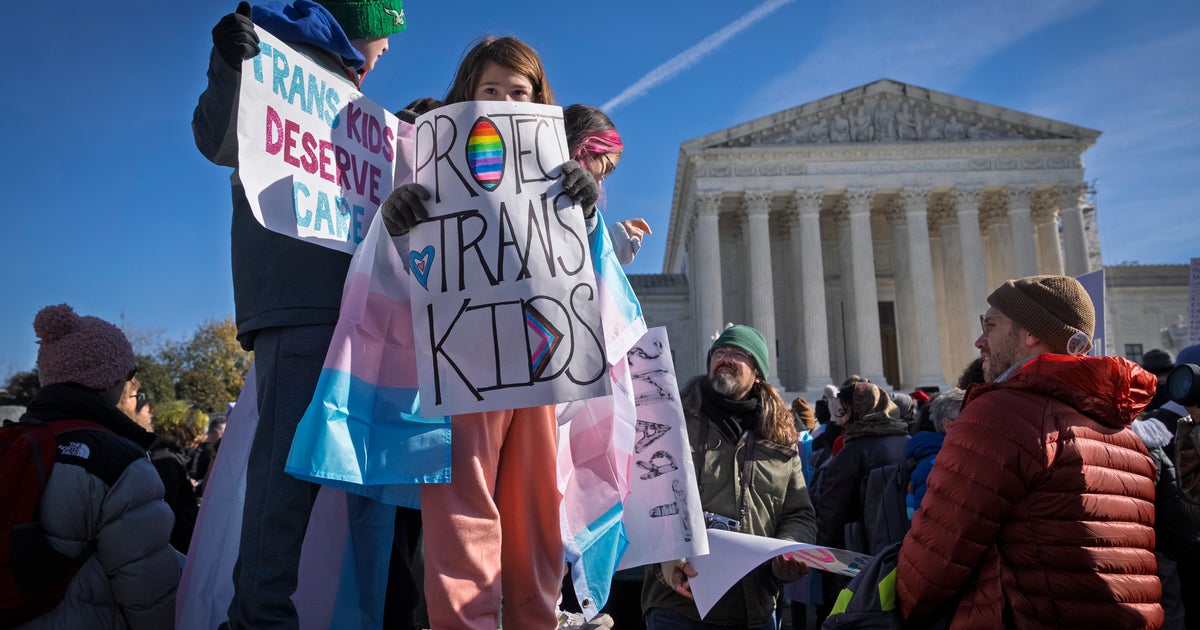
Conservative Justices Signal Skepticism In Case About Gender-Affirming Care For Minors
HuffPost
The landmark case could reshape transgender rights and sex-based discrimination laws nationwide.
The Supreme Court’s conservative majority expressed skepticism about a challenge to Tennessee’s ban on gender-affirming medical care for transgender youth during oral arguments on Wednesday, in what experts say is the most important transgender rights case the court has ever heard.
The case will determine whether a Tennessee law that bans gender-affirming care for transgender youth violates the Constitution and is a form of sex-based discrimination. U.S. v. Skrmetti, which was first brought by three families of trans children and a Memphis-based doctor, challenges Tennessee’s Senate Bill 1, a state law barring certain young people from receiving medications like puberty blockers or hormone replacement therapy. The law is meant to encourage minors to “appreciate their sex” and prohibits doctors from prescribing these medications in order to help them live as an “identity inconsistent with [their] sex.”
Elizabeth Prelogar, the United States solicitor general, argued that the law violates the equal protection clause of the Fourteenth Amendment because it bars trans youth from taking puberty blockers while allowing cisgender youth to take the same medications to treat different conditions, such as early puberty. (The scope of the case is limited to medication treatments, not surgery.)
“The law restricts medical care only when it induces physical effects inconsistent with birth sex. Someone assigned female at birth can’t receive medication to live as a male but someone assigned male can,” Prelogar said. “That’s a facial sex-classification — full stop — and a law like that can’t stand on bare rationality.”
The United States, which argued on behalf of the trans youth and their families, is hoping that the highest court rules to send the case back down to the 6th U.S. Circuit Court of Appeals with an instruction to apply “heightened scrutiny” — the highest legal standard, often used in civil rights cases. Such a move would force Tennessee to provide evidence as to why it has a compelling interest in upholding this law, posing another hurdle to its enforcement.


Follow the latest news on the major headlines of the day.

The CNN data analyst also found a number that made him say "yikes."

The newspaper's editorial board dropped a damning reality check on the president's war messaging.

Chad Bianco took nearly 1,000 boxes of ballots and election materials from the county's elections office in February.

Jessi Pierce, 37, covered the Minnesota Wild as a correspondent for NHL.com for the past decade.

The president has been vocal about being a "president for life" since at least 2018.

The president didn't seem to mind being ridiculed for his war-hungry attitude as he cosigned the new show's opener on Truth Social.

The congressional candidate laid out why the president is totally not "in the running" for the Kennedy family-created award.

San Antonio Spurs’ supporters used one fan's hateful text as fuel to celebrate their background and love for the team.

When asked about President Trump's latest threat to Iran, Secretary Scott Bessent had a chilling answer.

The possibility of an American ground operation in Iran is growing, but one service member familiar with troops in the region told HuffPost the prospect would be "an absolute disaster."

Brazilian soccer player Jorginho accused one of the singer's security guards of being "extremely aggressive" toward his family at a São Paulo hotel.

Brazilian soccer player Jorginho accused one of the singer's security guards of being "extremely aggressive" toward his family at a São Paulo hotel.