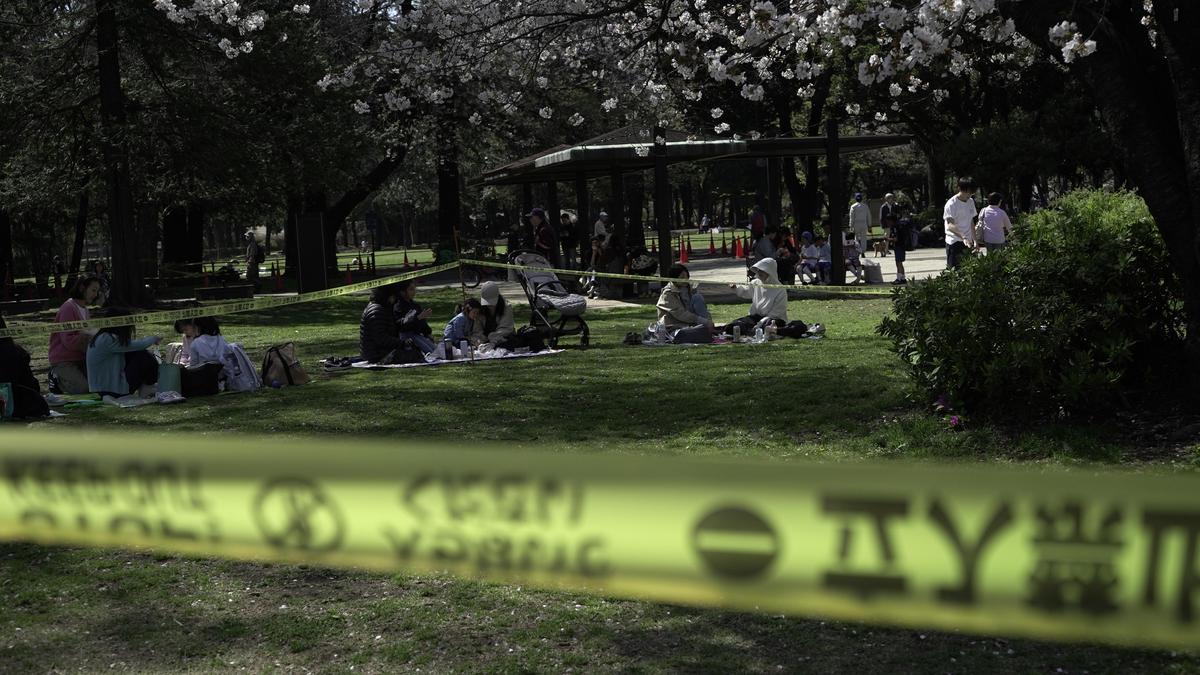
Collapse of Tokyo's aging cherry blossom trees during viewing season raises safety concerns
The Hindu
Tokyo's aging cherry blossom trees are collapsing, raising safety concerns during the beloved hanami viewing season.
Many of Tokyo's popular and iconic Somei Yoshino cherry blossom trees were planted during Japan's postwar advancement in the 1960s, and are now getting old and frail.
Some have fallen, and many others require support, triggering safety concerns as the Japanese celebrate the season of their favourite flower.
Two cherry blossom trees collapsed on Thursday (April 2, 2026), one at Kinuta Park in downtown Tokyo and the other at the Chidorigafuchi greenway. The one in Kinuta Park damaged a fence while the other tree almost fell into the Imperial Palace moat, though nobody was injured.
The tree in Kinuta Park was 18 metres (59 feet) tall and 2.5 metres (8.2 feet) in diametre. It was among the oldest, believed to be more than 60 years old, officials said. In March, another old cherry tree collapsed at the park, injuring a passerby.
Last year, 85 trees fell in Tokyo parks, injuring three people, and many were cherry trees, according to Masakazu Noguchi, a Tokyo metropolitan official in charge of public parks.
People gather under the trees during the season of hanami, or cherry blossom viewing, and the collapse of trees has alarmed officials in Tokyo, the birthplace of the cherry blossom variety.


Up to 75 women expected to benefit from Bank of America settlement in Epstein sex abuse, say lawyers
Up to 75 women may benefit from a $72.5 million Bank of America settlement related to Jeffrey Epstein's sexual abuse.

Follow The Hindu LIVE for the latest updates on the Iran-Israel war amid the escalating conflict in West Asia on April 4, 2026.

A 5.9 magnitude earthquake struck Afghanistan, felt in Delhi NCR, with no immediate damage reported.

Cambodia's parliament passes a strict cybercrime law targeting online scams, imposing harsh penalties to combat fraudulent activities.

Ukraine reports ten fatalities from intensified Russian missile and drone strikes, marking a significant escalation in daytime attacks.

China announces progress in peace talks between Afghanistan and Pakistan, mediating efforts following recent violent conflicts.

White House proposes $1.5 trillion defense budget for 2027 amid Iran war, requesting cuts to non-defense spending.

Trump claims the U.S. can reopen the Strait of Hormuz soon amid escalating conflict and rising global oil prices.

Chinese national Zhu Yi-eng arrested in Nepal for a multi-million rupee cryptocurrency scam, targeting locals via social media.

Russia offers to boost crude oil and LNG supplies to India amid West Asia crisis, enhancing bilateral energy cooperation.

French and South Korean leaders pledge cooperation to reopen the Strait of Hormuz amid escalating tensions in West Asia.

Iran warns the UN Security Council against provocative actions regarding the Strait of Hormuz ahead of a postponed vote.

UN praises Indian peacekeepers for reopening a vital supply route in South Sudan, enhancing humanitarian access after devastating floods.