Classical music’s folk links
The Hindu
The 10th edition of Deshaj, the folk music festival, showcased this connection
The importance of the folk tradition is beautifully encapsulated by H.G. Wells’s words: “to record folk songs is to record life”. Though many classically trained musicians believe that ragas evolved from the desi or non-classical music traditions, folk music in India is not given the respect it deserves. Despite each State having its own unique folk music and dance tradition, only a handful of artistes have been honoured with the Padma awards in the 67 years since its inception. Even Sangeet Natak Akademi began awarding folk artistes only after 2007.
One wonders at this discrimination, and the unspoken view that folk traditions are “inferior” to the classical. Based on the five types of ‘geeti’ or compositions mentioned in the chapter titled ‘Ragadhya’ in the 13th century Sangit Ratnakara by Śārngadeva, musicologist Arun Bhattacharya wrote, “The development of Indian music continued, from the very earliest times, in parallel and symmetrical lines.” (One culminated in the present raga system and the other in the geeti forms).
Music historian O.C. Gangooly in 1938 had referred to tribal influences in music, which later developed into ragas, including Ahiri and Gurjari. Quoting the ancient text Brihaddesi by Matanga, he had pointed out how regional culture too influenced ragas, proved by names like Desh, Gaur and Bangali.
Writing about Indian folk music in 1912, celebrated Irish violinist and a scholar of Indian music, Maud MacCarthy (or Maud Mann), said, “The inexpressibly lovely songs of the folk, which, by their rhythmitonal complexity, far in advance of ours — that is a point to note — suggest the remains of a noble art, rather than the spontaneous expression of untutored natures.”
Inarguably, a large element of the iconic Pt. Kumar Gandharva’s music draws inspiration from the folk tradition of the Malwa region. In fact, his daughter Kalapini Komkali goes so far as to say, “His perspective of music changed as a result of his close analysis of the folk music of the region; he understood that the ‘gaumukh’ (source) of this music was the folk tradition. He was the first classical musician to really explore this connection. The seeds of so many ragas such as Bhairav, Bilawal, Bhimpalas, Sarang, Todi to name just a few were visible in folk songs. He used to say, ‘uski jaan chhoti hai, jo naazuk hai, raga ka pet bahut bhara hai,’ which meant that folk songs are sweet little things while ragas can be expanded much more.”
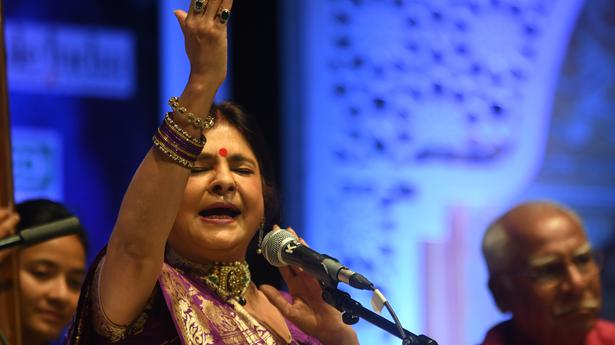
In December 2021, singer Malini Awasthi held the 10th edition of her popular folk music festival, Deshaj, in Lucknow. More than 400 artistes from across the country participated.
Despite being trained in the classical tradition, Malini has been working to promote folk music, for which she was honoured by Sangeet Natak Akademi. “My guru Appaji (Girija Devi) fully supported my interest in folk music. In fact, she taught me rare folk songs and encouraged me to sing them. She was a part of my institution, Sonchiraiyya, which presents this festival. Our folk tradition is invaluable — imagine, there are five dialects (Awadhi, Bhojpuri, Braj, Bundelkhandi, and Rohilkhandhi) in which folk songs are sung in Uttar Pradesh alone. Many people don’t know of the ‘charbet’ bandh qawwali/ nautanki tradition of Rampur, sung in Urdu/ Hindi.”


Spring season celebrated at Ramakrishna Mission Institute, Kolkata, with ‘Evening of Basant’

The Spirit of the Land, a solo show by artist Shivakumar Sunagar, is a vista of Nature-inspired emotions

Tal Fry is all set for an exciting new performance season

Netflix is making a bold move by snagging InterPositive, the AI filmmaking company founded by Ben Affleck, in a deal that could hit $600 million

Watch the eerie trailer for 'Hokum,' where Adam Scott faces a witch haunting in a mysterious Irish inn.

Oscars 2026 security heightened amid FBI warnings of a potential Iranian drone threat ahead of the Hollywood ceremony.

Directed by Rahul Pandey, the series also stars Naila Grewal, Nidhi Bisht, Anant Joshi, Anjum Batra and Kusha Kapila

A tribute to the versatile actor and comedian V.K. Ramasamy in his birth centenary year.

‘One Piece’ Season 2 review: As the Straw Hats enter the Grand Line, Netflix’s live-action adaptation finds its sea legs with bigger islands, stranger villains and the same stretch-happy sense of boundless adventure

Geeta Gandbhir, the Indian-origin American filmmaker is waves at this year’s Oscars with not one, but two nominations. Her documentaries, ‘The Perfect Neighbor’ and ‘The Devil is Busy’ are in the race for the Academy Award

Directed by filmmaker and environmentalist Pradip Krishen, the film follows a group of "dope-smoking, bellbottom-wearing and vaguely idealistic" final-year students racing to complete their theses.

Alan Ritchson powers through 'War Machine', a lean sci-fi action thriller on Netflix. A competent, Reacher-style chase adventure with nonstop tension and solid set pieces

Explore the Unshelving Memories exhibition in Thiruvananthapuram, showcasing diverse book art by 61 talented artists until March 15.