Chandrayaan 4 and 5 design complete; 70 satellites likely to be launched in 5 years: ISRO chief
The Hindu
ISRO chairman announces completion of Chandrayaan 4 and 5 designs, seeking government approval for moon missions.
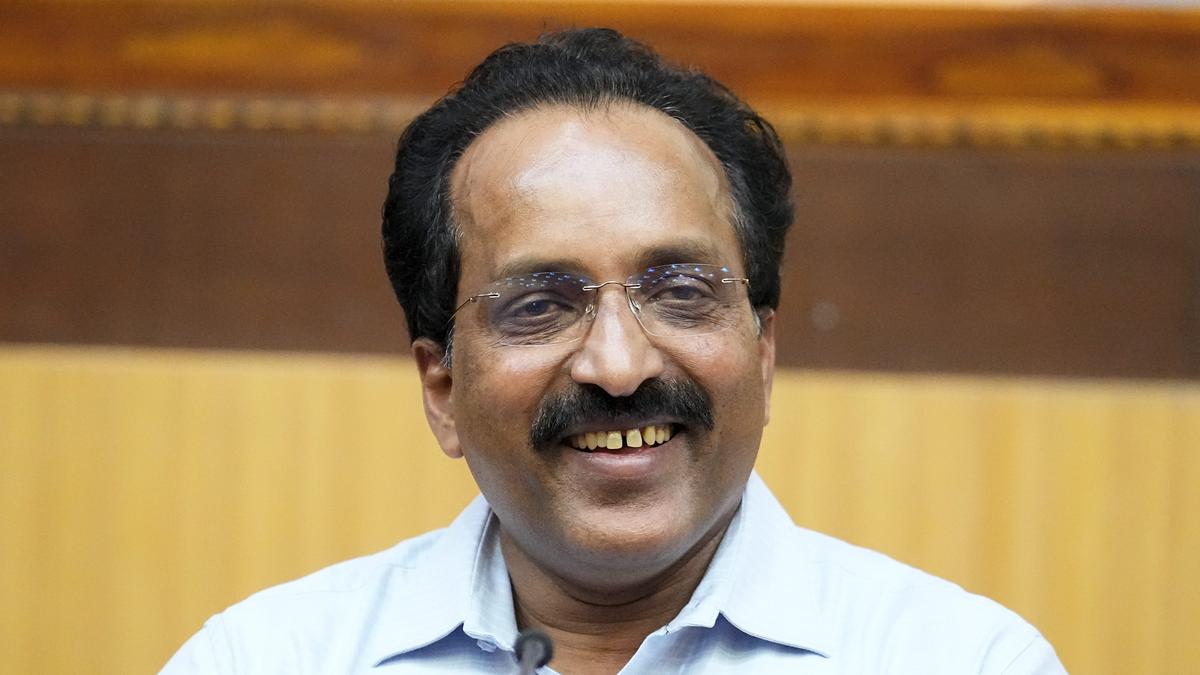
ISRO chairman S Somanath on Tuesday (August 20, 2024) said the space agency has completed the design for the next round of moon missions — Chandrayaan 4 and 5 — and is in the process of seeking government approval for the same.
The Chandrayaan-4 mission includes bringing back moon rocks and soil to earth after a soft landing on the lunar surface, launching a spacecraft from the moon, demonstrating a space docking experiment in lunar orbit and getting the samples back to earth.
“We have a series of missions to go to the moon. Chandrayaan-3 is over. Now, design for Chandrayaan 4 and 5 has been completed and we are seeking approval of the government,” Mr. Somanath told reporters here on the sidelines of an event organized by the All India Council for Technical Education and Indian Space Association.
Earlier, ISRO officials said that the targeted launch for Chandrayaan-4 mission was 2028.
Mr. Somanath also said that the space agency was planning to launch 70 satellites over the next five years, including a constellation of low earth orbit satellites to meet the requirements of different Ministries and departments of the government.
These 70 satellites include four for the NAVIC regional navigation system to provide positioning, navigation and time service, INSAT 4D weather satellites, the Resourcesat series of satellites, Cartosat satellites for remote sensing and high resolution imaging, he said.
Mr. Somanath said the space agency was also planning to develop the Oceansat series of satellites and technology demonstration satellites 01 and 02 to demonstrate electric propulsion systems, and quantum key distribution technologies.


BTS’s comeback with ‘Arirang’ marks a major global music event. When does the album release, and where can you watch their concert live stream? We have all the details

The 2026 U.S. cholesterol guidelines urge starting screening and treatment at 30 to prevent cardiovascular disease effectively.

Olam Festival 2026 in Thiruvananthapuram returns March 27-29 with 120+ vendors, music, art, and cultural zones.

A few storytellers in Thiruvananthapuram share their journeys, challenges, and evolving methods on World Storytelling Day, inspiring young minds.

76-year-old Kurian Jacob from Kerala triumphs with seven medals, including five golds, at the Open Masters Games in Abu Dhabi.

Explore the nature of the human mind as an emergent property of brain activity and complex neural interactions.

CERN's Large Hadron Collider discovers the Xi-cc-plus particle, enhancing understanding of quantum mechanics and baryon behavior.

Vibha Batra’s latest book, Spotless (Hachette India) is a novel in verse for young adults

In its first edition, the Madras Art Salon spotlights the works of journalist and artist Narayan Lakshman at The Botanical Club, a social space in the British Deputy High Commission, Chennai

Cholesterol enhances melanoma cell invasion by making nuclei squishier, revealing a potential treatment target in cancer progression.

The designers reinterpret the Swedish artist’s symbolic forms and colour energy through contemporary resortwear silhouettes

Discover the inspiring legacy of Bibha Chowdhuri, a pioneering woman in physics and a trailblazer in STEM history.

Discover the inspiring legacy of Bibha Chowdhuri, a pioneering woman in physics and a trailblazer in STEM history.