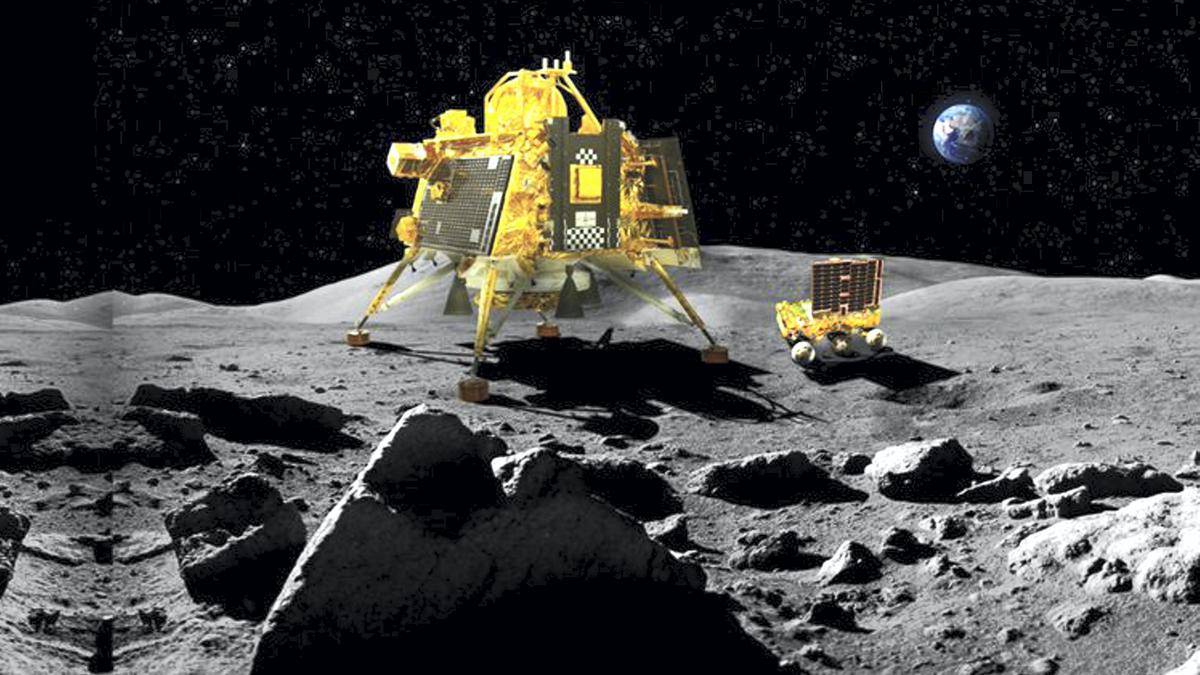
Chandrayaan-3 | How NASA, ESA will support ISRO during the Moon landing on August 23
The Hindu
NASA and the European Space Agency have been supporting ISRO to monitor the Chandrayaan-3’s health since its launch on July 14, 2023
Since the launch of the Chandrayaan-3 mission on July 14, the ground stations of the National Aeronautics and Space Administration (NASA) and the European Space Agency (ESA) have been supporting Indian Space Research Organisation (ISRO) to monitor the spacecraft’s health.
“Since the launch of Chandrayaan-3, ESA has been supporting the mission by utilising two of the ground stations in the ESTRACK network to track the satellite in its orbit, receive telemetry from the spacecraft and forward it to the Mission Operations Centre in Bengaluru, and forward commands sent from Bengaluru to the flying satellite,” Ramesh Chellathurai, ground operations engineer at ESOC Darmstadt, Germany told The Hindu.
The ESA’s 15-metre antenna in Kourou, French Guiana, and the 32-metre antenna belonging to Goonhilly Earth Station, U.K., were selected for the support, based on their technical capabilities as well as their periods of geometric visibility to the satellite.
“These two stations have been communicating with the Chandrayaan-3 mission on a regular basis, providing a complete communication channel between the Mission Operations Team in Bengaluru and the Chandrayaan-3 satellite,” Mr. Chellathurai added.
Now, with the Chandrayaan-3’s Lander making an attempt to touch down on the lunar surface on August 23, the support of the ground stations of these agencies becomes even more crucial.
The ESA’s 35-metre deep space antenna in New Norcia, Australia, a third ground station in the ESTRACK network, has been set-up to track and communicate with the Lander Module during the Lunar Descent phase.
The New Norcia antenna will serve as a back-up for ISRO’s own ground station during the descent. It will receive information about the Lander Module’s health, location and trajectory in parallel with the ISRO station.


IRSO's NavIC system faces challenges as the last atomic clock fails, reducing operational satellites for navigation services.

Discover efficient pressure cooking techniques to save up to 50% on fuel. OPOS B Ramakrishnan tells you how

Mercedes-Benz CLA 250+ with EQ Technology review: design, performance, range and features explained. Discover how the new electric CLA combines advanced AI, long range, fast charging and futuristic styling for the next generation of luxury EVs.

Pi Day is celebrated every year on March 14, honouring the significance of the mathematical constant π and its applications in mathematics.

Discover how sculptural interior design transforms modern spaces, blending creativity and functionality to evoke emotion and identity.

A study reveals that certain antibiotics can cause long-lasting changes in gut microbiome diversity for up to eight years.

Indian scientists and international experts are divided over a study questioning the viability of a nuclear reactor fuel called HALEU-thorium; while critics cite safety risks, proponents argue the technology is vital to achieve national energy goals.

ISRO and AIIMS partner to enhance space medicine research, focusing on human health during long-duration space missions.

A practical guide to induction setups for students, families, and home food businesses as India’s LPG supply faces its biggest disruption in years

Explore the electrifying Oscars 2026 race, featuring standout films, baffling nominations, and memorable performances amid a cinematic transition.

Zai and Rom Whitaker’s latest book for young readers, The Book of Indian Snakes, tackles common misconceptions surrounding snakes, highlighting their utility to humans

Discover PC Mahalanobis's pivotal role in India's statistical revolution and his lasting influence on modern statistics in this episode.

Explore why nothing can exceed light speed and the paradoxes that arise if it were possible.