Canada's measles outbreak control challenged by disinformation and distrust, doctors say
CBC
This story is part of CBC Health's Second Opinion, a weekly analysis of health and medical science news emailed to subscribers on Saturday mornings. If you haven't subscribed yet, you can do that by clicking here.
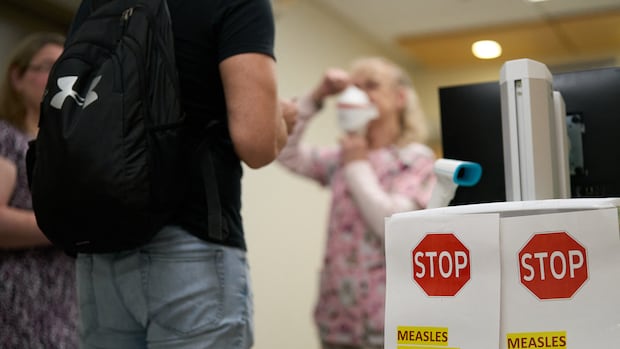
A year since measles started raging in Canada, the outbreak's subsided, but the virus shows no signs of being stamped out.
This week, the World Health Organization and Pan American Health Organization, said measles has made a "global comeback," with Canada currently reporting the highest total number of cases in the Americas region.
The Public Health Agency of Canada said it considers Oct. 27, 2024 the starting part of an outbreak that's hit more than 5,000 confirmed and probable cases of the highly contagious measles virus that spreads in the air. Two deaths in this outbreak, one in Ontario and one in Alberta, occurred among babies who were born pre-term and got measles in the womb.
While Canada achieved measles eradication status in 1998, doctors are on tenterhooks over the possibility it will lose that status, and join the ranks of places where it’s consistently present, currently at low levels.
"It's important to reflect on who else is on that list," said Dawn Bowdish, a professor in McMaster University’s medicine department and an immunologist. "Places in the world that are going through wars, major civil disruptions or don't have public health infrastructure.
"To have a country like Canada on that list is frankly shocking."
To be sure, keeping any disease out for good is tricky as international travel will continue to reintroduce measles virus in Canada.
But doctors say other problems here at home — from distrust of medical officials in vulnerable communities, to broader vaccine disinformation — could set the stage for future outbreaks. Here’s what they’d like to see change.
The pan-Canadian outbreak started when an international traveller attended a wedding in New Brunswick last October, sparking embers of cases that landed in Ontario, Manitoba, Quebec, Alberta, Saskatchewan, Prince Edward Island, the Northwest Territories, Nova Scotia, and British Columbia, mainly among unvaccinated communities, health officials say.
In Canada and worldwide, vaccine misinformation threatens immunization efforts.
The measles, mumps and rubella vaccine has been studied "backwards, forwards and sideways in terms of safety," said Dr. Lynora Saxinger, an infectious diseases specialist at the University of Alberta.
But persistent, strongly organized disinformation campaigns about the measles vaccine have left some people feeling scared, which Saxinger called a shame. She said countering those campaigns will take concerted effort, like hiring people to make debunking videos, instead of health professionals volunteering to do it informally.
"There also needs to be a bit of a critical look at algorithms and how social media is shaping disinformation and whether there's some amplification of disinformation that needs to be looked at through [a] legislative lens, which has been done in Europe."


Toronto police say they are creating a counter-terrorism unit and a specialized task force that will see officers with semi-automatic rifles stationed at key locations in the city.

ATCO Ltd. says it's taking a 40 per cent ownership stake in the company building the Grays Bay Road and Port project.

Justice Minister Sean Fraser says he has no plans to change how judges are appointed in Canada despite four premiers writing to Prime Minister Mark Carney to ask for more of a say in the process.

An RCMP-led corruption investigation is underway and at least one current and one former Calgary city councillor, as well as a business were subject to search warrants executed last week, CBC News has learned.

Ontario’s education minister is telling school boards to ensure their upcoming graduation ceremonies don’t express any “political views” or “engage in divisive or contentious issues of any kind,” according to an internal memo obtained by CBC News.

A new daily non-stop flight between Charlottetown and Montreal is set to begin this summer.

The Crown has dropped mischief charges for a second time against a London, Ont., doctor accused of spraying ketchup on the office of a local MP during a 2024 protest.

An RCMP-led corruption investigation is underway into at least one current Calgary city councillor as well as a business, CBC News has learned.

Much of Newfoundland is digging out of a blustery and messy day as another storm slams into the island.

Timiskaming—Cochrane MPP John Vanthof recalls the meeting in Thunder Bay earlier this month. He was part of the nine-day road trip along Highways 11 and 17 with other NDP MPPs.

A bill before the Nova Scotia Legislature is proposing raising the age limit for support for young people who have been in the foster care or group home system to 26.

The Fredericton Police Force has reallocated funds so new staff can be hired this year to better manage evidence after a police error upended murder cases against five people.

One of two pilots killed in a plane crash at New York's LaGuardia Airport Sunday earned his wings at an Ontario college, CBC News has learned.