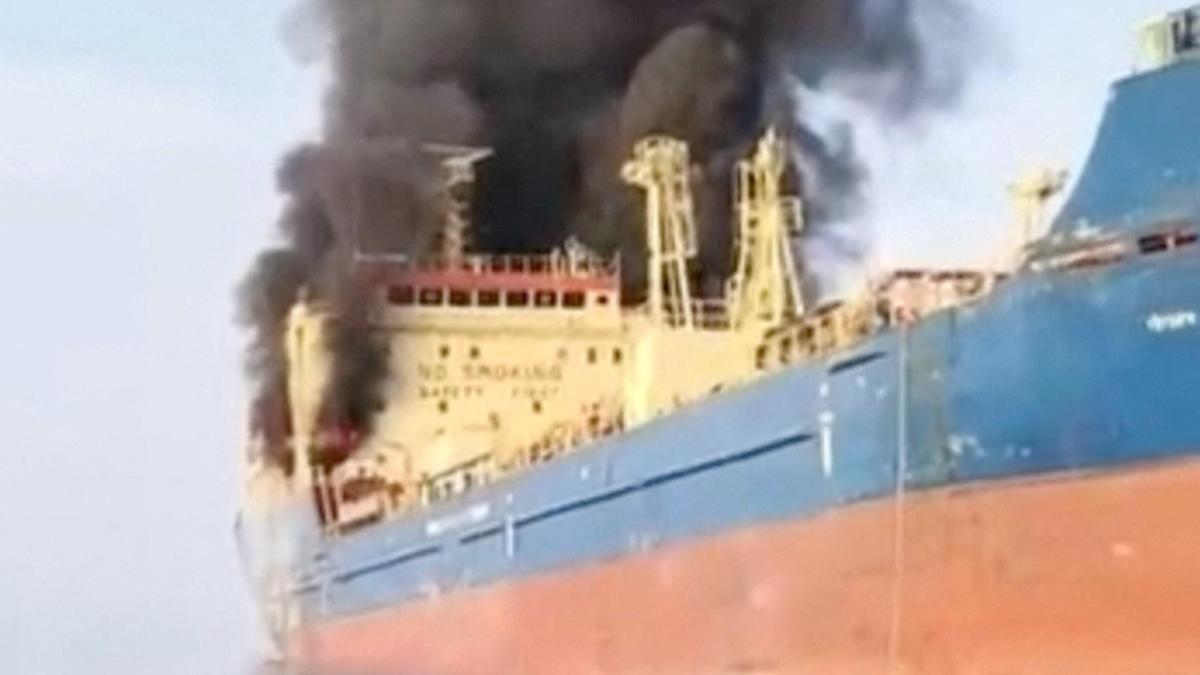
Attack on oil tanker ‘Skylight’ highlights risks to Indian seafarers in Persian Gulf route
The Hindu
The attack on oil tanker 'Skylight' underscores the dangers facing Indian seafarers in the Persian Gulf amid rising hostilities.
The attack on Skylight, a tanker with 15 Indian and 5 Iranian seafarers on board, has brought to the fore the risks to Indian seafarers serving on ships in the Persian Gulf route as well as those flagged as shadow fleet by the U.S.
Three ships have been reportedly attacked so far since the latest round of hostilities began. Ship traffic through the Strait of Hormuz has ground to a halt on March 1, 2026, while some 60 to 70 ships had transited in the previous day.
Oman’s Maritime Security Centre said Skylight was subjected to an attack around 5 nautical miles north of the port of Khasab in the Musandam governorate, according to Oman news agency.
The entire crew of 20 individuals, comprising 15 Indian nationals and five Iranians, have been safely evacuated, it said. It said four crew members sustained injuries of varying degrees and have been given medical care.
Skylight was included on the U.S. government sanctions list in December of 2025. Sanctions typically lead to companies being unable to do financial transactions or even do business, leading to wages of seafarers not being paid. It leads to much distress among seafarers, even abandonment of ships. Repatriation of seafarers to their home nations becomes a problem too.
International Federation of Transport Workers (ITF) data shows that 6,223 seafarers were abandoned across 410 ships in 2025. In terms of nationality, India had the most abandoned seafarers with 1,125, followed by the Philippines (539), Syria (309), Indonesia (274) and Ukraine (248).


Myanmar's military government pardons over 10,000 prisoners ahead of Parliament's reopening, but Aung San Suu Kyi remains imprisoned.

Iranian airstrikes shatter Dubai's reputation as a safe, tax-free oasis, causing fear and chaos amid escalating regional tensions.

U.S. futures and Asian shares decline as oil prices surge amid escalating tensions from U.S. and Israeli attacks on Iran.

AWS data center in UAE temporarily shut down due to fire after unidentified objects struck during regional missile attacks.

The U.K. implements stricter asylum rules, including regular status reviews, to deter migration and align with tougher European standards.

U.S. and Israel intensify strikes on Iran following Khamenei's death, escalating conflict as Trump signals willingness to engage.

Israeli military reports projectiles fired from Lebanon, marking a significant escalation amid ongoing tensions with Hezbollah.

Trump warns of likely more U.S. service member casualties in the Israel-Iran conflict, promising to avenge their deaths.

PM Modi expresses India's solidarity with the UAE, condemning recent attacks and emphasizing support for regional peace and stability.

Hezbollah supporters gather in Beirut to mourn Khamenei, condemning U.S.-Israel strikes and vowing to confront aggression.

Israel's strikes on Iran have resulted in the deaths of key Iranian leaders and scientists, escalating regional military tensions.

Three U.S. troops killed and five injured in first Iran operation, marking a significant escalation in military conflict.

Iran's Guards claim to have struck the USS Abraham Lincoln with ballistic missiles, escalating regional tensions.