Andhra Pradesh has fallen prey to regionalism as search for capital city continues, says historian
The Hindu
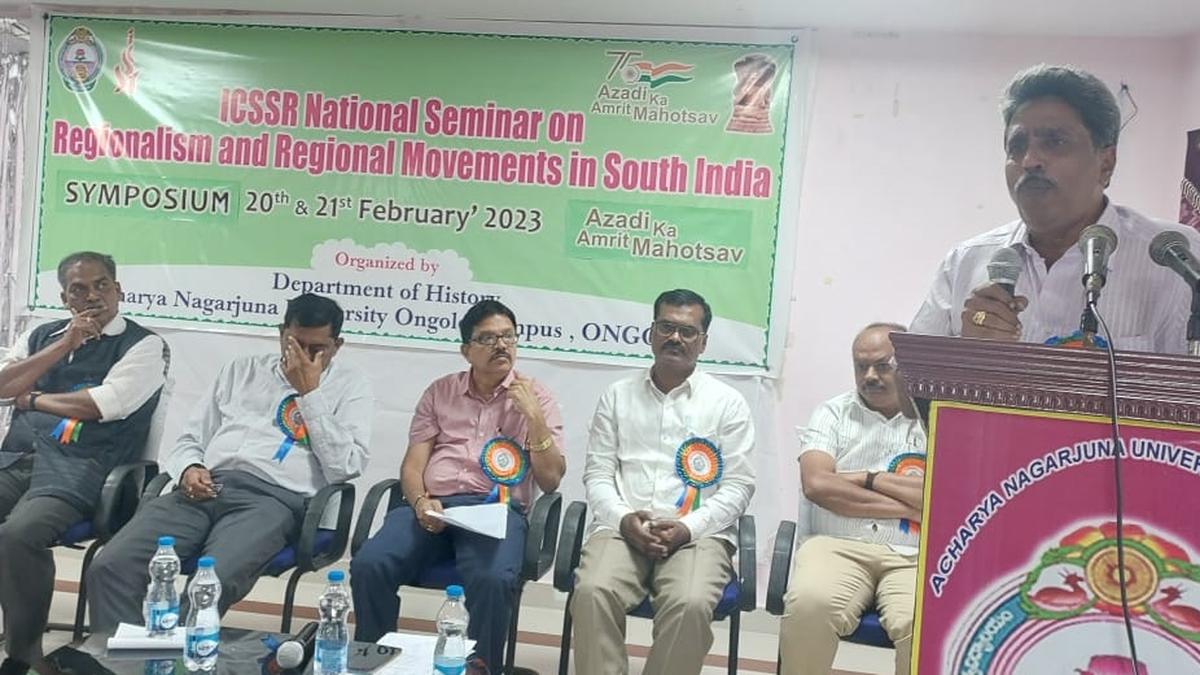
Acharya Nagarjuna University P.G. Centre holds a seminar on ‘Regionalism and Regional Movements in South India’
Andhra Pradesh has become a victim of regionalism as its search for the capital city continues, noted historian B. Ramachandra Reddy from the Kanchi Mamunivar Centre for Post-Graduate Studies and Research (KMCPGS), Puducherry has said.
Addressing a seminar sponsored by Indian Council for Social Science Research on ‘Regionalism and Regional Movements in South India’ organised by the Acharya Nagarjuna University P.G. Centre here on February 21 (Tuesday), Mr. Ramachandra Reddy said that thanks to regionalism, Telugu people, scattered all over the erstwhile composite Madras State, had lost their capital city of Chennai when the first linguistic State of Andhra was formed in 1953 in the wake of the sacrifice made by ‘Amarajeevi’ Potti Sriramulu.
The yearning for a capital city of their own by the people of Andhra and Rayalaseema regions continued since then as after a brief experiment with Kurnool as the capital city, they settled for Hyderabad, the City of Nizams developed it with decades of toil. After the bifurcation of united Andhra Pradesh in 2014, the search for a suitable capital city continued in the absence of consensus over its location at Amaravati, the administrative head since the time of Satavahanas, the earliest kings of Andhra, he said.
ICSSR Director Y. Ramesh said that regionalism spurred ‘fissiparous tendencies’ and needed to be curbed with an iron hand in the national interest.
Regionalism, a product of colonialism, had largely benefited the higher strata of the society rather than the lower strata, pointed out Priyadarshini Vijayasri of the Centre for the Study of Developing Societies, New Delhi.
Andhra Kesari University Vice-Chancellor Mareddy Anji Reddy said he was happy to take part in the first national seminar after bifurcation of the ANU to form a new varsity from Ongole.


iKure and Izawa Co. partner to combat avoidable blindness by integrating innovative eye care technology into rural healthcare networks.

Thousand Lights MLA from the DMK N. Ezhilan, in an interview to The Hindu, observes that any popular personality entering politics will attract the limelight. But only a structured party machinery combined with popularity can ensure success. In this interview, he speaks about his tenure as first-time MLA from Thousand Lights Assembly constituency in Chennai, Vijay’s political entry shaping the 2026 elections, redressal of key grievances and more.

Abhishek Banerjee challenges BJP's Suvendu Adhikari in Nandigram, pledging community health initiatives if Trinamool Congress wins.

Rising LPG shortages in Karnataka boost firewood demand, reviving an informal market as households and hotels seek alternatives.

Against the backdrop of intense poll activity, a 400-metre stretch of an arterial road in the outskirts of Chennai (technically in Madurapakkam panchayat under Tambaram assembly constituency) presents a salute to the idea of res publica, which underpins India’s system of governance, where citizens have a say, at least before a government is securely ensconced in the seat of power. A Republic Day initiative shines bright every night

Fadnavis claims zero FIR in Ajit Pawar crash is a defamation attempt by Karnataka against Maharashtra's investigation efforts.

Set to unfold as a one-day pop-up on April 5, the Easter Sadya brings together both vegetarian and non-vegetarian menus, offering a peek into the food traditions of the Syrian Christian (Nasrani) community. While the traditional Sadya is often associated with dishes such as sambar, avial, and rice, this version expands to include community-specific festive dishes.

BJP nominates mother of R.G. Kar victim Abhaya to contest from Panihati in West Bengal Assembly elections.

Veteran Malayalam actor-director E.A. Rajendran passes away at 71, leaving behind a rich legacy in the film industry.

Dakshina Kannada Zilla Panchayat has rolled out digital mode of water bill generation and collection in 23 gram panchayats on a pilot basis for the first time in Karnataka. This is set to be extended to the remaining 200 panchayats shortly, according to the Zilla Panchayat Chief Executive Officer Narwade Vinayak Karbhari.

Bengaluru police questioned a man carrying ₹6 lakh for medical expenses at Vidhana Soudha, later releasing him after verification.

BJP accuses Bengaluru's Congress government of corruption in e-Khata issuance, halting infrastructure projects due to financial mismanagement.

Misinformation in Hyderabad sparks panic buying, causing disruptions as residents react to unfounded rumors of an impending lockdown.