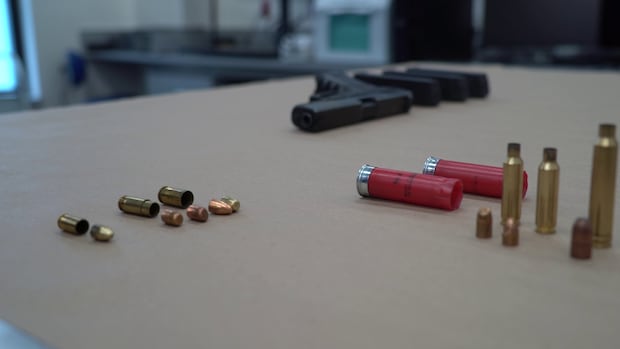
An inside look at how London, Ont., police go from seizing illegal guns to finding out how they got here
CBC
With the number of reported shootings in London, Ont., reaching 20 in 2025, police say they're working tirelessly to pinpoint where illegal firearms are coming from and take them off the streets.
The Guns and Gangs Section of the London Police Service (LPS) has traced the origin of 31 guns so far this year in the Firearms Analysis and Tracing Enforcement (FATE) process.
Police officials gave CBC London an inside look at how that process begins and how investigators learn about everything from the owner’s identity to a weapon’s origin.
After a firearm arrives in the Forensics Identification Section lab, Det. Const. Craig Walsh, a forensic specialist, immediately gets to work looking for clues.
The laboratory deep inside the police station is filled with equipment and technology that makes that possible, but the first step is often simple and time-tested.
“DNA is a huge part of forensics in our world here, so that is my first priority. We bring it in with the least amount of handling possible and we swab the firearm for DNA,” said Walsh.
A cotton swab is moistened and rubbed on any part of the weapon that is textured or grooved to search for sloughed-off skin cells, bodily fluids or other sources of DNA.
After the swab is sent to the Centre for Forensic Science in Toronto, it’s not unusual for DNA from multiple people to be detected. Walsh said those are valuable clues that could lead to arrests and gun seizures.
Once DNA is collected, the next clue Walsh looks for is fingerprints.
“If somebody has handled this firearm, there’s a good chance they left fingerprints on it,” Walsh said, pointing to the Glock handgun he used for a demonstration. It's among the common weapons that pass through the lab.
Walsh uses a brush to dust the smooth parts of the weapon’s surface with a fine powder that is often invisible to the naked eye.
A perfect fingerprint is revealed when a laser is shone on the gun, as the powder fluoresces in the light.
“I would take this fingerprint back and submit it to the RCMP national database where we store all of our fingerprints,” said Walsh. “If we were to have a suspect in mind, I can do a direct comparison … if we have their fingerprints on file.”
Human fingerprints aren’t the only kind of interest to police.


The family of an Edmonton woman who died in Honolulu last year is pushing for Hawaiian authorities to re-open the case.

It was around this time in 2020 that everything changed.

With its emergency shelter beds frequently running at 50 per cent over capacity and demand so great that it's forced to refer some women escaping domestic violence elsewhere, Gillian's Place in St. Catharines will soon be able to offer a broader range of services to more victims of gender-based violence.

The ceiling of the CAW Student Centre at the University of Windsor is decorated by flags of numerous nations — among them, Iran.

Turmoil in Iran, a major disruption in world oil markets, and stratospheric gasoline prices in Canada and beyond. What's racking motorists and governments in 2026 also faced them in 1979, sparked by the Iranian Revolution.

Five decades later, and Thunder Bay's Music World Academy remains a family-run business.

Dalton Dubois of Guelph, Ont., made history at the recent Paris Fashion Week when she became the first transgender model to walk the runway for Chanel Exclusive.

Work is scheduled to begin over the summer at the site of the former Clinton Creek asbestos mine, about 65 kilometres northwest of Dawson City, Yukon.

They may be bitter rivals in the House of Commons, but outside the chamber, recent events may have led to Conservative Leader Pierre Poilievre and Prime Minister Mark Carney forging a bond.

Local fans and industry insiders say the province’s move to ban the reselling of event tickets for more than their original value is a step in the right direction, but some say there are still larger issues that need to be addressed.

This First Person column is the experience of Mehdi M. Kashani, who lives in Toronto. For more information about CBC's First Person stories, please see the FAQ.

A very quiet queue has formed in Europe where some of Canada's long-standing, closest allies are seeking shelter under France's small but robust nuclear umbrella.

Friday morning's dusting of snow was no match for the large crowd visiting the Suleman Dawood Masjid in St. John’s for Eid-al-Fitr. A busy service marked the end of Ramadan, the Islamic holy month.