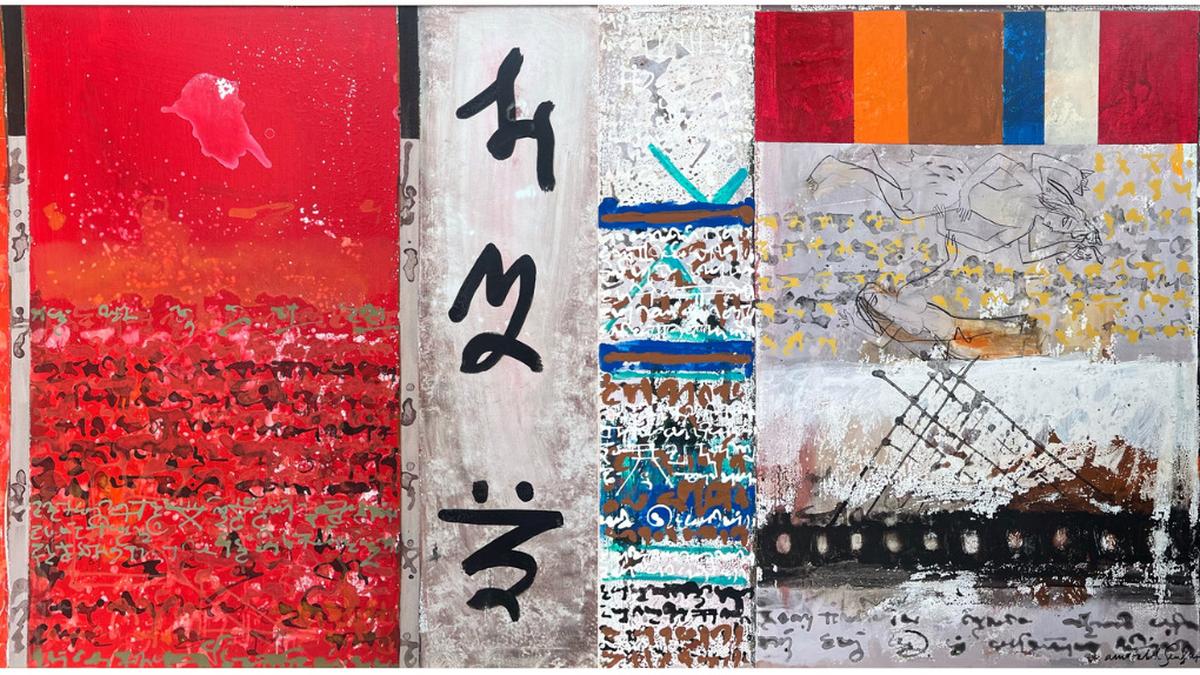
Amitabh Sengupta finds his driving force in lines, strokes and the written word
The Hindu
Shared Echoes, a solo show by Kolkata-based artist Amitabh Sengupta, is currently underway at Gallery Time and Space in Bengaluru
Swathes of green and a peculiar script beckon you at Shared Echoes, and the longer you gaze on those fonts, the more certain you are of having seen them before. Familiar, and yet new, the raw and primal hand seems to be a cross between hieroglyphics, calligraphy and runes off an ancient manuscript.
Shared Echoes, an exhibition by Amitabh Sengupta, display his art works from the Forest and Inscription series. A closer look at his canvases, especially in the Inscription series, reveal far more than what first meets the eye. The Forest series serves as a startling reminder of a world where the green cover is rapidly diminishing.
Amitabh says he did not have a permanent address for the longest time, travelling outside the country to study in Paris and later on to Nigeria where he worked for 11 years, following which he moved to the United States for higher studies. “This experiential side of my life and the constant moving about is reflected in my art. The people, culture and landscapes — rainforests, arid deserts and cosmopolitan cities — all served to inspire me.”
“Cultures and languages are different, and people respond differently. These experiences and realities have manifested in the themes, colours and my style over the years,” says the 84-year-old artist.
While almost each of his travels has inspired a series, Amitabh says the one constant has been the appearance of syllabary. “The Inscription series seems to be the longest running, and it merges with almost all my other series now,” he says.
The artist delves deep into the permanence and enduring resilience of the written word. “A city’s walls are mirror of its life with social and political slogans, protests and cinema posters, reflecting its nature. And while, every city has its own pattern of life, these are revealed through the writings in public places.”
He goes on to explain how he noticed inscriptions on historic artefacts. “They were not always religious in nature. Sometimes it would be a dedication to a ruler or the selfless act of a citizen. Those walls would have broken and the stones crumbled, but what they communicated still remained despite the passage of time. That intrigued me far more than the information those fragments offered.”


The government plans to amend the FCRA, introducing new regulations for NGO asset management and accountability for key functionaries.

The draft policy for “Responsible Digital Use Among Students”, released on Monday by the Department of Health and Family Welfare, has recommended that parents set structured routines with clear screen-time rules and prioritise privacy, safety, and open conversation with children on digital well-being.

Police Observer Sushant Kumar Saxena conducts surprise inspection at Shencottai police station, reviewing warrants and security arrangements ahead of elections.

Andhra Pradesh government to launch key projects in April, focusing on industrial growth and infrastructure development, says Nara Lokesh.

Lok Sabha refers the Corporate Laws (Amendment) Bill to a JPC amid opposition concerns over CSR provisions dilution.

SHG members in Kanniyakumari use snakes and ladders to raise election awareness and boost voter turnout.

Government accelerates consultations for early implementation of the Women’s Reservation Act to ensure women’s representation in 2029 elections.

CM A. Revanth Reddy distributes ₹1 crore insurance cheques to families of deceased Electricity department employees, enhancing financial security for workers.

The Bengaluru Traffic Police (BTP) registered 634 cases of drunk driving during a week-long special enforcement drive conducted across the city between March 16 and March 22.

GHMC intensifies action against property tax defaulters, seizing properties and offering a One Time Settlement scheme for payments.

CCB arrests three drug peddlers in Mangaluru, seizing ₹2.5 lakh worth of MDMA and other valuables.

TVK's 28 candidates in Puducherry include former BJP MLAs, a sitting Independent, and a retired police IG.

BRS submits notice on private member bill to Speaker