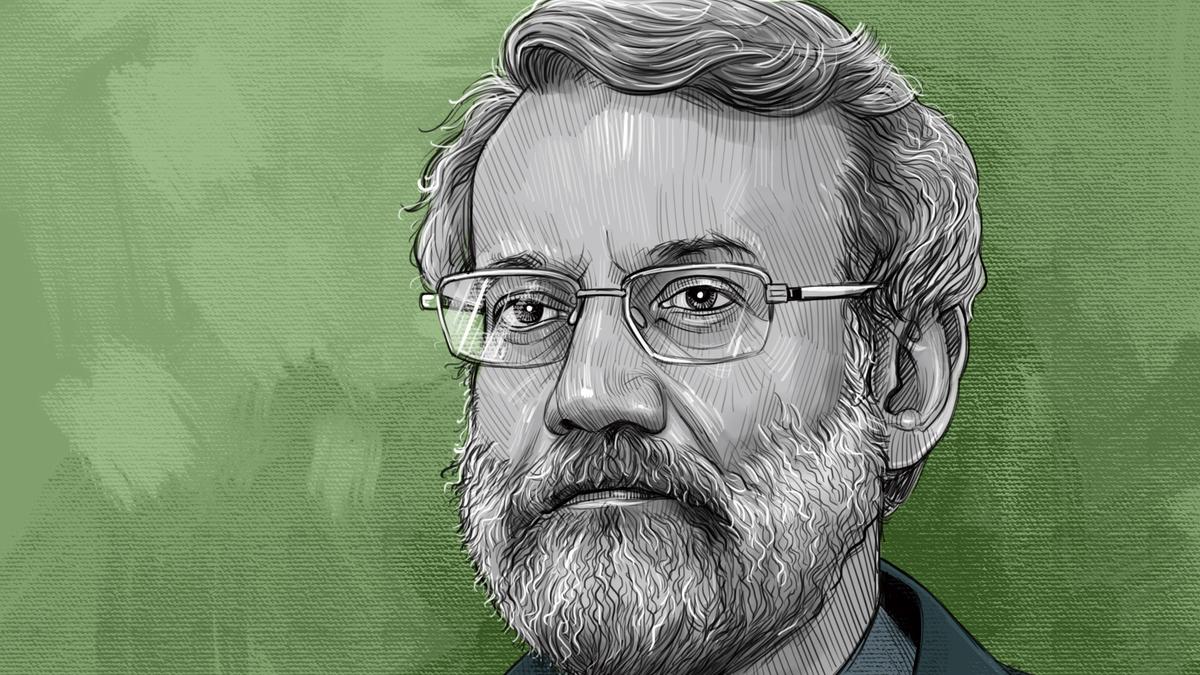
Ali Larijani — the philosopher who seeks vengeance Premium
The Hindu
Explore Ali Larijani's pivotal role in Iran's security landscape amid escalating tensions with the U.S. and Israel.
On March 1, a day after the U.S. and Israel started bombing Iran, U.S. President Donald Trump said in an interview that the Iranian leaders wanted to resume negotiations. “I have agreed to talk,” he said. A response came swiftly from Ali Larijani, Secretary of Iran’s Supreme National Security Council. “We will not negotiate with the Americans,” he wrote in a social media post. “You have set ablaze the hearts of the Iranian people,” he said in an interview, referring to the assassination of Ayatollah Ali Khamenei, the Supreme Leader. “We will burn the hearts of our enemies.” In the days that followed, the U.S. and Israel stepped up their bombing campaign across the country. Iran retaliated by launching missiles at American bases in the Persian Gulf, and Israel. “The martyrdom of Imam Khamenei will exact a heavy price from you,” Mr. Larijani said on March 4. On March 6, both President Masoud Pezeshkian and Foreign Minister Abbas Araghchi said Iran was not immediately seeking a ceasefire. Mr. Trump then demanded “an unconditional surrender” from Iran’s rulers.
As the war unfolds with regional implications, Mr. Larijani has emerged as a defiant face and voice of the Iranian state. The Security Council he leads is one of the most important institutions of the state, especially during wartime. Founded in 1989 under the revised Constitution, the Council’s main responsibility is to define defence and national security policies. The secretary of the Security Council is roughly the equivalent of the National Security Adviser of India.
West Asia on fire: On the Israeli-American war against Iran
Mr. Larijani came of age during the tremulous years of pre-revolutionary Iran. His father, Grand Ayatollah Hashem Amoli, a renowned Shia cleric, fled to Iraq in the 1930s to avoid persecution under the Shah. Ali Larijani was born in Najaf, the central Iraqi city which hosts the tomb of Imam Ali, in 1958. The Larijanis moved back to Iran in 1960. Ali Larijani studied in a religious seminary in Qom and got a bachelor of science degree in computer science from Aryamehr University of Technology, Tehran. For his Master’s and Ph.D., he switched to Western philosophy.
According to a profile of Mr. Larijani on the University of Tehran website, he has published three books on Immanuel Kant (all in Farsi) — The Mathematical Method in Kant’s Philosophy, Metaphysics and the Exact Sciences in Kant’s Philosophy, and Intuition and Synthetic A Priori Judgments in Kant’s Philosophy. He has also written a book on Descartes’ Discourse on the Method. He has additionally published on Saul Kripke — the American philosopher of language and modal logic — and David Lewis, the analytical metaphysician.
Like many of his generation, who were inspired by the 1979 revolution, Mr. Larijani joined the Islamic Revolutionary Guard Corps (IRGC), the paramilitary organisation founded by Ayatollah Khomeini soon after the revolution. The IRGC grew into one of the most formidable institutions of the Islamic Republic during the 1980-88 Iran-Iraq war. Many of the veterans of the war emerged as future leaders of the country. During the administration of President Hashemi Rafsanjani (1989-97), Mr. Larijani was appointed as Minister of Culture and Islamic Guidance. In 1994, he became the director general of the Islamic Republic of Iran Broadcasting (IRIB), an arm of the Office of the Supreme Leader. This role brought him closer to the leader (rahbar), Ayatollah Khamenei. By the turn of the century, Mr. Larijani had become one of the key figures of the elite of the Islamic Republic, with close ties with the country’s conservative establishment.


Canadian PM Mark Carney advocates for removing Prince Andrew from royal succession due to alleged misconduct and ties to Jeffrey Epstein.

Israeli Foreign Minister Sa'ar explains Modi's lack of briefing on Iran strikes, decision made after his Israel visit.

Anthropic said it only sought to restrict its technology from being used for two high-level usages: mass surveillance of Americans or fully autonomous weapons.

Balendra Shah's RSP wins 18 seats and leads in 99, marking a significant political shift in Nepal's elections.

A Pakistani man linked to Iran was convicted for plotting to assassinate U.S. President Trump and other officials.

Bangladeshi man Zobaidul Amin extradited to U.S. faces federal charges for exploiting teens via social media.

U.S. urges Sri Lanka to withhold repatriation of Iranian crew and survivors from a sunken warship, internal memo reveals.

Jimmy Wales discusses AI's potential benefits and challenges for Wikipedia, emphasizing the importance of accurate translations and attribution.

Iran-Israel war LIVE: Follow the latest updates on the West Asia conflict, on March 7, 2026

Ghana's peacekeeping battalion in Lebanon suffers missile attacks, critically injuring two soldiers and damaging facilities, reports the army.

Iranian warship strike near Sri Lanka prompts concerns about India's naval role and U.S.-Iran tensions in the Indian Ocean.

Boots vs Bots: Finding the fighter for the new American war

Iran's President Pezeshkian confirms mediation efforts amid escalating conflict, as IRGC warns of a prolonged war ahead.