Alberta unions promise ‘big and bold’ response — but can they deliver?
CBC
Alberta’s labour movement is flirting with a tactic that its leaders say would be “big and bold and unprecedented,” but they’re still not quite ready to flip the switch.
Last week, labour leaders promised an “unprecedented response” to the provincial government’s decision to use the Charter's notwithstanding clause to force striking teachers back to work.
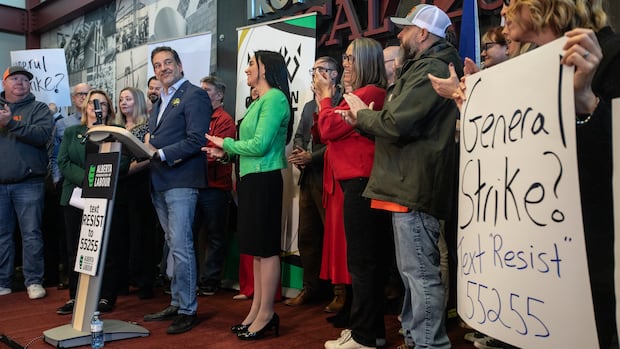
Days later, supporters and media congregated at Ironworkers Hall in Edmonton to hear more about what the Alberta Federation of Labour had up its sleeve.
But if one was expecting concrete plans for a provincewide strike, as Gil McGowan, president of the AFL, had intimated was under consideration, the press conference that followed laid out a longer road ahead.
“General strike?” read one of multiple noncommittal signs on stage.
McGowan has said the labour movement needed more time to speak with union leaders and non-unionized workers about the possibility of enacting a general strike, which would see people across various fields refusing to work.
There’s still much to work through nearly a week later.
“If we’re going to do it, it needs to be so big and so many people involved, that it would be difficult for the government to arrest and fine everyone,” McGowan told CBC Radio's Alberta at Noon host Kathleen Petty on Tuesday.
“In order to protect the people that are involved, it has to be big and bold and unprecedented —and that’s exactly what we’re working towards organizing.”
Jason Foster, a professor of human resources and labour relations at Athabasca University, said this moment is a significant one for the Alberta labour movement.
“Alberta does have an active and militant labour history … but it’s been much quieter in the last 20 to 30 years,” he said.
“And that’s why, I think, that makes the teachers’ strike and all the fallout that’s been happening in the days since quite significant.”
But as history shows, maintaining early momentum will be no cakewalk, and Alberta’s labour landscape poses its own challenges.
Alberta has long had the lowest percentage of workers in unions in the country.


Shawne Hopkins never saw it coming.

Politicians return to Queen’s Park Monday for a shortened spring session, as Premier Doug Ford prepares to unveil his eight budget amid heightened global economic uncertainty.

Despite a recent announcement that a water supply pipeline will be build in Oneida Nation of the Thames, some members of the community say that's no excuse for taking water for granted.

As scandal has swirled around former prince Andrew Mountbatten-Windsor, questions and curiosity have also focused on his ex-wife, Sarah Ferguson, and their daughters, Princesses Beatrice and Eugenie.

Friday may have been the first day of spring, but winter storms are not over yet for Newfoundland.

While we officially welcomed spring last week, an incoming system will be a reminder that snow is still very much part of the new season, especially early on.

The future of a national historic site in Fredericton is up for discussion at meetings across New Brunswick in the next few weeks as the Anglican diocese considers what to do about costly repairs needed at Christ Church Cathedral.

Amanda Lathlin, the first First Nations woman to be elected to the legislative assembly in Manitoba's history, has died, the provincial NDP said on Saturday.

CBC's road trip series Land of Living Stories explores inspiring stories of community spirit from across Saskatchewan. In our latest visit, CBC-Radio Canada hit the road to La Ronge. This is the fifth of a multi-part series from that community.

Dozens of people filled Regina's Fresh and Sweet cafe on Saturday to paint, collage and craft their concerns about artificial intelligence by making zines — a type of self-published small booklet, typically created by hand.

Wildfire season has officially started in Alberta. As the snow starts to melt, people are starting to wonder: Will I have to evacuate this year?

Two hikers were rescued near Lions Bay, B.C., on Saturday after slipping down steep, treacherous terrain, according to search and rescue personnel.

Members of the Filipino community on P.E.I. came together over the weekend to enjoy basketball at the Eastern P.E.I. Community Navigators’ second annual tournament.