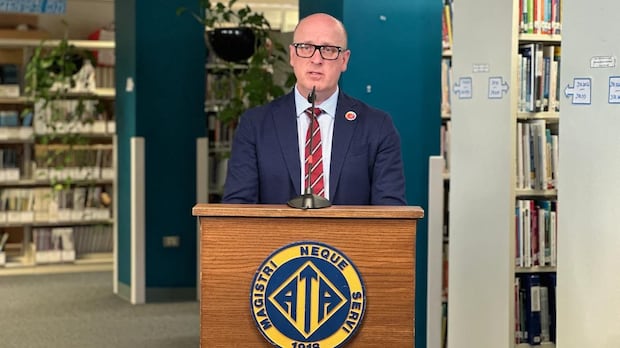
Alberta Teachers’ Association might take the government to court. Here’s what we know
CBC
The Alberta Teachers’ Association is weighing its legal options to challenge back-to-work legislation imposed by the provincial government.
“The association will fight this abuse of power with every tool the law provides, and every ounce of conviction we possess,” ATA president Jason Schilling told reporters on Tuesday.
The Back to School Act pre-emptively invokes the notwithstanding clause to stop teachers from striking and prevent courts from overturning the law.
The government has said the use of the clause was justified to prevent localized strikes and ensure school is not interrupted again.
The ATA has been mum on what it plans to do. But CBC spoke to lawyers and civil liberty associations to get a sense of whether the back-to-work order could be challenged in court.
The notwithstanding clause, or Section 33 of the Canadian Charter of Rights and Freedoms, allows governments to pass legislation that violates certain portions of the Charter for up to five years.
Using the clause means the legislation can not be overturned, but Marion Sandilands, a partner at Conway Litigation said how a court can rule alongside the notwithstanding clause remains an open question.
“Even if it can't strike it down because of the notwithstanding clause, the court can declare whether or not it violates Charter rights,” she said.
“So in this case, the court might be asking itself, does this violate the right to collective bargaining, for example?”
There are two high-profile recent cases where the notwithstanding clause has been invoked and challenged in court: In Saskatchewan and Quebec.
In 2023, Premier Scott Moe's Saskatchewan Party government brought in a law preventing children under 16 from changing their names or pronouns at school without parental consent.
And in 2019, the Quebec government used the notwithstanding clause to pass its secularism law.
Both cases saw legal challenges and were appealed by the provincial governments with contrasting results.
In Saskatchewan, the court of appeal said courts can make declarations about constitutionality, even if a law can’t be struck down, but that wasn’t the case in the Court of Appeal of Quebec.


Premier Doug Ford says his government plans to give Toronto's Billy Bishop Airport special designation that would allow the province to bypass municipal and provincial laws as it pushes to expand the runway downtown.

Jenelle Hughes says she worries every time her two older children take their car to get to Fanshawe College in London, Ont., from their home in Dutton.

Oil prices fell Monday morning after President Donald Trump said the U.S. would hold off on striking Iran’s energy infrastructure amid productive talks between the two countries.

While spring technically started late last week, Newfoundland and Labrador isn't free from winter weather just yet.

The Sudbury School Bus Consortium is suspending all school buses in Greater Sudbury as the community continues to clean up following a major storm.

Two large corporate landlords owning a combined 9,008 rental units in Halifax are reporting smaller annual increases in their average rents for 2025 than the previous year.

The Holt government has reached a deal with Ottawa on compensation for tens of millions of dollars in lost sales tax revenue from the Christmas season in 2024.

The government of Saskatchewan has announced plans to reduce the length of non-resident game bird hunting licences to combat illegal guiding.

An 87-year-old Alberta man is fighting extradition to the United Kingdom to stand trial for historical allegations of physical and sexual assault involving minors.

Eight casinos across southwest B.C. have been sold to First Nations in the last two years, with the province's gambling scene set to be reshaped as a result.

Hamilton hosts the Junos Sunday, and the musical awards show is bringing tourists, musicians, concerts and a ton of themed events to the city this week.

The multi-million-dollar deal at the heart of a high-profile fight between the Canadian government and one of the world’s biggest carmakers contains multiple clauses about the company’s footprint in Ontario, according to a copy obtained by CBC Windsor.

In recent months, Calgary police have carried out three day-long safety blitzes, parading out dozens of officers to flood an area with their increased presence — at least, temporarily.