Air India’s update won’t kill the sari
The Hindu
One can hope Air India’s new uniform for female cabin crew is distinctive and uniquely Indian
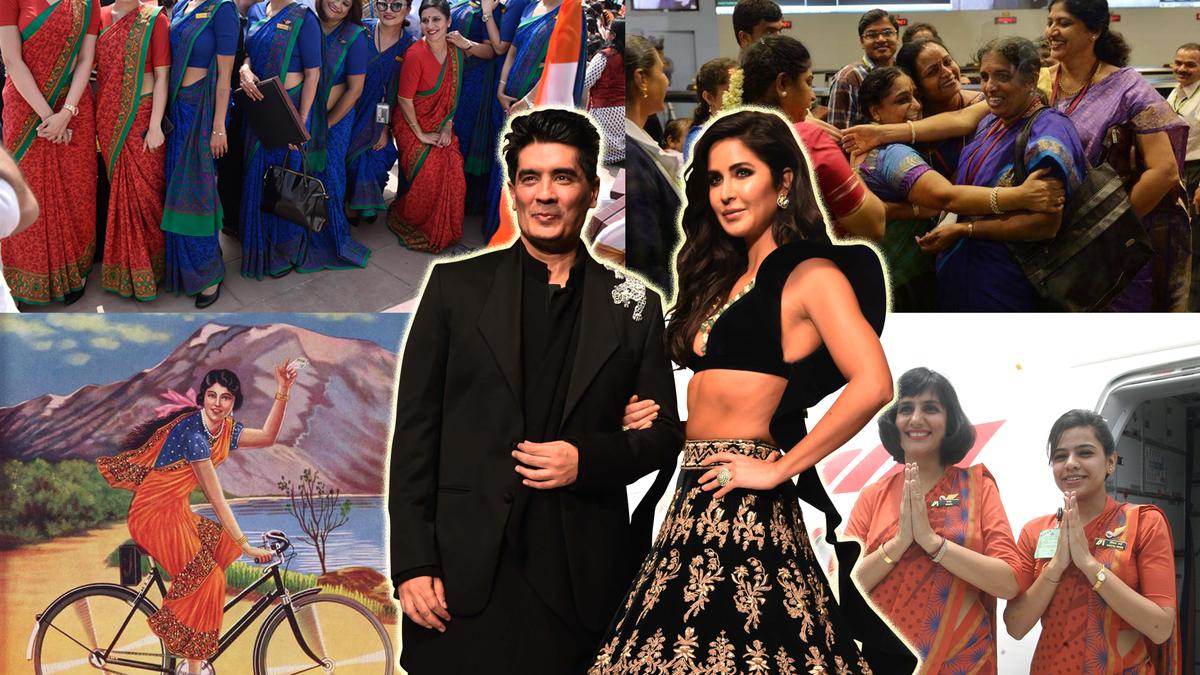
No more saris? Air India may bring in new look for flight crew” was the headline. The article continued, “For six decades now, Air India’s flight attendants have worn the whole nine yards while negotiating long-haul flights and demanding passengers... The new look, expected to be unveiled in November, will include churidars for women and suits for men”. As someone known to be a sari aficionado, my phone began to ring. Everyone wanted my views.
My initial reaction was sadness. Since I wear saris even when riding a camel or climbing onto the upper berth in a train, I can vouch for their comfort and ease in all situations (except possibly a typhoon or snow storm!). To give “negotiating long-haul flights and demanding customers” as a reason to abandon the sari is nonsense. Women all over India cycle, work on building sites, run businesses, and deliver babies wearing saris. And the women scientists who worked tirelessly to make our successful mission to the moon happen, all wore saris. Saris epitomise a timeless feminine aesthetic and are exquisitely becoming, making all shapes and sizes look beautiful.
However, change and innovation are inevitable. Every era and new management wants to impose its own stamp. Nor is all change a bad thing; it often brings with it freshness and vitality. Giving up the traditional sari drape may be an opportunity for creativity and our known jugaad. India has many costumes that permit easy movement, while the sari itself has over a 100 draping styles, including knee-length, calf-length and divided skirt versions, as well as more contemporary stitched variations.
I remember a wonderfully sleek Tarun Tahiliani sari dress that could hold its own on any 21st century fashion ramp, let alone the aisle of an airline. Air India itself once had an elegant printed silk tunic and an Aligarh pyjama ensemble with a long scarf attached to one shoulder. There are hundreds of exciting options. Just as long as they don’t put Air India cabin staff into the tight jackets, mini skirts, neck scarves, little caps, and stockings that make flight attendants of most of our Indian airlines look so dowdy, imitative, and dated.
I gather that designer Manish Malhotra has been entrusted with the task. He is certainly both versatile and experienced, having designed not just the Swarovski and zardozi-encrusted lehengas, ghagras and sherwanis that feature at every Bollywood and socialite wedding, but also costumes for literally hundreds of films in every genre from gangster to sci-fi. His repertoire includes jewellery, home decor, and beauty products. Wikipedia describes Malhotra’s style as “timeless, relevant and inspirational for every generation” and what could be a better brief for this particular challenge.
Nor do I think Air India changing its uniforms spells the end of the sari! Ever since I can remember, people have been predicting its demise. Luckily, it hasn’t happened yet. A sari is simply too becoming to abandon altogether. In fact, our Dastkar weaver groups say sari buying is actually on the rise. It’s true that the young wear them less, and so do urban office-goers. But almost all still wear saris as well. I don’t think it’s so much an issue of actually draping and wearing it, as the bother of laundering and ironing. Both the old-fashioned dhobis and spaces to hang and dry a sari are in short supply in our high-rise metro cities. I wish some brilliant IIT graduate would invent a machine that could starch, dry and roller-press saris. It would be a sell-out. Otherwise, working-class sari wearers will end up only wearing synthetics, and others will reserve theirs for formal and festive wear, losing many wonderful handloom cotton traditions in the process.
And, back to newspaper reports, why do reporters always refer to the sari as the ‘whole nine yards’? The sari is six yards or five-and-a-half metres, unless it’s the almost extinct Maharashtrian or Tamil Brahmin style. To call it “the nine yard drape” is as silly and inaccurate as calling the proposed churidars a change to “more contemporary attire”. In fact the Nivi sari style current today originated in Kolkata in the late 19th century, while churidars are from Mughal times.


India approves 23 institutions for quantum labs under the National Quantum Mission, aiming to advance quantum technology and research.

The Gaza conflict exacerbates environmental damage, emitting millions of tonnes of CO2 and threatening climate stability in West Asia.

Chefs and cookery experts share smart kitchen hacks, hybrid cooking methods and appliance tips to help households reduce LPG use without compromising on food

Discover groundbreaking research on Titan's lakes, bat vaccinations, and the unique aroma of ripening bananas in just one minute.

IRSO's NavIC system faces challenges as the last atomic clock fails, reducing operational satellites for navigation services.

Discover efficient pressure cooking techniques to save up to 50% on fuel. OPOS B Ramakrishnan tells you how

Mercedes-Benz CLA 250+ with EQ Technology review: design, performance, range and features explained. Discover how the new electric CLA combines advanced AI, long range, fast charging and futuristic styling for the next generation of luxury EVs.

Pi Day is celebrated every year on March 14, honouring the significance of the mathematical constant π and its applications in mathematics.

Discover how sculptural interior design transforms modern spaces, blending creativity and functionality to evoke emotion and identity.

A study reveals that certain antibiotics can cause long-lasting changes in gut microbiome diversity for up to eight years.

Indian scientists and international experts are divided over a study questioning the viability of a nuclear reactor fuel called HALEU-thorium; while critics cite safety risks, proponents argue the technology is vital to achieve national energy goals.

ISRO and AIIMS partner to enhance space medicine research, focusing on human health during long-duration space missions.

A practical guide to induction setups for students, families, and home food businesses as India’s LPG supply faces its biggest disruption in years