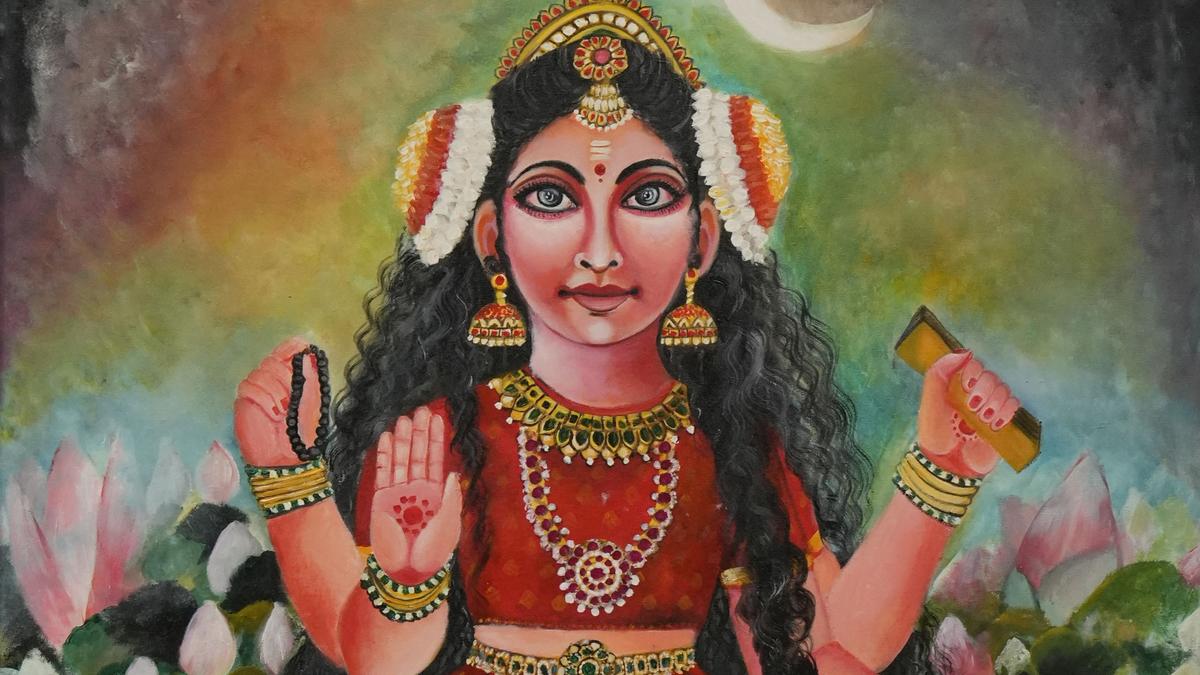
A travelling exhibition presents the 64 Yoginis through modern art
The Hindu
Beena Unnikrishnan’s travelling exhibition, Ekaa: The One, reimagines the 64 Yoginis through modern art
Among the Hindu pantheon of gods and goddesses, the idea of the Chausath (64) Yoginis occupies a distinct and somewhat enigmatic place. The Yoginis are a group of 64 female divinities, associated primarily with Shakta and Tantric practices between the 9th and 12th centuries. Unlike mainstream temple deities placed within enclosed sanctums, Yogini temples were often circular and open to the sky, as seen in historic sites such as Hirapur in Odisha and Bhedaghat in Madhya Pradesh. Scholars interpret this architectural form — symbolising cosmic wholeness — as a space that easily allowed conducting moonlight rituals.
It is this legacy that artist Beena Unnikrishnan engages with in her project ‘Ekaa: The One’. Over a decade, she has created a complete painted series envisioning all 64 Yoginis through her contemporary interpretation. The works are not copies of temple sculptures, nor are they academic reconstructions, but artistic reflections inspired by the idea of feminine energy as understood within Hindu philosophy.
“It all started with the desire to paint Ma Tripura Sundari, and that led me to know about the 64 Yoginis or her 64 expressions. As I started painting these feminine powers, their different aspects began to unravel,” says Beena, who is travelling with the show and has so far exhibited her creations in eight cities. Her current stopover is Delhi, where her works are on display at the Visual Art Gallery, India Habitat Centre. The project is on an 81-day road journey across India, and moves to Gwalior after Delhi. Each stopover is a three-day exhibition.
Beena Unnikrishnan’s paintings of the 64 Yoginis are inspired by the idea of feminine energy within Hindu philosophy. | Photo Credit: Special Arrangement
The Yoginis are manifestations of Shakti, the primordial feminine power that sits at the core of creation in the Hindu philosophy. They represent dynamic energies of Nature, consciousness, protection, transformation, and wisdom. Some are benevolent, others fierce and together they reflect the many dimensions of the feminine-divine. Over time, Yogini worship has declined due to various social factors, but the concept of the 64 Yoginis remains a significant part of the sacred feminine traditions in India.
We find references to them in texts such as Durga Aarti. Bahurup, Tara, Narmada, Yamuna, Shanti, Varuni, Kshemankari, Aindri, Varahi, Ranveera, Vanarmukhi, Vaishnavi, Kalaratri, Vaidyarupa are the names of some of the Yoginis.


Beena Unnikrishnan’s travelling exhibition, Ekaa: The One, reimagines the 64 Yoginis through modern art

A.R. Rahman agrees to credit the Dagar brothers in Ponniyin Selvan II following Supreme Court recommendations on song acknowledgment.

Explore director Shahrbanoo Sadat's rom-com "No Good Men," challenging Afghan narratives at Berlinale 2026 and celebrating women's stories.

‘Heated Rivalry’ series review: Hudson Williams and Connor Storrie star in Jacob Tierney’s Candian phenom, Heated Rivalry, now streaming in India on Lionsgate Play

Bengaluru-based artist Bharathesh GD talks about his solo show Pain Corporation of India

Solve The Hindu Sunday crossword no. 44 with engaging clues across and down for puzzle enthusiasts.

Discover the landmark exhibition "Ce qui se trame," celebrating four centuries of Indo-French textile dialogue at Galerie des Gobelins, Paris.

Ramachandra, popularly known as Ramu, blended technical precision with artistic depth to shape the visual language of Kannada cinema

Giridhar Udupa presents the Udupa Music Festival 2026, featuring Begum Parveen Sultana,Thiruvaarur Bakthavathsalam, Vishwa Mohan Bhatt and others

Swanand Kirkire opens up on writing the coming-of-age drama, working with Ankur Tewari, how he instils simplicity to his songs and more

From being a database developer to a television actor… actor Varshini Suresh of 'Auto Vijayashanti' serial drives recollects her journey

As per the doctors, Salim is in the ICU and his recovery might take some time given his age

More than 80 artists, including Javier Bardem, Tilda Swinton and prominent directors Miguel Gomes and Adam McKay, have signed an open letter to the Berlinale condemning the festival's “silence” on “Gaza” and for “censoring” those who have spoken out