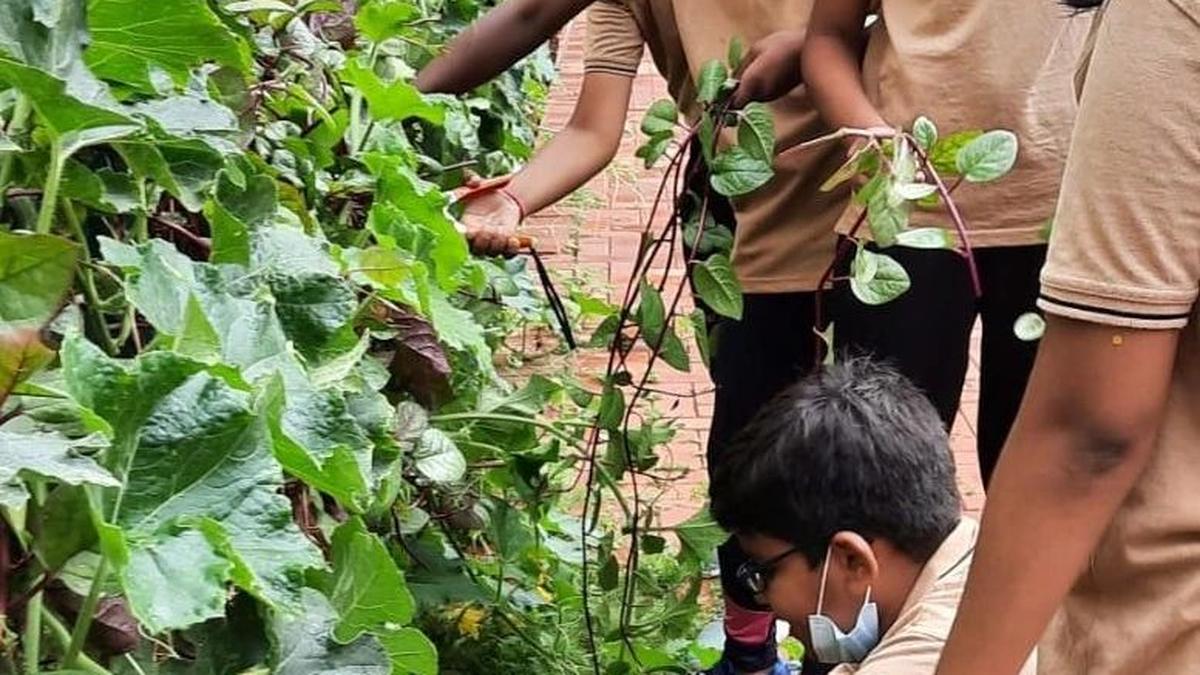
A farm for the school: harvesting the benefits of teaching plant and soil health to students
The Hindu
At APL Global School in Thoraipakkam, the classroom “extends’ into the garden with a gardening initiative having travelled swiftly from the periphery of learning to the centre stage. In 2017, it sprouted as a club initiative by Maya Ganesh, a multi-hyphenate with regenerative farming as one of her specialisations, and soon put out promising shoots that developed into sturdy branches. The initiative now stands robust as a full-fledged regenerative gardening curriculum that reaches students of every grade in tailored and measured forms. “We do not have traditional landscaping here,” says Shalini N, architect and garden coordinator at APL. “Instead, we have turned our open spaces into edible landscapes. Every plant is chosen not for beauty, but for its utility and ecological value.”
At APL Global School in Thoraipakkam, the classroom “extends’ into the garden with a gardening initiative having travelled swiftly from the periphery of learning to the centre stage.
In 2017, it sprouted as a club initiative by Maya Ganesh, a multi-hyphenate with regenerative farming as one of her specialisations, and soon put out promising shoots that developed into sturdy branches. The initiative now stands robust as a full-fledged regenerative gardening curriculum that reaches students of every grade in tailored and measured forms.
“We do not have traditional landscaping here,” says Shalini N, architect and garden coordinator at APL. “Instead, we have turned our open spaces into edible landscapes. Every plant is chosen not for beauty, but for its utility and ecological value.”
Ahead of International Plant Health Day (May 12), this initiative can serve as a reminder that ensuring plant heath is ensuring human health and planet health.
“It began as a club,” recalls founder Gita Jagannathan, “but with Maya’s vision and dedication, it soon evolved into a structured part of our curriculum. Environmental education is central to our ethos. We see farming not as an extracurricular activity but as a means to understand the self, society and the environment.”
The regenerative gardening curriculum is multi-tiered to suit different learning stages. Kindergarteners take “Garden Walks,” exploring biodiversity in age-appropriate language. Primary students get five to six annual sessions in organic farming. Middle and senior school students can opt for deeper regenerative agriculture modules through the unique subject “Expressions”.
A live seed bank is central to APL’s regenerative agriculture initiative. Started after the pandemic, the bank preserves open-pollinated and heirloom seed varieties. “We never use hybrid seeds. Our seeds come from regenerative farmers across India — from Yarowway Farm, Hooga Seeds, and Sahaja Seeds,” explains Shalini, who came on board in 2020 and now nurtures what was started and perfected by Maya ever since the latter moved out of Chennai.


Supreme Court affirms the public's right to critique its judgments while addressing concerns over an NCERT textbook's content.

Amit Shah reviews Manipur's security, urging the CM to tackle drug cartels and aid displaced communities after ethnic violence.

Kerala's fisherfolk urge political parties to address livelihood concerns, demanding fair pricing, rule enforcement, and better support during elections.

Moderate rainfall in Visakhapatnam brings relief but causes traffic disruptions and power outages across the city.

Shubman Gill’s Gujarat Titans banks on its tried-and-tested formula

Agriculture Ministry reviews unseasonal rains' impact, assesses farm losses, and discusses relief measures for affected farmers.

Premium petrol prices rise by ₹2 per litre, but government claims no impact on the common man amidst global oil tensions.

Kum. Veerabhadrappa’s acclaimed novel Aramane has been adapted into a television serial. Kannada channel DD Chandana (Doordarshan) has launched the serial with the same name. National Award-winning filmmaker Mansore is the director behind the project,

Diya Chitale and Manav Thakkar reach semifinals, while Yashaswini Ghorpade upsets top seed Sreeja Akula at National TT Championships.

DYFI criticizes A.P.'s job calendar for failing unemployed youth, demanding a revision to include 1 lakh posts and higher age limits.

‘Lethargic’ officials who left Chambal sanctuary to the mercy of sand miners will be held liable: SC
Supreme Court holds negligent officials accountable for enabling illegal sand mining in Chambal Sanctuary, emphasizing habitat protection laws.

Work on the Srisailam Left Bank Canal tunnel resumes after 13 months, with completion targeted by 2027-end, says Minister Reddy.

Ancient ‘Vanni’ tree at Sri Meenakshi Sundareswarar Temple tilts; steps on to restore it