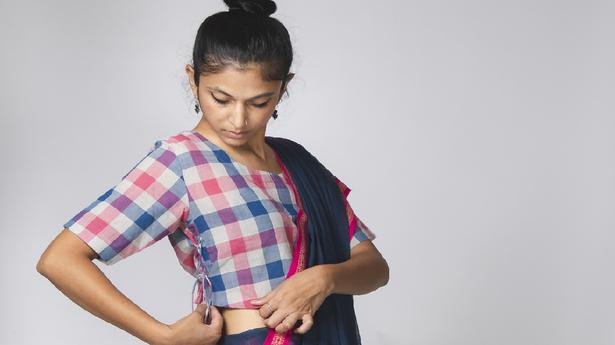
Women weavers power Creyo
The Hindu
Saris by women weavers women from Srikakulam, East Godavari and Narayanpet take centre stage at Creyo, the new entrant at Crafts Council of Telangana’s CCT Spaces in Hyderabad
Veerabasweswari from East Godavari district and Sandhya from Ponduru, Srikakulam district, are among the women handloom weavers who have travelled to Hyderabad for the inauguration of Creyo, a store at the Crafts Council of Telangana premises CCT Spaces. Creyo will stock saris, fabrics and garments woven by the weaver clusters in East Godavari, Srikakulam and Narayanpet, supported by Chitrika foundation.
The women beam with pride when they spot saris woven by them at the store. “Many of us come from families of weavers. I grew up watching my mother and other women work at the loom and I took to it naturally. Weaving is a way of life for me, my mother and my mother-in-law,” says Sandhya. Her speciality is the kuppadam weave of Srikakulam, which is an interlocking technique to design temple borders in contrasting colours.
The kuppadam of Srikakulam is different from that of East Godavari in which the interlocking technique plays up contrasting colours, often without the temple border.
Both the women mention that some of the saris woven by their clusters were worn by actor Ritu Varma in the Telugu film Varudu Kavalenu. “Some of the Baahubali team members also picked up our saris,” they add.
Chitrika foundation has been working with women weavers in Srikakulam, East Godavari and Narayanpet. The label Chitrika, which until now tapped consumers through their online portal (chitrika.in) and exhibitions hosted by Crafts Council, hopes to widen its reach through the Creyo store. Vijaya Switha Grandhi, who founded the label in 2005, says Creyo will act as an umbrella label that will stock products of Chitrika as well as products from small agriculture and dairy farm units in the near future.
In the last few years, Chitrika has roped in textile designers and fashion graduates to tweak the traditional weaves and make them more appealing to urban buyers. Switha and textile designer Samyuktha Gorrepati, who has been closely associated with the organisation, say that the design interventions have helped expand the colour and design palette while retaining the distinct identity of the native weaves. “For example, checks are common in Narayanpet and East Godavari regions. We retained the checks but gradually got the weavers to experiment with a mix of colours,” says Samyuktha.
Similarly, the traditional zari borders were replaced with borders in a pop of colours. A solid, bright border contrasts the gamcha-like small check pattern in a sari. In another, the checks and stripes are used in some portions of the sari while the woven jamdani butas draw attention to the pleats and pallu.


Explore 2026's wallpaper trends in India, highlighting botanicals and handmade designs that enhance modern homes with nature-inspired aesthetics.

Mercedes-Benz CLA 250+ with EQ Technology review: design, performance, range and features explained. Discover how the new electric CLA combines advanced AI, long range, fast charging and futuristic styling for the next generation of luxury EVs.

AI tool for sparrow conservation

BTS’s comeback with ‘Arirang’ marks a major global music event. When does the album release, and where can you watch their concert live stream? We have all the details

The 2026 U.S. cholesterol guidelines urge starting screening and treatment at 30 to prevent cardiovascular disease effectively.

Olam Festival 2026 in Thiruvananthapuram returns March 27-29 with 120+ vendors, music, art, and cultural zones.

A few storytellers in Thiruvananthapuram share their journeys, challenges, and evolving methods on World Storytelling Day, inspiring young minds.

76-year-old Kurian Jacob from Kerala triumphs with seven medals, including five golds, at the Open Masters Games in Abu Dhabi.

Explore the nature of the human mind as an emergent property of brain activity and complex neural interactions.

CERN's Large Hadron Collider discovers the Xi-cc-plus particle, enhancing understanding of quantum mechanics and baryon behavior.

Vibha Batra’s latest book, Spotless (Hachette India) is a novel in verse for young adults

In its first edition, the Madras Art Salon spotlights the works of journalist and artist Narayan Lakshman at The Botanical Club, a social space in the British Deputy High Commission, Chennai

Cholesterol enhances melanoma cell invasion by making nuclei squishier, revealing a potential treatment target in cancer progression.