Women, the heart of Kondh agriculture on Andhra Pradesh-Odisha border Premium
The Hindu
Kondh women guard paddy seeds in hilly Andhra-Odisha border, using traditional methods, step farming, and unique jewelry.
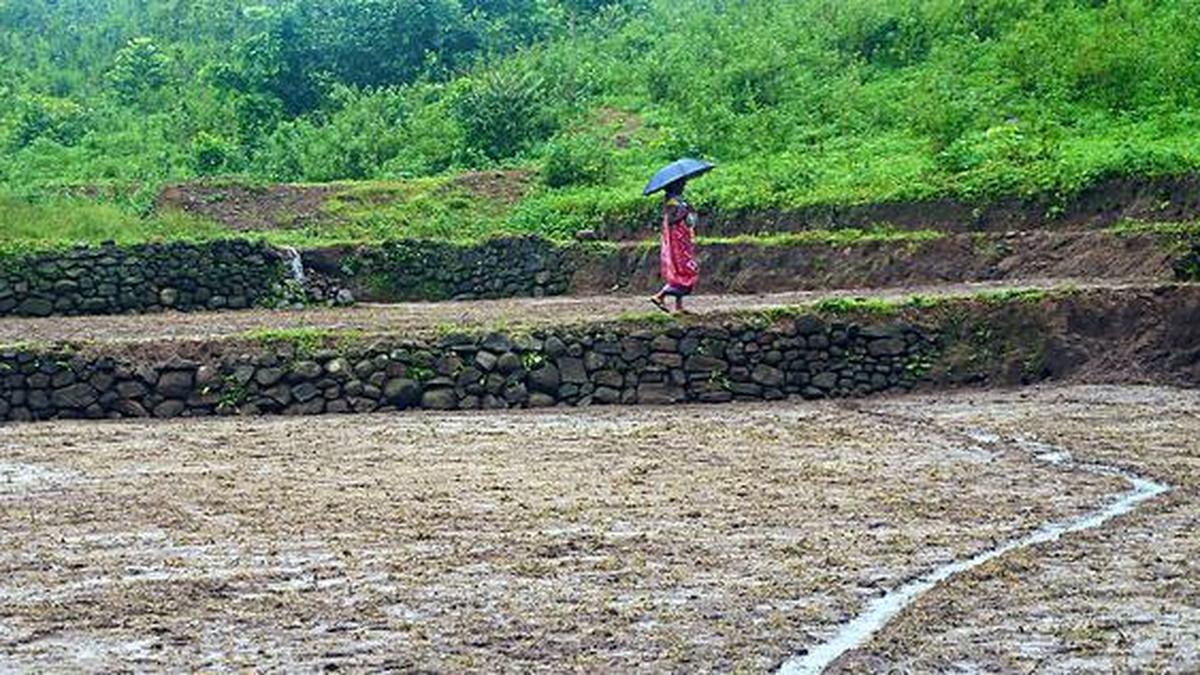
Carrying her five-month-old baby girl on her waist, 35-year-old Kilo Rasmu of the Kondh tribe guards her tiny piece of land located between a hill range and a dense forest on the Andhra Pradesh-Odisha border.
Braving the frequent spells of rain that discomforted the baby in her lap, she takes up the task of safekeeping the paddy seeds sown on her family’s field from birds, since the commencement of kharif this year.
In Mettagudem village of Y. Ramavaram mandal in the Alluri Sitharama Raju district, every Kondh woman takes up the responsibility of protecting the paddy seeds on the fields for at least two weeks until the seeds germinate.
This is because, unlike in the plains, paddy in the hilly areas is grown using the direct sowing method wherein the seed is planted directly into the land. Contrastingly, in the plain areas, paddy cultivation is done by planting the saplings raised in the nurseries.
Ms. Ramsu, a few years ago, lost her only boy to health complications. She is now raising her two daughters. “Our family owns three land holdings in which we cultivate paddy in kharif. All the holdings are near our village and my sole task is to guard all of the seeds planted from the birds trying to prey on them,” says Ms. Ramsu while breastfeeding her baby under the cover of an umbrella as it drizzles.
The Mettagudem village was formed with Kondh and Porja tribes. The Kondh families own small holdings of less than 20 cents each. A few decades ago, the Kondhs converted the forest cover into cultivable land. The migration of these two tribes in Mettagudem was ‘internal’ as they migrated from the Araku Valley region to settle along the Sileru river on the Andhra Pradesh-Odisha border during their search of land for agriculture.
Post-1970s, many such settlements were also formed along the Sileru River with the tribes that migrated for work in the hydroelectric projects across the Sileru.


Congress criticizes PM Modi for India-U.S. trade deal, labeling it an "ordeal" stemming from his "desperation and surrender."

Metro 4 incident exposes government negligence and safety concerns, highlighting serious risks at Mumbai's metro construction sites.

Dozens of national delegations at an artificial intelligence summit in India will issue their statement on how the world should handle the technology on Saturday, a day later than expected, India said.

Shorts News:No change in trade deal with India; it is on Trump after SC verdict

The Hindu Mind event: P.P. Chaudhary emphasizes simultaneous elections as vital for India's development by 2047, urging political unity for electoral reform.

Start your day with key updates: Trump’s tariff order, CAA panel in Bengal, judicial involvement in electoral rolls, and more.

Explore how optimism influences health, survival, and resilience, highlighting its evolutionary benefits and impact on well-being.

Saisudha Acharya on why the discipline of history isn’t as easy as people make it out to be

Sindhi community members uphold a 40-year tradition, serving Iftar at Wallajah Big Mosque, promoting unity and cultural harmony during Ramadan.

Maharashtra's Ladki Bahin Yojana promises ₹1,500 monthly for women, but many face hurdles in accessing benefits.

CM Rekha Gupta highlights her government's achievements in one year, surpassing AAP's decade of work on legacy issues.

The Indian hockey team aims for redemption in Hobart against Spain and Australia in the FIH Pro League.

About 60,000 students from 350 colleges celebrate creativity at SRMIST's Milan cultural fest in Chennai.