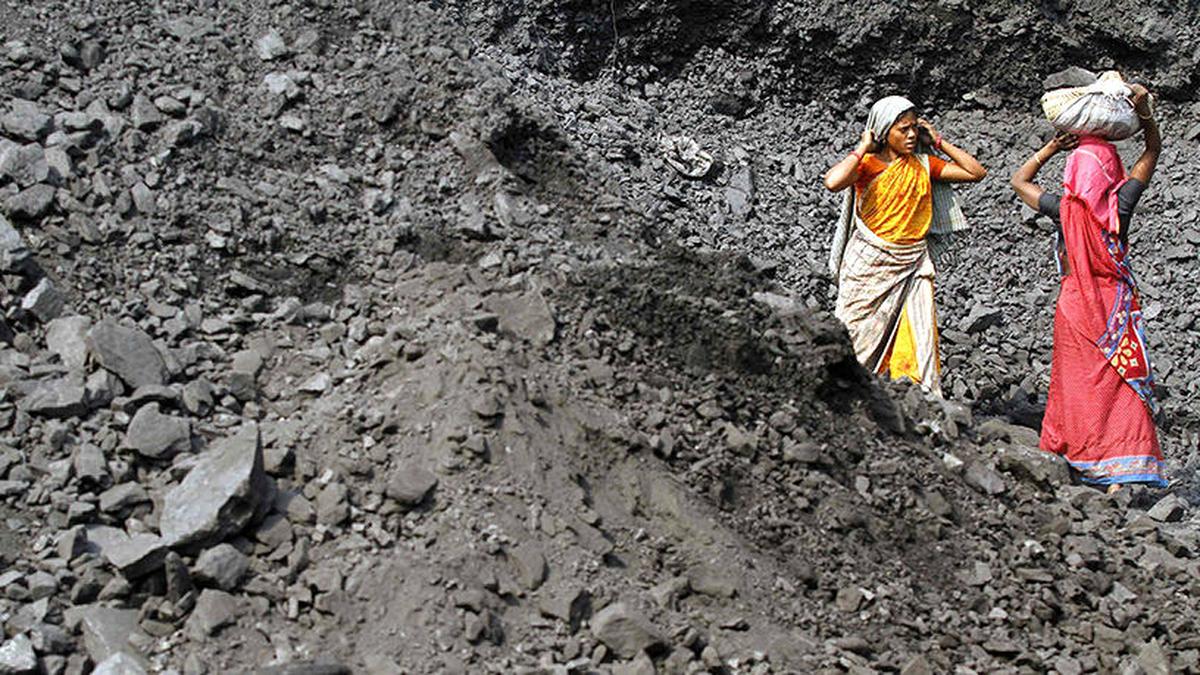
Women’s concerns at a coal site in Odisha Premium
The Hindu
Women in mining regions face displacement, loss of income, domestic violence, and alcoholism due to coal mining activities.
The challenges faced by women in mining regions differ significantly in many respects from those in the non-mining areas. During our recent visit to Mahanadi Coal Field Ltd. (MCL), Basundhara, Sundargarh district of Odisha, the women shared their concerns regarding the manifold challenges they faced in everyday life as a consequence of mining.
Kishori and Saraswati face displacement from Gopalpur, a village in Sundargarh district of Odisha. They have been staying in Gopalpur for long — Saraswati for 40 years and Kishori for about 35 years. Their houses have been adjacent, and they have lived as a family. Since the MCL acquired their village for mining activities, villagers now await relocation. The anxiety that plagues these women currently is whether they will be relocated together or not. Both had always lived together and therefore, the separation, if it happened, would definitely impact them emotionally. They are unaware of the new relocation site. They hope to move to the same location to minimise the emotional burden of the displacement.
Due to mining activities, everyday life in the villages has been severely impacted in this region. For example, in Telendihi mining village, water from borewells has become undrinkable. The only source, which is relatively better, is a small rivulet flowing around 700 metre away. Unfortunately, the responsibility of fetching water from such long distances falls on young girls, indicating the skewed gender division of labour in the community. During summer, the situation worsens, compelling the young girls to walk farther away to fetch water, thereby grievously compromising their education.
Discussions with women in Ratanpur village revealed more about the loss of income they have suffered due to mining. Prior to the mining activities, after harvest, they used to take care of the household activities for six long months by collecting mahua, tendu leaves, firewood and non-timber forest produce etc. Selling leaf-based products like bowls and plates made from Sargi leaves (of the Sal tree) accounted for the bulk of their livelihood. They sold even the tender sticks as toothpicks. The sale and quality of these products have, however, reduced drastically because of the omnipresent coal dust. Earlier, women used to equally shoulder the burden of daily household expenses. Now, two things have happened simultaneously—(i) women have lost their regular livelihood options; and (ii) they are unable to make their day-to-day monetary contribution to the household. In the present scenario, the income of the women has become nil and consequently, they have become increasingly vulnerable to domestic violence. Any financial ask by the women could potentially lead to violence at home.
Increased insecurity and violence have emerged as very important issues in this area. It would be pertinent to discuss Kishori’s (Gopalpur village) story in this context. Her husband died 27 years back, leaving behind three daughters and a two-and-a-half year old son. Being a single woman, Kishori faced a lot of challenges in bringing up the children. Nevertheless, she managed to arrange the marriages of all four of them. Unfortunately, her son became an alcoholic very early on, with the situation turning grim after he started working as a truck driver for the mines. This led to frequent verbal abuse of Kishori, later also directed at his wife. Kishori lost her son to alcoholism six months after his marriage. A family of seven has now been reduced to only two members—a young, widowed daughter-in-law and Kishori. Living in a dilapidated thatched house, Kishori constantly fears for her daughter-in-law’s safety, especially in an environment that has deteriorated due to the mining activities. “I am scared about the potential of sexual assault on my young daughter-in-law at any time because so many migrants roaming here and there. Drunkards are another threat to us. Therefore, I urged her to return to her natal home, where more men are present, offering greater security,” she lamented. Though no violence has occurred yet, the constant apprehension of it has taken a heavy psychological toll on the women.
Alcoholism is a major cause of domestic violence against women. It is reflected in the recently released National Family Health Survey (2019–21), which reveals that the highest incidence of violence (58.5%) against women aged 18–49 in Odisha is when the husbands gets drunk “often”. There is a sharp decline in the percentage of women experiencing violence (from 58.5% to 22.1%) when the husband “does not drink”. In other words, “no drinking” reduces the risk of violence by nearly three times compared to “often drinking” husbands. This result is corroborated by the reality in these villages where alcoholism is identified as the main cause of many social evils. Women from Ratanpur village expressed it differently by sharing how their alcoholic men come home and either commit violence or go off to sleep, and if somehow the women survive, the entire wealth of the family gets consumed in paying for their husband’s eventual medical expenses. Either way, women bear the brunt—initially as the victims of violence and subsequently as widows, left to cope with the family’s exhausted wealth.
We had another revelatory conversation about alcoholism and violence with the women of Kund village, another mining village of the district. In many cases, we found that the men generally gave their earnings to the women. It is the women who shoulder all the responsibilities of managing the meagre earnings to cover household expenditure, children’s education, medical bills apart from allocating a certain portion for the men’s liquor, meat and other expenditure. If women deny them this, it leads to abuse—often verbal but at times also physical. Though men give their earnings to the women, they clearly assert their ownership over it, with the retort “who are you to deny me my money” being the typical starting point for violence in such a scenario.


L&T confirms 95% of its West Asia project sites are safe, while addressing logistics challenges amid ongoing regional conflicts.

Mines Ministry to auction 19 critical mineral blocks on March 23, expanding strategic resources for clean energy and technology sectors.

Mines Ministry to auction 19 critical mineral blocks on March 23, expanding strategic resources for clean energy and technology sectors.

Five top firms lose ₹1 lakh crore in market value, with HDFC Bank experiencing the largest decline of ₹56,124.48 crore.

HDFC Bank terminates three senior officials over client onboarding issues at its DIFC branch amid ethical concerns following chairman's resignation.

Air India CEO warns of potential flight cuts and reduced travel demand due to rising fuel costs amid ongoing Gulf conflict.

Options are widely used by retail traders to speculate on the value of the stock for immediate gains and such behaviour in large scale can distort the market

India achieves 1 billion tonne coal production for the second consecutive year, ensuring stable energy supply and economic growth.

Generic drugmakers in India launch affordable Semaglutide versions, targeting a $1 billion diabetes and weight loss market.

Indian and Asian refiners eye Iranian oil purchases as U.S. waives sanctions amid energy crisis linked to the Iran-Israel war.

Iran war impacts pesticide prices, warning of a 20-25% rise and increased risk of counterfeit products during the kharif season.

India's forex reserves fell by $7 billion to $709.76 billion, according to RBI data for the week ending March 13.

Natco Pharma will launch its Semaglutide injection (multi dose vials) in the domestic market on Saturday.