Winnipeg still lags behind on active transportation, experts say
Global News
Winnipeg’s streets are getting some major investments, but experts say we need to consider more than just vehicles when planning improvements.
Winnipeg’s streets are getting some major investments. There are plans to revitalize downtown and Osborne Village, as well as widen Route 90 to improve traffic flow.
However, Jino Distasio, professor of geography and urban studies at the University of Winnipeg, says when planning to improve the roads, we need to consider more than just vehicles.
“Along some of our main arteries, we’ve got to figure out a better way to share the road. And we have to move past ‘the road is only for cars,’” says Distasio.
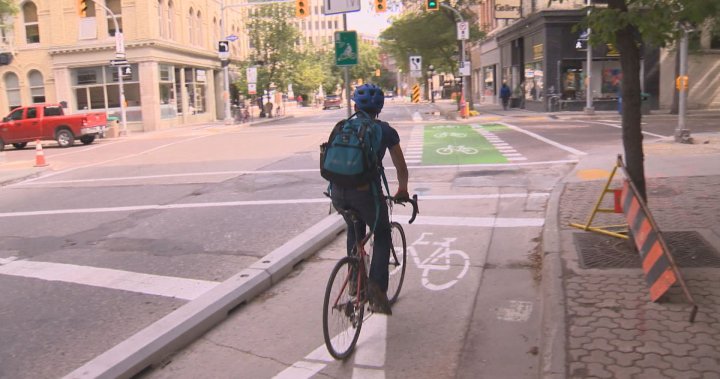
Experts say active transportation, like biking, walking, or rollerblading, sometimes feels like an afterthought in city planning. Even the new CentrePlan 2050, which aims to transform how people get around downtown, only has six streets being studied for potential new bike lanes.
That’s disappointing to Mark Cohoe, executive director of Bike Winnipeg, who says the routes displayed feel disjointed. He also says it’s not enough simply to build more active transportation infrastructure. The city needs ensure people actually use it, he adds.
“We don’t actually encourage people to get out there, we don’t work at actively getting them out and promoting that transit use, that bike use,” says Cohoe. “So, people maybe aren’t aware of what the benefits are.”
Cohoe says rather than continuously expanding the major routes, like Route 90, the city should aim to better balance multiple transportation systems. But Distasio says making that shift isn’t easy.
“Others will say, maybe it’s time we get people out of their cars and onto bikes or through a rapid transit corridor, but we haven’t really caught up with that, either.”


Some experts say that a cyberwar through 'proxies' may be the next stage of the Iran war, with civilian infrastructure also coming under threat.

The study is being billed by the university as "the first to study a wide range of factors which link ADHD symptoms and mental ill health symptoms over time."

The group says MAGA Energy hasn't paid its lease for three years, and therefore the company is no longer allowed on their land in Edmonton.

The analysis by the Canadian Climate Institute says oilsands producers will pay an average of about 50 cents per oil barrel, if the minimum carbon price rises to $130 per tonne.

Between November 29 and February 27, authorities recorded 406 outbreaks of bird flu in domestic birds in 32 European countries and 2,108 outbreaks in wild birds, they said.

Dr. Michael Domeier, director of the Marine Conservation Science Institute, told Global News that they tag the adult females as they are the most interesting.

Regina’s recycling contamination is currently triple the limit and city is urging resident to change sorting habits now to avoid citywide fines and higher resident fees.

The study found that higher ultra-processed food intake at age three years was associated with adverse behavioural and emotional symptoms at age five years.

Edmonton's single-use waste rules were controversial and unpopular when introduced in 2023 — but new data shows the changes are having the intended effect of reducing garbage.

Carney's speech to Australia's parliament highlighted a soon-to-launch Canadian low earth orbit satellite network that experts say could soon compete with Elon Musk's Starlink.

The Pentagon said in a statement Thursday that it has “officially informed Anthropic leadership the company and its products are deemed a supply chain risk, effective immediately.”

Opioid overdose deaths in Canada are falling, but there's growing concerns on a certain veterinary tranquilizer being cut into fentanyl and other opioids.

The product is being recalled in Alberta, British Columbia, Manitoba, Ontario, Quebec and Saskatchewan due to 'undeclared almonds' being found.