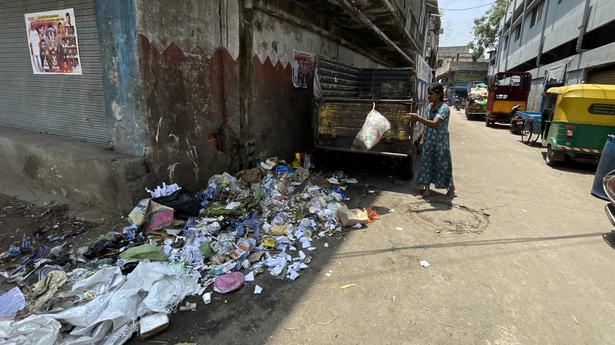
Will a single agency for collection of waste in Bengaluru work?
The Hindu
Presently, wet waste and dry waste are collected by two separate agencies in two different vehicles
In what will be a reversal of the Solid Waste Management (SWM) strategy in Bengaluru for nearly a decade now, if it goes through, the civic body will likely revert to a single agency/contractor collecting all streams of waste from the doorstep under the new tenders being drafted.
Presently, wet waste and dry waste are collected by two separate agencies in two different vehicles — wet waste every day by contractors and dry waste twice a week by those managing Dry Waste Collection Centres (DWCCs). “Today we have different agencies responsible for wet waste, dry waste, sanitary waste, medical waste, construction and debris waste, animal waste and waste from bulk generators creating a multitude of agencies making it tough to hold anyone to account,” a senior civic official said, arguing for a single agency to collect all streams of waste.
Back in 2012, after segregation of waste at source was made mandatory by the Karnataka High Court, contractors drew the ire of citizens as even when households gave segregated waste, collectors poured them into one container mixing it again. This led to the experiment of DWCCs, managed by ragpickers and NGOs, being given charge of collecting dry waste in 2013, separating collection and processing of wet and dry waste. Those managing DWCCs and a section of SWM activists have opposed the reversal of this policy, raising fears that segregation levels in the city will drop again.
“Separate collection of dry waste twice a week has worked well for nearly a decade now and the city is able to empower ragpickers through this programme. Households have also got used to giving dry waste twice a week. Going back to contractors collecting both streams of waste in a single vehicle will only amount to undoing all the good work done over the last decade,” said Nalini Sekhar of Hasiru Dala, an NGO working with ragpickers and managing over 36 DWCCs and collecting waste in those wards.
SWM expert Sandhya Narayan said “one-size-fit-all” would not work in the city. “In commercial areas and slum pockets where garbage is collected every day for the first time, a single vehicle collecting both streams of waste will work. But in residential areas with middle and high income groups, which make up 80% of the city, there is already a working system where streams of collection are entirely separate and why should they go back to a single vehicle system. We have done time and motion studies earlier which clearly show the single vehicle system won’t work,” she said.
However, not all seem to agree. “Despite all streams of waste collection being separate, we are still collecting majorly mixed waste dumping it at landfills and blackspots in the city are only increasing. Evidently, this experiment to separate streams of collection of waste to boost segregation has failed and needs a rethink. Moreover, NGOs running DWCCs and collection streams have also developed conflict of interest by indulging in business through waste processing,” said V. Ramprasad, a SWM activist in the city.
“The contractors are the bedrock of SWM in the city and cannot be kept out branding them as mafia, especially when they are ready to reform and implement transparency measures. Contractors have also realised there is money if waste is segregated,” said a senior civic official, indicating a move back to contractors.


T.N. CM Stalin urges the Centre to build consensus with transgender persons before imposing changes to the Trans Amendment Bill 2026.

Trump's engagement with Pakistan as a mediator for Iran echoes Nixon's historical diplomacy with China amid shifting geopolitical dynamics.

Telangana's Petroleum Dealers Association assures no fuel shortage, attributing temporary stock issues to panic buying fueled by rumors.

The Ottiyambakkam panchayat had an harrowingly difficult time keeping people from swimming in the deadly quarry with its protruding rocks under the water. There had been many deaths. And then nature intervened, and the fatal accidents stopped. An invasive, floating weed that is a bane of water sources everywhere, the water hyacinth is not just tolerated in the quarry but welcomed

Fuel supply panic causes severe traffic congestion in Hyderabad on March 25, 2026, prompting police intervention to manage long queues and road chaos.

Mohamed Salah will leave Liverpool at season's end, concluding a remarkable nine-year tenure at Anfield.

Telangana CM to hold urgent meeting on March 25 to address petrol, LPG, and urea stock concerns amid rising demand.

Karnataka Minister announces efforts to resume separate Haj terminal at Mangaluru airport, pending Centre's approval.

Ahead of the Assembly election, DMK Youth Wing secretary and Deputy Chief Minister Udhayanidhi Stalin has tasked the party youth wing members with meeting young voters every day till the polling day to explain various achievements of the ‘Dravida model government’ to them.

Bird flu outbreak in Chhattisgarh's Bilaspur kills 4,400 chickens, prompting increased surveillance and culling measures.

Four queer activists discuss the repercussions of the Trans Amendment Bill 2026 on dignity and identity within the community.

Explosion in Ooty's Botanical Garden highlights Tamil Viduthalai Padai's protest against Hindi imposition and demand for Tamil Eelam.

Assembly polls 2026: Follow updates from The Hindu on the upcoming elections in five States on March 25, 2026