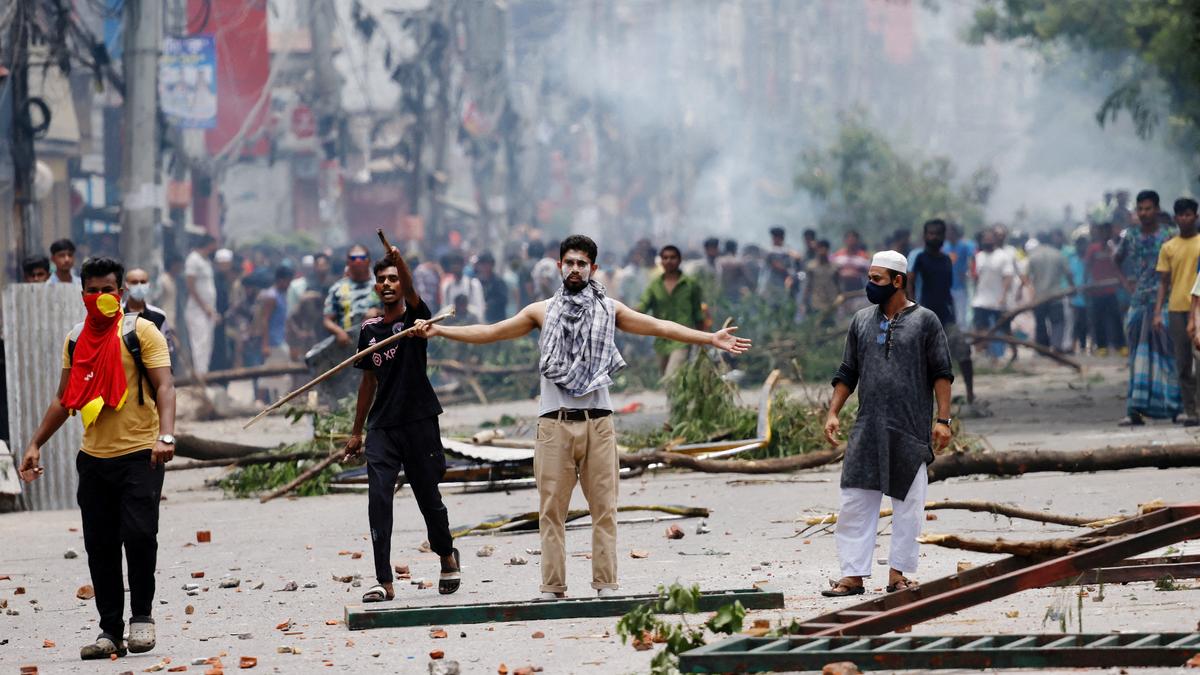
Widespread frustration, anger evident among people in Bangladesh, says civil society member
The Hindu
Bangladesh Prime Minister Sheikh Hasina faces widespread protests over job quotas, sparking violence and criticism from rights groups.
Bangladesh Prime Minister Sheikh Hasina imposed a nationwide curfew last week and used the Army to quell protests against job quotas that killed nearly 150 people, but anger against her government does not seem to have abated.
The protests, which started in universities and colleges earlier this month, turned into a more widespread agitation against Ms. Hasina and her government.
Police fired rubber bullets, tear gas and lobbed sound grenades to disperse tens of thousands of protesters who came out on the streets. The government denied any live rounds were fired, but hospital sources said dead and injured people had wounds from bullets and shot gun pellets.
Rights groups and critics say Ms. Hasina has become increasingly autocratic during her last 15 years in power and her rule has been marked by mass arrests of political opponents and activists, forced disappearances and extrajudicial killings, the charges she denies.
Badiul Alam Majumdar, the secretary of Shushahoner Jonno Nagorik, a Dhaka-based civil society platform for good governance, said the protests were "just the tip of the iceberg" and the use of force against students will breed further discontent against Ms. Hasina's government.
On the student protests in Bangladesh | Explained
"People are being deprived of their basic rights, with a significant lack of human rights and justice. They can't cast their votes freely," he said. "This widespread frustration and anger among the people is evident in the protests."


Explore the strategic significance of the Strait of Hormuz and its impact on global energy security and economies.

Explore Trump's consideration of Section 122, 301, and 232 tariffs amid legal challenges and trade negotiations with various countries.

Trump expresses shame over Supreme Court's ruling against his global tariffs, calling the decision "deeply disappointing."

Trump expresses shame over Supreme Court's ruling against his global tariffs, calling the decision "deeply disappointing."

Brazil and India aim to strengthen ties and expand trade, tapping into their potential as major democracies and economies.

PM Modi's letter to Bangladesh's new leader emphasizes India's commitment to a democratic, progressive, and inclusive future.

Hamas demands an end to Israeli aggression as a prerequisite for Gaza's reconstruction amid international peace discussions.

Kim Jong Un praises North Korea's economic progress and regional influence as he outlines future policies at the Workers' Party Congress.

Israeli settlers shot and killed 19-year-old Palestinian American Nasrallah Abu Siyam, escalating violence in the occupied West Bank.

The U.S. Supreme Court struck down on February 20, President Donald Trump's sweeping tariffs that he pursued under a law meant for use in national emergencies, rejecting one of his most contentious assertions of his authority in a ruling with major implications for the global economy.

General Upendra Dwivedi's Australia visit enhances India-Australia military cooperation, focusing on strategic partnerships and joint exercises.

Iran's Foreign Minister asserts the U.S. hasn't demanded zero nuclear enrichment, contradicting statements from American officials.

U.K. Foreign Minister Yvette Cooper to discuss Diego Garcia base tensions with U.S. Secretary of State Marco Rubio amid Trump's criticisms.