Why is Germany headed for snap polls? | Explained
The Hindu
Germany's ruling coalition collapses, leading to snap elections amid budget disagreements and rising influence of far-right party AfD.
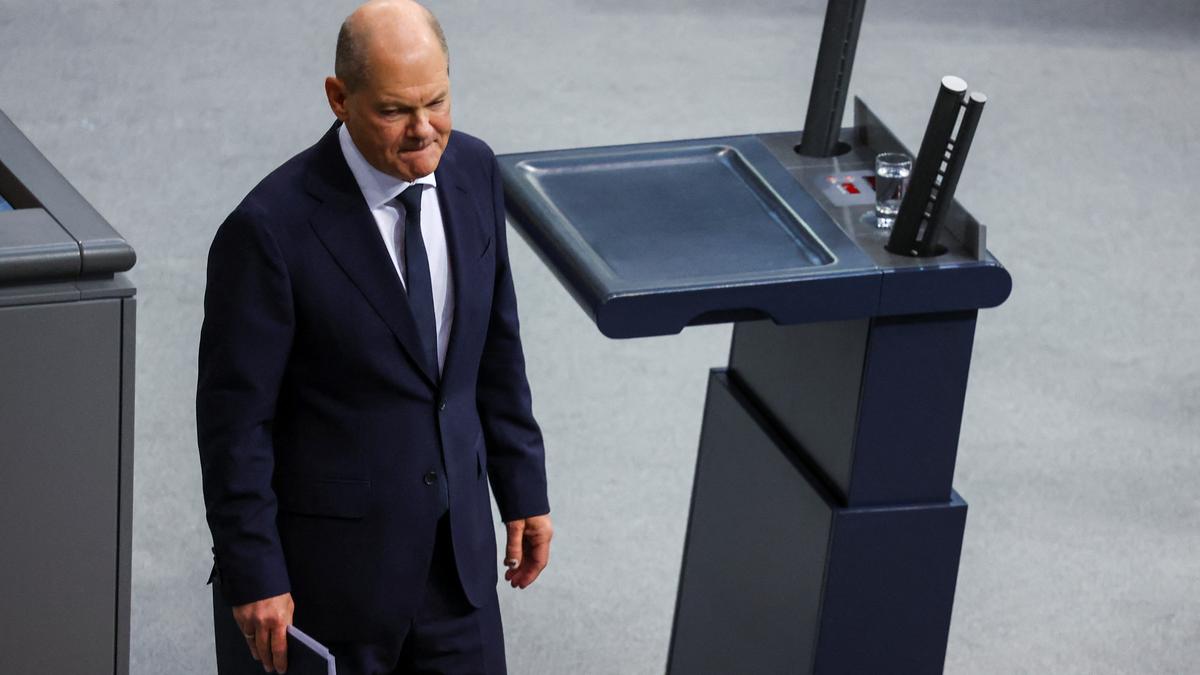
The story so far: On November 6, Germany’s ruling ‘traffic light’ coalition, composed of the Social Democrats (SPD), the Greens and the Free Democrats (FDP), collapsed when Chancellor Olaf Scholz fired his Finance Minister, FDP’s Christian Lindner. A no-confidence motion against the government will be initiated on December 16, which Mr. Scholz is sure to lose without the support of the FDP. Therefore, Mr. Scholz has agreed to hold snap elections on February 23, 2025 ahead of the scheduled election in September 2025.
Germany’s current ruling coalition, which came to power in 2021, has been one of the most ineffective coalitions that the country has seen. Constant infighting over key issues such as the budget agreement, war with Ukraine, defence and energy spending has brought about a dysfunctional governance model.
While the Chancellor’s SPD and the Greens want heavy state investment by increasing government borrowing, Mr. Lindner’s bro-business party has rejected the same by espousing strict adherence to Germany’s debt brake rule which prohibits borrowing beyond a set limit. Further, the FDP has asked for tax cuts for the wealthy, and austerity measures both of which have been staunchly opposed by the other two coalition partners.
The looming multi-billion dollar gap in the federal budget is yet another thorn on the side of the government.
Germany’s debt brake rule limits the EU country’s borrowing to 0.35% of its GDP. This limit, written into Basic Law (German Constitution), effectively means that the government has to try to balance its books every fiscal year, that is, it can only spend what it makes via taxes and levies. This rule was written into the law in 2009 after the 2008 economic crisis to bring public finances back under the control of the government. The debt brake limits indiscriminate government borrowing which would later translate to huge interest and fall as a burden on future generations. While it had been opposed then by the Greens and other opposition parties as limiting the government’s ability to spend and act, it became legally binding for the federal government and the states in 2016 and 2020, respectively. No other EU country has such strict borrowing rules.
However, there is an exception clause “which allows the Bundestag [German Parliament] to suspend the debt brake by a simple majority in the event of a natural disaster or other extraordinary emergency situations beyond the control of the state.” The Bundestag has already used this exception from 2020-2022 citing the COVID-19 pandemic and the onset of the Ukraine-Russia war which caused the energy crisis in the country — Germany has been one of the strongest defenders of Ukraine in the EU, with funds for Ukraine’s security capacity building initiative in 2024 alone amounting to approximately 7.1 billion euro. However, this has led to Germany cutting/weaning off from Russian energy causing an energy crisis in the country, the effects of which are still felt in the economy.
To work around the debt brake and to finance its fiscal needs, Germany has a list of various off-budget ‘special funds’ which it uses for economic spending without breaking the debt limit. Some of these funds include the climate and transformation fund, the economic stabilisation fund, the federal armed forces fund etc. The ruling coalition was depending on these funds to get them through the increased commitments to climate initiatives and defence spending.


The Id-ul-Fitr festival in 2026 is unfolding across the world in contrasting circumstances, shaped by both celebrations and conflicts.

U.S. and Israel strike Iran's Natanz nuclear facility, with no reported radioactive leakage, says Iran's atomic energy organization.

International Day of Forests 2026 | Theme, significance and economic importance of forest ecosystems
International Day of Forests 2026 seeks to place forests at the centre of sustainable, resilient and long-term economic planning

Escalating conflict in West Asia: Israel attacks Tehran and Beirut as U.S. Marines deploy amid rising casualties and economic concerns.

Ukraine launches over 280 drones at Russia in a significant escalation, prompting defensive actions and reports of damage.

A fire at a South Korea car plant killed 10, injured 59, and left four missing; rescue operations ongoing.

Trump considers winding down military operations in Iran, rejecting a ceasefire amid escalating tensions and regional conflict.

BTS returns with a massive concert in Seoul, attracting 260,000 fans and streaming live on Netflix.

U.S. airport delays are expected to worsen as TSA staffing issues persist amid an ongoing government shutdown.

Iran-Israel war: Follow the latest updates from The Hindu on the West Asia war, on March 21, 2026

A federal judge blocks the Pentagon's restrictive press access policy, emphasizing the public's right to diverse information.

UK approves US strikes from British bases on Iran missile sites, while Prime Minister Keir Starmer seeks to avoid war.

Czech authorities investigate a suspected arson at a drone technology warehouse linked to anti-Israel group claims.