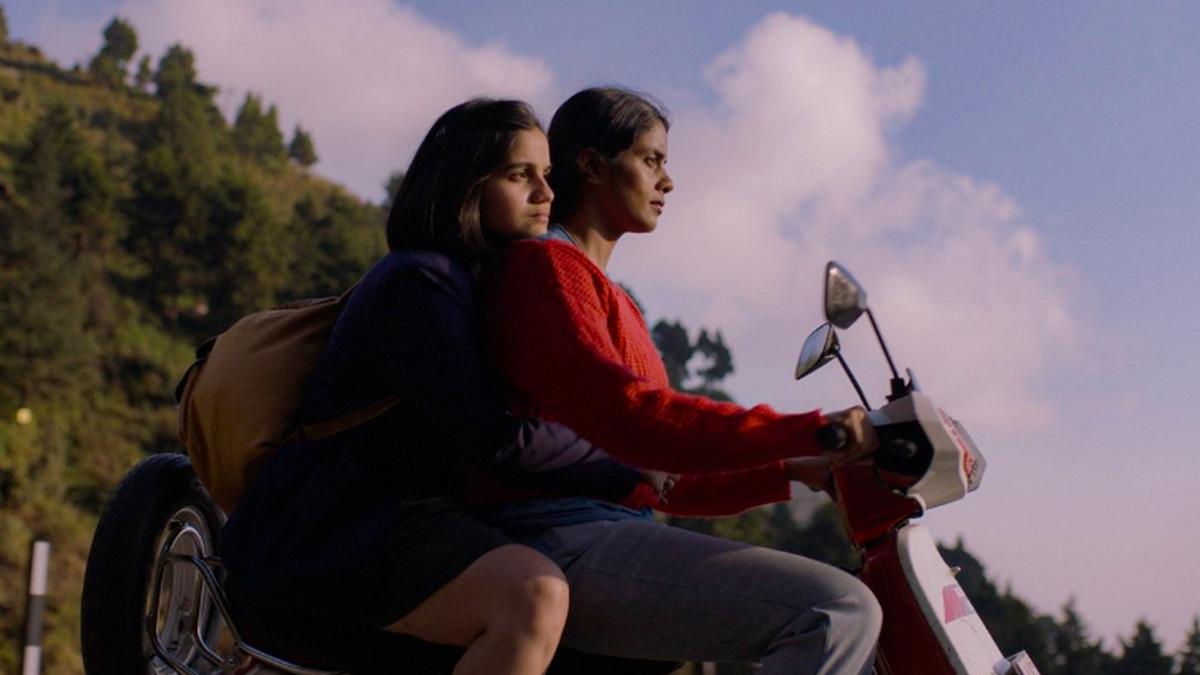
Why Indo-French movie ‘Girls Will Be Girls’ was shot by a mostly female crew
The Hindu
Shuchi Talati's film "Girls Will Be Girls", shot by a mostly female crew, explores female sexuality and mother-daughter relationships in an Indian boarding school.
Shuchi Talati, writer-director of Girls Will Be Girls, which debuted at the ongoing Sundance Film Festival, wanted to create a movie set where girls could be girls. So she involved a mostly female crew to shoot the film. “In spaces which are more ‘male’, women wear armour. But when we don’t have to fight for respect or be more masculine to be taken seriously, it opens up mental space and we can get more done,” says Talati. “And because the film is about a young girl’s sexuality, for me it was very important to build a safe space where the cast could be vulnerable.”
Girls Will Be Girls was among the first titles picked to compete in the festival’s world dramatic competition, a Sundance programmer informed viewers at the film’s premiere. It is a delicately spun duel for attention between teen girl Mira (Preeti Panigrahi) and her young mother Anila (Kani Kusruti), after Mira befriends Sri (Kesav Binoy Kiron), an attractive new classmate at her boarding school.
U.S.-based Taiwanese filmmaker and photographer Jih-E Peng handled the cinematography, Avyakta Kapur (Jee Karda, Prime Video) led production design, while Amrita David came on board as editor. The film was produced by women too — Claire Chassagne from France and Richa Chadha in India, who attended college with Talati in Mumbai.
New York resident Talati’s last film — a short called A Period Piece, in which a couple contends with blood stains on the couch after a night of intimacy — was also shot by a mostly female crew. “It was special to try and recreate that in India. Film sets are very ‘male’ everywhere but that is a little bit more true in India.” After six years in the making, several funding applications, and a stint at the Berlinale Talents Script Station programme later, Girls Will Be Girls was introduced at the grand Egyptian Theatre in Park City, Utah, where an international audience gasped and giggled along with the plot’s subtle twists. “We were surprised by how audibly people were reacting,” cast member Kiron noted after the screening. “Because ours is actually a quiet film.”
The filmmaker first began writing a story of sexual awakening set in a strict Indian school in 2018. That milieu had caught Talati’s imagination ever since she spent a night at a boarding school where the bunk beds were covered in lovey-dovey etchings. “There were all these little messages by all the girls who had slept in them over the years, recording their crushes,” she says. Talati was also fascinated by the boarding schools described in Enid Blyton’s St. Clare’s and Malory Towers, as well as her own school in Vadodara, “where they policed everyone but especially the girls”.
As an adult looking back, the writer in Talati was struck by how much of her girlhood was governed by society. “When you are a student, you are so steeped in the culture, so while there is the thrill of exploring your sexuality, there is also shame and judgement, so you want to keep the rebellion a secret,” she says. “Sometimes you don’t even tell your best friend that you kissed your boyfriend.”
The film’s protagonist Mira is one such girl who, as a straight A student and the first female head prefect of her school, must walk the tightrope between upholding the “age-old Indian culture” and asserting her budding sexual agency.


Kanye West (Ye) announces his debut India show on March 29

Iranian director in exile, Mohammad Rasoulof, has already started working from his adopted country exploring themes around the autonomy of an artist

Anirudh Ravichander launches Albuquerque Records and announces a nationwide concert tour celebrating 15 years of his musical career.

Veteran screenwriter Salim Khan hospitalized in Mumbai; family and Salman Khan visit amid updates on his condition awaited.

Actors Rahul Bhatt and Sunny Leone open up on essaying complex characters in Anurag Kashyap’s ‘Kennedy’, all set to stream on Zee5

Acclaimed Tamil filmmaker Thiagarajan Kumararaja has reunited with his Super Deluxe star Vijay Sethupathi for his upcoming film, Pocket Novel

Legendary actor Robert Duvall, known for iconic roles in "The Godfather" and "Apocalypse Now," dies at 95.

The film is set to release in 2027 and is produced under Bhansali Productions and Maya Movies, with Mehta also serving as a writer on it

The concert is part of Kanye West's global run of headline performances and will take place in New Delhi’s Jawaharlal Nehru Stadium

Sinclair Daniel and Mark O'Brien speak of their experiences of working on 'The Copenhagen Test', balancing the action with emotion, and the challenges of filming in extreme weather

Tamil film producer V. Tamil Azhagan, known for iconic films, passes away at 70; Rajinikanth expresses deep condolences.

Arundhati Roy withdraws from Berlin Film Festival, criticizing Wim Wenders' stance on Gaza and the role of politics in art.

‘My Lord’ movie review: Except for a contrived pre-climax sequence, Raju Murugan’s film intersperses social satire and political commentary with wit, heart, and conviction