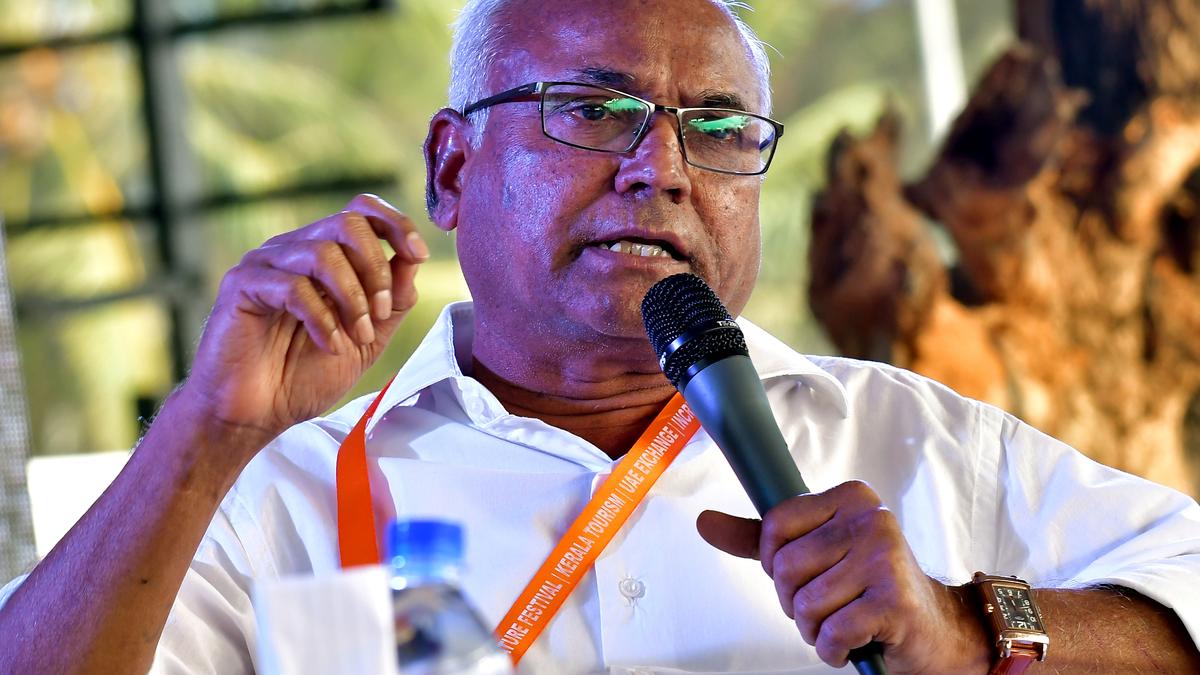
‘Why has India’s feminist movement not spoken on Savitribai Phule as yet?’: Kancha Ilaiah
The Hindu
Dalit rights activist Kancha Ilaiah criticises BJP's stance on Phule movie, questions feminist movement, and lack of OBC representation in CBFC.
Raising questions on the BJP’s efforts to renegotiate with the ideologies of Mahatma Jyotiba Phule and Dr Babasaheb Ambedkar, Dalit rights activist Kancha Ilaiah said that the government’s perceived tacit support to the recent Central Board of Film Certification’s (CBFC) action against ‘Phule’ movie will hurt the OBCs, which the ruling party cannot afford.
He also raised questions on India’s feminist movement for not taking a public stance against the objections taken about the portrayal of Savitribai Phule.
Also Read | ‘Phule’ and censorship: How Bollywood’s elite resist caste-conscious cinema
“Here is a woman leader, a woman social reformer who had no parallel in India. I’m still waiting for the entire feminist response to Savitribai’s portrayal. After the controversy over the film, I have not seen large feminist groups talk about it,” he said. He was speaking to The Hindu in an exclusive interview on the background of the recent release of ‘Phule’, the biopic on Mahatma Jyotiba Phule and Savitribai Phule.
“Mahatma Jyotiba Phule and Savitribai Phule did not just work for the education of the Dalit and Brahmin women, contributing to the social reform movement, but they changed the socio-political and economic ideas of India,” he said, adding that the couple was revolutionary in many ways, in their personal as well as social lives; and that Mahatma Phule’s contribution was to start the discourse on labour, agriculture and farmers through his writings in 19th century India.
WATCH | Why are Phule and Ambedkar’s ideas still making people uncomfortable?
“Mahatma Phule started first Dalit school and dug a well where the Dalits were invited to draw water, which was a revolution at that time. Now, this is the man who actually started talking about the farmers and the labour and the agriculture. In India, there was a school called agriculturalism before the Vedic philosophy came in. It spoke of the relationship between the seed and land, seed and water, seed and crop and the human beings. This was a philosophical domain. And Buddha tried to negotiate with that philosophy. But later on, the different schools of thought that emerged, the Sankhya school, the Vedic and Vedantic schools, they completely removed the agrarian philosophical school from any engagement. He brought it back,” Mr Ilaiah said.


Opposition parties criticize Delhi's budget as inflated and misleading, questioning transparency and funding for key initiatives.

Srirangam residents seek improved infrastructure and amenities to support rapid urbanization and growing tourism demands in the constituency.

Alandur faces unresolved civic infrastructure issues, including lack of water and drainage, despite recent development efforts ahead of TN Election 2026.

Delhi's fiscal deficit surged by 62% in 2025-26, reflecting revenue declines and raising concerns about the city's economic health.

Kerala Assembly Elections 2026: Anvar and Firos face multiple namesake rivals in their constituencies amid a crowded candidate field.

Kamal Haasan announces support for DMK in 2026 elections, emphasizing the need for 'Dravidian Model 2.0' for Tamil Nadu's welfare.

DMK finalises seat-sharing for the 2026 Tamil Nadu Assembly elections, contesting 175 seats with allies DMDK and VCK.

Parliament may adjourn early for Assembly elections, allowing MPs to campaign in key election-bound states.

Indian vessels can freely sail through the Strait of Hormuz without needing permission, confirms a senior government official.

The Hindu Morning Digest gives a select list of stories to start the day. Read the top news today on March 25, 2026

An IndiGo flight at Vijayawada airport was grounded due to a tyre burst, but all 79 occupants are safe.

Tamil Nadu Assembly election 2026: TMC(M) gets five seats in NDA, to contest on BJP's 'Lotus' symbol
TMC(M) secures five NDA seats, to contest Assembly elections using BJP's 'Lotus' symbol in Tamil Nadu.

The Karnataka government will discuss with officials the possibility of creating a portal for unemployed youth to share their details and access job opportunities in micro, small and medium enterprises (MSMEs), Minister for Small Industries and Public Enterprises Sharanabasappa Darshanapur said in the Legislative Council on Tuesday.