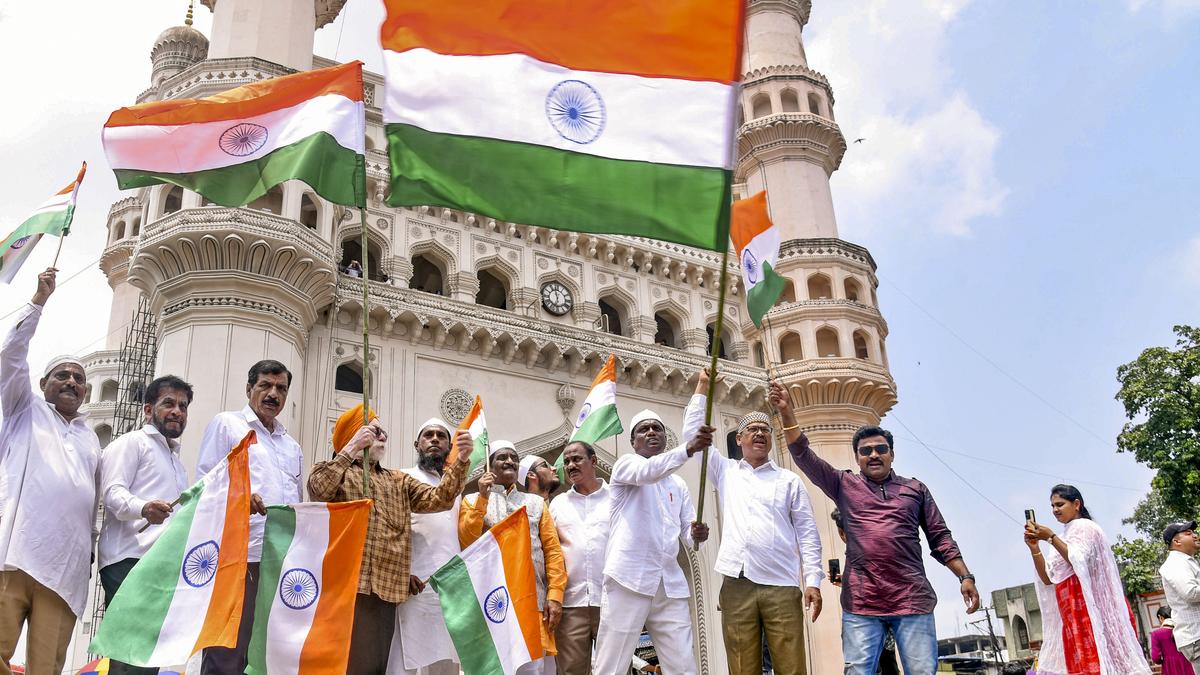
When Telangana celebrated ‘Har Ghar Tiranga’ before Independence Day
The Hindu
The freedom struggle in Nizam’s Dominion was not limited to the Telangana area. Ganpati Amrite fell to bullets of Razakars while hoisting the Indian National Flag in Umari village in present-day Maharashtra in September 1947.
On October 2, 1942, Hyderabad witnessed a revolutionary form of protest. A march of women who chanted: ‘Gandhi ka charkha chalana padega, Goron ko London jana padega (As Gandhi’s wheel spins, Whites have to leave to London).’ In a region where the writ of the Nizam Osman Ali Khan ran, this was nothing short of an explosive challenge to his authority. Hours before this protest, Sarojini Naidu was arrested. But other women carried on the peaceful protest to be arrested. Among them was Padmaja Naidu who unfurled the flag near the Residency Building.
The event was a testament to the fact that people in Hyderabad knew the British were the real rulers even if the Nizam Osman Ali Khan sat on the yellow masnad in Chowmahalla Palace. And it was different from the July 17, 1857 attack on the British Residency when minister Salar Jung saved the day for the British and the Nizam. Times had changed. This challenge to Nizam’s authority and the support for merger with India was much more widespread even before the Operation Polo that became a fait accompli.
The fervour of India’s independence movement bypassed Hyderabad on August 15, 1947. But not completely. The Congress gave a call for the ‘Join Indian Union Movement’ across the princely state of Hyderabad to be observed on August 7, 1947.
The State with its three linguistic regions was in ferment before and after India’s Independence. It took the form of Satyagraha and the Join Indian Union Movement crystalised it.
The Satyagraha that began in 1938, was a simple affair with five members proclaiming themselves as members of the banned Congress organisation. The police would bundle the group (jatha) into the nearest police station and later imprison them.
The Join Indian Union Movement led to a mass awakening where the political activists would unfurl the Indian Tricolour in a public space knowing the serious consequences. The princely police machinery of the Nizam could not control the groundswell of backing for a merger with India.
The dramatic heroes in this fight were ordinary Indians who disappeared as soon as Hyderabad was merged with India.


Mysuru-based anti-corruption activist Snehamayi Krishna, the complainant in the MUDA case against Chief Minister Siddaramaiah and his family members, was questioned for almost all day by the Bengaluru City Police on Friday for allegedly using forged documents and audio to make false allegations.

Alexandra Kosteniuk discusses her chess journey, the game's evolution, and her motivations as a top player in her 40s.

Youth Eco Summit 2026 Reframes the AI Conversation for the New Generation

O. Panneerselvam claims DMK has a strong chance of retaining power, citing their achievements in the past five years.

From traditional handicraft items from Manipur to a variety of dress materials from across state by women Self-Help group members are on display at the stalls at the National SARAS mela in Karavali Utsava ground in Mangaluru. The nine-day long mela began on Friday.

India participated as an observer at the Board of Peace meeting, reaffirming its support for a viable Palestinian state.

T.N. Deputy Chief Minister inaugurates CREDAI FAIRPRO 2026, showcasing over 500 real estate projects from 80 developers in Chennai.

Andhra Pradesh prioritizes Guntur Mirchi Yard's development with a new committee focused on quality yields and farmer support.

Navy delegates from 50 countries explore natural dyeing and local crafts at Sankalpa Art Village during the International Fleet Review.

Farmers complained about indiscriminate stone quarrying taking place in Madurai district, particularly at Kallanai in Kalligudi taluk. They urged authorities to take necessary action to stop the indiscriminate quarrying activities and protect the environment

Madras High Court dismisses Ramadoss's petitions to freeze 'mango' symbol, emphasizing resolution through civil court, not writs.

After more-than-two-year wait, the flyover at Goripalayam junction will be commissioned on Saturday. As of now, the main arm of the new flyover, named after freedom fighter Netaji Subash Chandra Bose, will help to decongest vehicular movement from Tamukkam junction till Nelpettai junction on East Veli Street.

PAC criticizes the government for poor execution and financial delays in the ₹4,455 crore SANKALP skill development scheme.