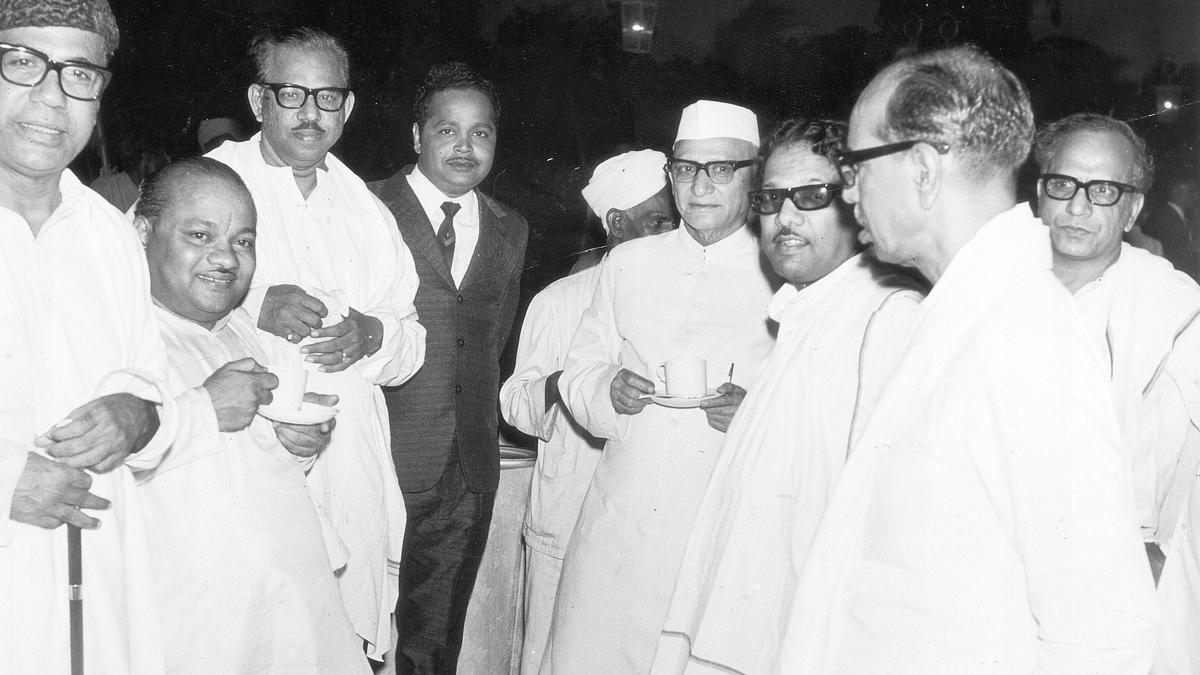
When parallel sessions unfolded in the Assembly leading to Speaker’s removal
The Hindu
Stable tenures of Tamil Nadu Assembly Speakers, with rare removal of K. A. Mathialagan in 1972.
The Tamil Nadu Assembly is known for the stable tenures of Speakers. Ordinarily, the incumbents do not get disturbed. Those who gave up the post were far and few. Among those were J. Sivashanmugam Pillai (1901-75), Tamil Nadu’s first Speaker belonging to the Scheduled Castes, who quit in August 1955 on his appointment as a Member of the Union Public Services Commission (UPSC); Si. Pa. Aditanar (1907-81), who resigned in August 1968 and became Cooperation Minister six months later; K. Kalimuthu (1942-2006) in 2006; and D. Jayakumar (1960-) in 2012.
But, in the history of the State Legislature, only once was its presiding officer getting removed through a motion. That presiding officer was K. A. Mathialagan, and he was thus removed in December1972, when the DMK was in power.
After this incident, there were five other occasions wherein notice for the removal of the Speaker was given by the Opposition. On all the occasions (April 1993 and 1995, August 2006, May 2007, and March 2017), the motions were declared either lost or dropped.
The Assembly met on November 13, 1972, barely a month after the ruling DMK suffered a split following the exit of its treasurer M.G. Ramachandran (MGR). According to a news report published in The Hindu on November 14, 1972, MGR, the leader of the ADMK [at that time, it was the Anna Dravida Munnetra Kazhagam] group, which has been allotted separate seats, took his seat in the front row with other Opposition leaders shortly before 10 a.m. “He greeted the Ministers sitting opposite to him,” the report stated.
The day’s session lasted nearly an hour in which Mathialagan suggested to Chief Minister M. Karunanidhi that he recommend to the Governor to dissolve the Assembly and seek a fresh mandate from people. (Only on March 15, 1971 was the Fifth Assembly constituted). The reason for his suggestion was that an “extraordinary situation” had prevailed in the State that required an “extraordinary solution”.
However, the Chief Minister was quick to reject the suggestion, though the Speaker adjourned the House till 10 a.m. on December 5, 1972 to enable Karunanidhi to consider his proposal. Before adjourning the Assembly, Mathialagan informed the members that a notice for a no-confidence motion had been given by two members of the ruling party. The same day, 182 MLAs, belonging to the DMK, the Forward Bloc, the Muslim League, and the Tamil Arasu Kazhagam, urged the Speaker to resign as he had “conducted the proceedings of the Assembly this morning in a manner violating democratic traditions and principles”.
Three days after the House met, Governor K.K. Shah, who assumed office in May 1971, prorogued the session and summoned the House to meet on December 2, 1972. Expectedly, utter confusion prevailed on the D-Day, with two parallel sessions and heated exchanges. The Speaker and the Chief Minister challenged each other to resign and seek re-election. Mathialagan said a no-confidence motion, moved by K.T.K. Thangamani of the CPI and other Opposition members against the Karunanidhi Ministry, would have precedence over another motion against himself.


Growing burden of obesity a threat to the society, say doctors

Announcing that he would resign from his post if evidence was provided on the corruption charges, Excise Minister R.B. Thimmapur, on Friday, said that he was targeted with politically motivated and defamatory allegations because he was a Dalit.

Senior BJP leader H. Raja was hospitalized after collapsing during a public event in Chennai, receiving immediate assistance from Dr. Tamilisai Soundararajan.

Confident Group, led by C.J. Roy, pioneered Sarjapur real estate, expanding significantly in Bengaluru, Kerala, and Dubai.

Supreme Court overturns Madras HC directive for accused to marry for bail, citing concerns over pre-judging allegations.

C.J. Roy, founder of Confident Group, died by suicide during an Income Tax raid in Bengaluru, raising concerns over pressure.

Telangana Municipal Polls 2026 received 28,456 nominations for seven Corporations and 116 Municipalities, with voting on February 11.

Congress protests in Himachal and Punjab against the Centre's renaming and dilution of MGNREGA, aiming to restore employment rights.

CPI(M) activists in Ongole demand the continuation of the old MGNREGA scheme to ensure financial security for rural communities.

The group of doctors arrested in connection with the November 10 Red Fort car-borne suicide attack that killed over a dozen people, were allegedly conspiring to bomb the outlets of a global coffee chain, whose founder is a Jew, a source in the government told The Hindu.

A communication from British Council Chennai notes the physical library shuts down on February 15. Library services will however continue in an enhanced digital format. In a larger development, the Council will be shifting to a new space, relinquishing its famous address, 737 Anna Salai

Neelambur junction in Coimbatore faces severe evening traffic congestion, prompting calls for immediate management and infrastructure improvements.

Sunetra Pawar is set to become Maharashtra's first woman Deputy Chief Minister amid ongoing discussions about NCP leadership and reunification.