What is the antitrust case against Meta in the U.S.? | Explained Premium
The Hindu
Meta (earlier Facebook) bought Instagram in 2012 for $1 billion and bought WhatsApp in 2014 for $19 billion.
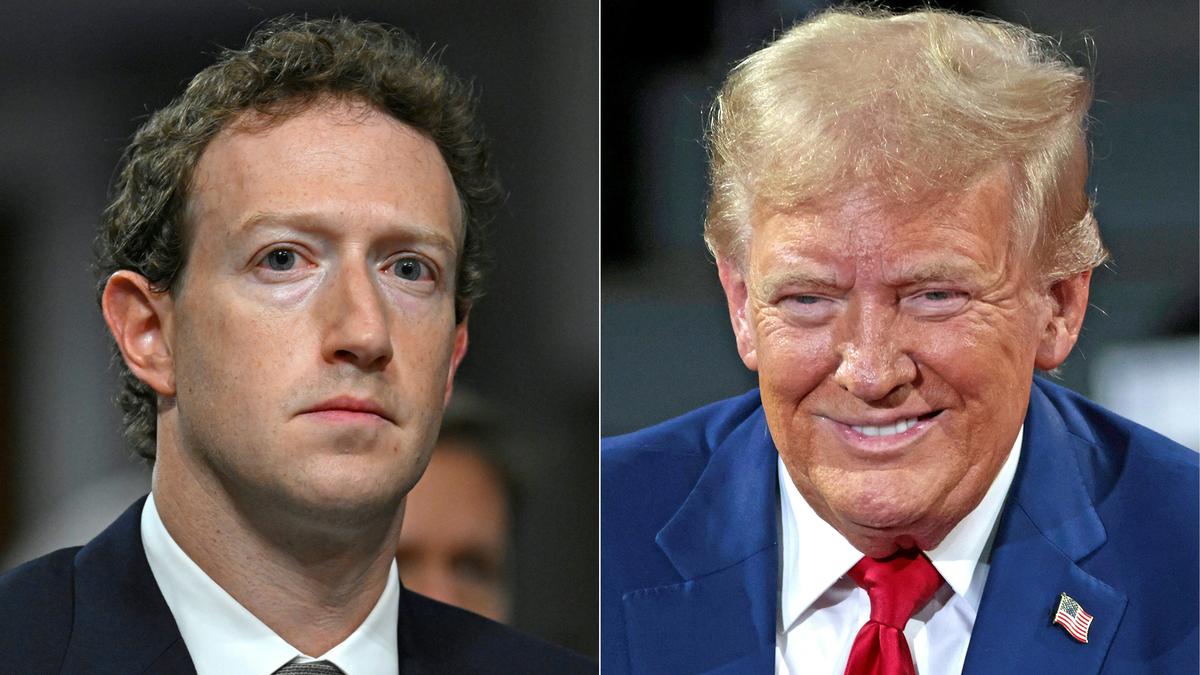
The story so far: Nearly five years after the U.S. Federal Trade Commission (FTC) sued Facebook over its alleged monopoly status and for preying on smaller firms it considered threats, CEO Mark Zuckerberg took the stand on Monday to defend the company’s acquisitions of WhatsApp and Instagram, which were bought more than a decade ago.
“Kingdom,” “empire,” “titan,” “giant”—these are just some of the words commonly used to describe Meta, which owns Facebook, Instagram, Threads, and WhatsApp, apart from acquiring over 90 other businesses.
In this antitrust case, the FTC is seeking to prove its claim that Meta for years carried out anti-competitive conduct to illegally maintain a monopoly in the personal social networking (PSN) market.
“The complaint alleges that Facebook has engaged in a systematic strategy—including its 2012 acquisition of up-and-coming rival Instagram, its 2014 acquisition of the mobile messaging app WhatsApp, and the imposition of anticompetitive conditions on software developers—to eliminate threats to its monopoly,” said the FTC.
If the FTC wins, Meta could be forced to divest two major apps that are firmly embedded into its social media ecosystem.
It is key to note that the FTC’s complaint against Meta was initiated during U.S. President Donald Trump’s first term and actively pursued during former President Joe Biden’s term under the leadership of FTC Chair Lina Khan before returning to the current FTC Chair Andrew Ferguson. This case has united American lawmakers and bureaucrats who are otherwise divided along party lines.
Meta (earlier Facebook) bought Instagram in 2012 for $1 billion and bought WhatsApp in 2014 for $19 billion. In order to successfully prove that Meta has an illegal monopoly in the personal social networking (PSN) market, the FTC has to first define the market and then defend its allegations. However, Meta argues that the FTC’s definition of this market is too small and leaves out other major apps that compete with Instagram and WhatsApp.


Power Minister highlights energy security and renewable transition during Bharat Electricity Summit 2026 amid global tensions.

The rupee hits a record low of 93.08 against the dollar, pressured by rising oil prices and FII outflows.

OpenAI said on Thursday it will buy Python toolmaker Astral, as the ChatGPT maker seeks to strengthen its portfolio against rival Anthropic to gain more share in the artificial intelligence coding tools market.

Crude oil prices drop over 2% as Netanyahu reassures investors amid ongoing Iran conflict and rising energy market concerns.

PPAC designated as nodal agency to enhance data collection on domestic fuel and energy stocks for improved mandate enforcement.

Indian markets plunged over 3% amid soaring crude prices, rupee depreciation, and escalating West Asia geopolitical tensions in March 2026.

Government launches ₹497 crore RELIEF scheme providing credit insurance to exporters affected by the West Asia crisis, focusing on MSMEs.

Crude oil futures rise amid Middle East attacks, pushing Brent above $116 on fears of tightening global supply.

West Asia conflict delays India’s FTA talks with GCC and Israel, while UK and EU agreements proceed as planned in 2024.

Russian Urals oil vessels will reach India on March 21 amid stable fuel prices and diversified LPG imports.

Warner Bros. dominated the Academy Awards, but Paramount’s looming acquisition of the studio signals the biggest restructuring of the industry in decades and a battle over the future of Hollywood itself

HDFC Bank board calls Atanu Chakraborty’s resignation baffling, affirms robust corporate governance and strong market confidence.

RNFI and Jio Payments Bank launch cardless UPI QR cash withdrawals for instant access across urban, semi-urban, and rural India.