Primary Country (Mandatory)

Other Country (Optional)

Set News Language for United States

Primary Language (Mandatory)
Other Language[s] (Optional)
No other language available

Set News Language for World

Primary Language (Mandatory)
Other Language(s) (Optional)

Set News Source for United States

Primary Source (Mandatory)
Other Source[s] (Optional)

Set News Source for World

Primary Source (Mandatory)
Other Source(s) (Optional)
  • Countries
    • India
    • United States
    • Qatar
    • Germany
    • China
    • Canada
    • Singapore
    • World
  • Categories
    • National
    • International
    • Business
    • Entertainment
    • Sports
    • Special
    • All Categories
  • Available Languages for United States
    • English
  • All Languages
    • English
    • Hindi
    • Arabic
    • German
    • Chinese
    • French
  • Sources
    • India
      • AajTak
      • NDTV India
      • The Hindu
      • India Today
      • Zee News
      • NDTV
      • BBC
      • The Wire
      • News18
      • News 24
      • The Quint
      • ABP News
      • Zee News
      • News 24
    • United States
      • CNN
      • Fox News
      • Al Jazeera
      • CBSN
      • NY Post
      • Voice of America
      • The New York Times
      • HuffPost
      • ABC News
      • Newsy
      • USA TODAY
      • NBC News
      • CNBC
    • Qatar
      • Al Jazeera
      • Al Arab
      • The Peninsula
      • Gulf Times
      • Al Sharq
      • Qatar Tribune
      • Al Raya
      • Lusail
    • Germany
      • DW
      • ZDF
      • ProSieben
      • RTL
      • n-tv
      • Die Welt
      • Süddeutsche Zeitung
      • Frankfurter Rundschau
    • China
      • China Daily
      • BBC
      • The New York Times
      • Voice of America
      • Beijing Daily
      • The Epoch Times
      • Ta Kung Pao
      • Xinmin Evening News
    • Canada
      • CBC
      • Radio-Canada
      • CTV
      • TVA Nouvelles
      • Le Journal de Montréal
      • Global News
      • BNN Bloomberg
      • Métro
    • Singapore
      • CNA
      • The Straits Times
      • Lianhe Zaobao
What explains SpaceX, Blue Origin stepping up their moon plans? | Explained
Premium

What explains SpaceX, Blue Origin stepping up their moon plans? | Explained Premium

The Hindu
Tuesday, February 10, 2026 05:36:03 AM UTC

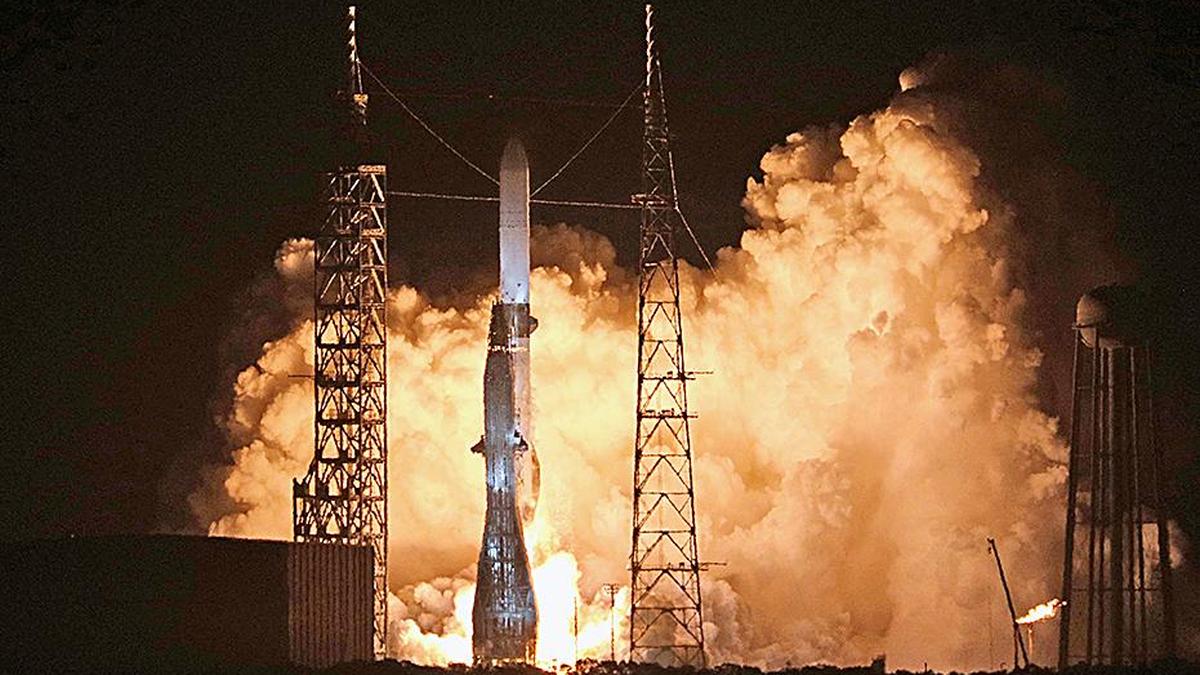
SpaceX and Blue Origin are shifting focus to moon missions, influenced by NASA's lunar priorities and geopolitical competition.

Two of the world’s most visible private space companies are shifting their attention and resources to moon missions even as both continue to speak about longer term ambitions to Mars and beyond.

For many years, the public identity of SpaceX has been fused with settling humans on Mars. Its founder and CEO Elon Musk has repeatedly argued that a self-sustaining settlement on Mars would reduce the risk that a catastrophe on the earth ends human civilisation. He and SpaceX have also presented the Starship programme as the transport system that could render large-scale interplanetary travel feasible.

Blue Origin, founded by billionaire Jeff Bezos, has projected a different long-term vision: of building industrial capacity in space so that heavy industry can move off the earth. In recent years it has focused on developing its New Glenn heavy-lift rocket and a lunar lander for NASA’s Artemis programme. It has also been flying paying customers on short suborbital trips aboard its New Shepard rocket.

SpaceX has also been central to NASA’s Artemis plans to the moon for some time; now, however, the company is describing the moon as its immediate next priority in its sequence of major goals. The company has reportedly told investors that it is targeting an uncrewed lunar landing by March 2027 and that Musk has decided to focus on building a “self-growing city” on the moon. He also said on X.com that this can be achieved in under 10 years even while claiming that plans for a Mars city could still follow in roughly five to seven years.

For those unaware, SpaceX has already shifted focus to building a self-growing city on the Moon, as we can potentially achieve that in less than 10 years, whereas Mars would take 20+ years. The mission of SpaceX remains the same: extend consciousness and life as we know it to…

While the moon and Mars are both interplanetary bodies, missions to the former are easier for many reasons. The moon is under a week away by rocketflight, the distance is low enough for communications to be near-real-time, and the orbits of the earth and the moon are such that there are roughly three opportunities to launch to the moon every month.

Read full story on The Hindu
Share this story on:-
More Related News
NASA announces overhaul of Artemis lunar programme amid technical delays

NASA revamps its Artemis lunar program to address delays and ensure a Moon landing by 2028.

West Asia flight disruptions: Stranded Indians in Dubai, Doha and Jordan share stories of uncertainty and support

West Asia flight disruptions: Stranded Indians in Dubai, Doha and Jordan share stories of uncertainty and support

IISc and Pratiksha Trust launch moonshot project on brain co-processors

IISc and Pratiksha Trust launch a groundbreaking project to develop AI-powered brain co-processors for stroke rehabilitation.

Why India needs to radically think its doctoral education programmes Premium

India must revamp its PhD programs to prioritize practical innovation and societal relevance over traditional publication metrics.

Why India needs to radically think its doctoral education programmes Premium

India must revamp its PhD programs to prioritize practical innovation and societal relevance over traditional publication metrics.

In pictures: Lunar eclipse enthrals skywatchers across India and the globe

Witness the blood moon during the lunar eclipse day in India and other countries, through pictures here.

What is a megamaser? Premium

Discover the fascinating world of hydroxyl megamasers, powerful cosmic lasers revealing secrets of distant galaxies and the universe's evolution.

How the next major breakthrough in cancer could come from India Premium

Discover how India's unique resources could lead to groundbreaking advancements in global cancer care and research.

Science Snapshots: March 1, 2026 Premium

Discover groundbreaking research on Mars lightning, innovative smart materials, and a universal ageing marker in just one minute.

How do astronauts return from space and survive re-entry?

A launch vehicle’s ascent battles gravity to gain orbital velocity, while re-entry is a controlled struggle against the atmosphere to systematically shed that immense kinetic energy through aerobraking, thermal protection and precise guidance within the re-entry corridor. Operating as a semi-ballistic body, the crew module performs a deorbit burn, manages communication blackout, and deploys a three-stage parachute system to ensure a safe splashdown.

Nissan Gravite: A value-driven seven-seater

The Nissan Gravite is a budget-friendly seven-seater MPV designed for practical family use in India. Sharing its platform with the Renault Triber, it offers flexible 2-to-7 seating, a removable third row, generous boot space, and a fuel-efficient 1.0-litre petrol engine delivering around 19 km/l. With features such as a floating touchscreen, wireless connectivity, digital instrument cluster, and six airbags as standard, the Gravite blends affordability, safety and everyday usability in a compact footprint tailored to urban and small-family needs.

Meet the teenage cyclists from Tamil Nadu racing at the Track Asia Cup

Discover the dedication of Tamil Nadu's teenage cyclists competing at the Track Asia Cup, balancing sport and academics.

Why are scientists studying gypsum in the Salar de Pajonales? Premium

Explore how Salar de Pajonales in Chile serves as a vital Mars analogue for studying microbial life and ancient fossils.

© 2008 - 2026 Webjosh  |  News Archive  |  Privacy Policy  |  Contact Us