What does U.S. want from Canada to renew CUSMA? Trump’s trade rep has list
Global News
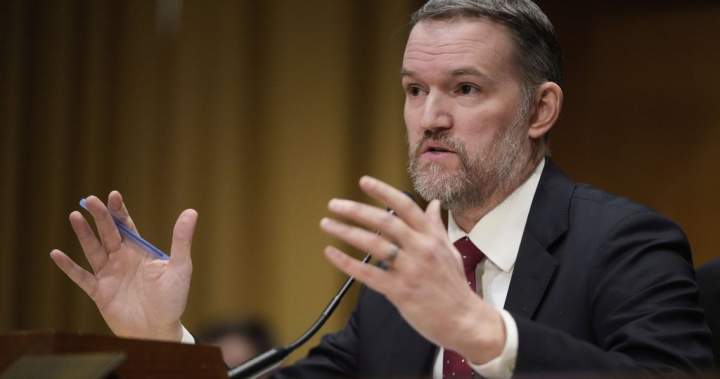
U.S. Trade Representative Jamieson Greer told members of Congress this week that next year's joint review 'will depend on the successful resolution' of several issues.
The U.S. wants Canada to expand dairy market access for American products and lift provincial bans on U.S. alcohol as part of the upcoming review of the Canada-U.S.-Mexico Agreement (CUSMA), Washington’s top trade envoy says.
U.S. Trade Representative Jamieson Greer told members of Congress this week the joint review “will depend on the successful resolution” of those and other issues, according to a copy of his opening statement shared online after the closed-door meetings.
The statement also lists “the impact of Canada’s Online Streaming Act and Online News Act for U.S. digital service providers,” “discriminatory procurement measures in Ontario, Quebec, and British Columbia,” and “complicated customs registration for Canadian recipients of U.S. exports” as other issues to address. “Unfair treatment” of Montana electricity providers by Alberta was another item listed.
For both Canada and Mexico, Greer listed efforts to strengthen rules of origin for non-automotive industrial goods and “mechanisms to penalize offshoring of U.S. production” to the other two North American countries.
The statement says the list of issues came from public consultations the U.S. has engaged in this fall to prepare for the mandatory review set for next July.
CUSMA “has been successful to a certain degree” and “provided some certainty for North American trade,” Greer told the U.S. House ways and means committee and the U.S. Senate finance committee on Tuesday and Wednesday, according to the opening statement.
“But at the same time, it is clear that we have not achieved all of our goals with respect to strengthening U.S. manufacturing capacity and creating good jobs, and nearly all stakeholders advocate improvements.”
Greer goes on to lay out “shortcomings” in the trade pact, some of which are specific to Mexico and Canada.


Dashcam video shows the wild scene as a vehicle crashed into two parked cars at a high speed on Shaunslieve Drive in Bedford.

City of Wetaskiwin officials have issued a statement on the decision to ban Mayor Joe Branco from city hall — but it does little to clarify the ongoing situation.

An Abbotsford woman who was sexually abused as a child is speaking out after suffering years of abuse at the hands of her stepfather, starting at the age of just 12 years old.

Technology Minister Nate Glubish says such images, known as deepfakes, can cause people serious harm and that changing the law should create a new layer of protection.

Renters in Quebec may soon have final say over whether they're allowed to keep pets in their homes following a legal ruling that no-pet clauses in leases violate Charter rights.

Alberta RCMP say they have located a Grey 2022 Ford F-150 involved in the fatal highway shooting of an Edmonton man earlier this month. The suspect remains at large.

Education Minister Paul Calandra, however, said he won't use the notwithstanding clause if he moves to eliminate trustees in Ontario.

U.S. President Donald Trump said on Sunday that he would order federal immigration agents to airports to assist TSA. Canadians landing the U.S. should be prepared.

Three overpasses in Saskatoon have been hit in the past three weeks, with charges announced against the driver in the first incident.

Auditor General Karen Hogan says there are critical weaknesses in the integrity controls for the International Student Program.

Return trips by Canadian residents from the U.S. fell 22 per cent in January compared with a year earlier, according to the latest data.

Three byelections are being held on April 13 and the results could have an impact on both the makeup of Parliament and how long it lasts.

Ontario's provincial members of parliament are heading back to Queen's Park Monday, as the legislature sits for the first time since December.