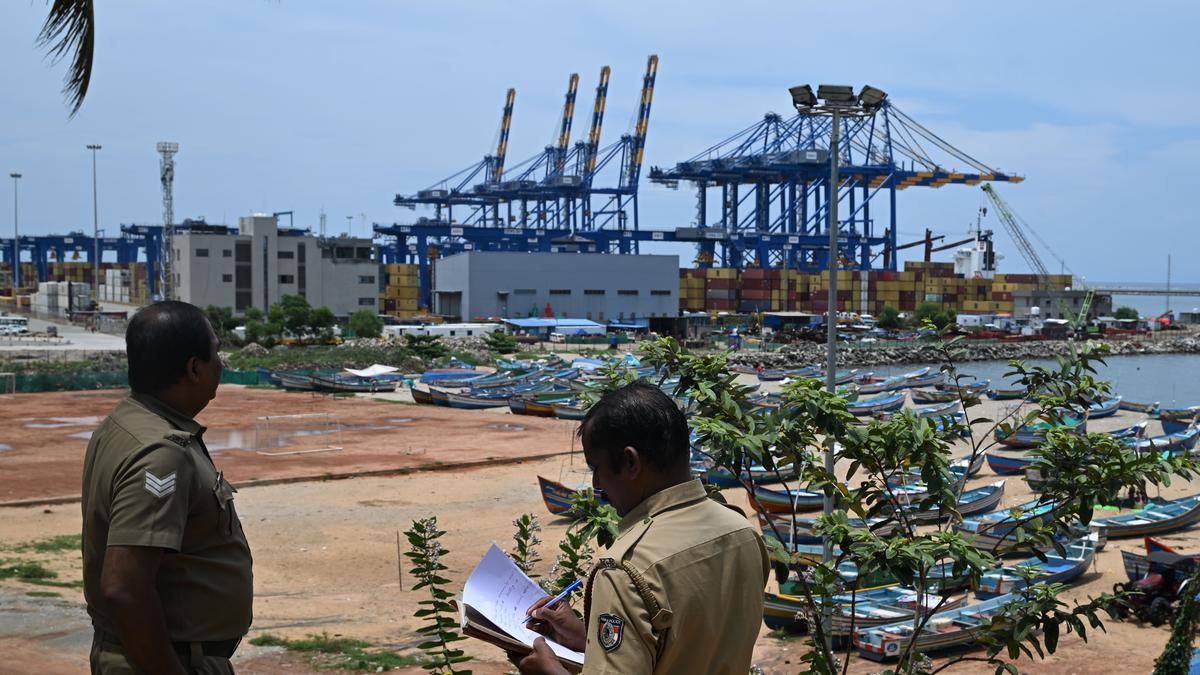
Vizhinjam seaport set to boost South Asia’s maritime trade
The Hindu
Vizhinjam International Seaport, a game-changer in South Asia's maritime trade, officially commissioned by PM Modi on May 2, 2025.
The Vizhinjam International Seaport, an all-weather port which is poised to be a pivotal hub for India’s maritime transshipment, will script a new history in the annals of Indian maritime trade on Friday (May 2, 2025) with Prime Minister Narendra Modi dedicating the ambitious port project to the country by 11 a.m. Leveraging cutting-edge technology, Vizhinjam Port is expected to be a game-changer in South Asia’s maritime trade.
Mr. Modi arrived at Thiruvananthapuram International Port on Thursday evening (May 1, 2025) to officially commission the project.
Also Read | Tight security in Thiruvananthapuram ahead of PM’s visit
The first semi-automated port in the country, Vizhinjam seaport positions itself as one of the most technologically sophisticated transshipment ports globally, reducing vessel turnaround times and enhancing India’s capacity to handle large container ships. Armed with an AI-driven control room and Vessel Traffic Management System (VTMS) developed by IIT-M and Maritime Technology Pvt Ltd., the first Indigenous vessel management system implemented at an Indian port, the port could track ships approaching the port using radar and sensors, providing real-time location and movement updates to nearby vessels and optimising port traffic flow and berthing assignments.
The port is also expected to reduce the dependence of the country on other international ports. Around 75% of the country’s transshipment cargo is being handled at international ports, resulting in a loss of up to $200-220 million of potential revenue each year, rendering the Indian industries vulnerable to an increase in costs, potential inefficiencies and congestion issues, and creating long-term risks for India’s trade competitiveness.
The all-weather port has weathered many challenges in its way. Among the challenges, the stiff protest raised against the construction of the breakwater by fishermen backed by a prominent church outfit was the main issue the Kerala government had to deal with, although the location of the port offers several advantages, such as natural depth and lack of littoral movement, making it an ideal location for an international-scale seaport.
However, the rubble-mounded breakwater constructed, surviving the challenges put up by a section, is an engineering marvel in the country. A 2,960-meter-long breakwater has been constructed in water at a depth of 18 to 20 meters with an overall height of 28 meters, which is equivalent to a 9-storey building, making it the deepest breakwater ever constructed in the country.


Perundurai's industrial growth faces challenges of pollution, water scarcity, and healthcare, impacting residents ahead of the 2026 elections.

The Travancore Devaswom Board asserts that courts should respect community beliefs in its Supreme Court submission on Sabarimala's entry issue.

Karnataka cancels Deendayal Upadhyay event at KSOU due to protocol violations, citing inconsistency with university objectives.

Illegal pickle unit busted in Hyderabad, one arrested; unhygienic stock worth ₹3 lakh seized

Karnataka has entered a state of demographic transition where a large working-age population will no longer be enough to drive economic growth, and future gains will depend on how productively people are employed, the ‘State of Working India 2026’ report said.

Key demands in Sulur Assembly constituency include reviving the powerloom sector, addressing farmers' needs, and protecting River Noyyal.

Kodihalli urges Karnataka CM to allocate ₹10,000 crore revolving fund for seamless procurement of farm products under MSP scheme.

Kerala's political parties continue to marginalize women candidates, highlighting a troubling disconnect between gender demographics and representation.

The High Court of Karnataka on Tuesday ordered the issue of a notice to the State government on a PIL petition, which had complained about disturbances caused to people residing in the localities around the National Public School situated in Rajajinagar 5th block due to use of loudspeakers with high volume in the school and parking of school buses in residential areas.

China is extensively mapping ocean floors to enhance submarine warfare capabilities against the U.S. and allies across key oceans.

AIADMK's 2026 manifesto promises free rations, women's benefits, education reforms, and economic growth initiatives for Tamil Nadu.

The vehicle towing drive will soon resume in the city to ease traffic congestion. The Bengaluru Traffic Police (BTP), in coordination with the Greater Bengaluru Authority (GBA), is set to relaunch the vehicle towing drive across the city shortly to tackle traffic congestion and illegal parking.

Panic buying, not shortage, is leading to long queues at Hyderabad petrol pumps.