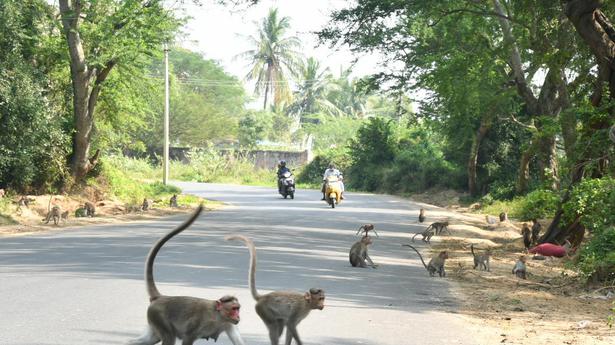
Vellore Collector asks Forest Department if monkeys can be trained to pluck coconuts for farmers
The Hindu
Officials say written permission from Chief Wildlife Warden is required for the task
When Vellore Collector P. Kumaravel Pandian asked the Forest Department official about the possibility of training wild monkeys to pluck coconuts in the district’s groves, those in attendance at the farmers’ grievances meeting held at the Collectorate in Vellore burst into laughter.
But the Collector, it turned out, was serious in his recommendation in using the monkeys for the laborious task. The issue came up for discussion when farmers from Gudiyatham demanded compensation from the district administration after troops of monkeys damaged the coconut groves in the border town. “I am serious about the idea. The Forest Department should explore the possibility of training monkeys for the job,” the Collector said.
Forest Range Officers for Amrithi, Vellore town and Odugathur were among those present at the meeting. Officials said currently, wild monkeys were classified under Schedule 4 of the Indian Wildlife Protection Act, 1972. Any controlled experimentation of wild species in the region should be done only after a written permission is obtained from the Chief Wildlife Warden.
At present, compensation for crop damage, livestock, properties and human lives was allowed for all wild species, including spotted deer, sloth bears, wild boars, elephants, leopards, wild dogs and peacocks, commonly found in Vellore region, covering Vellore, Tirupattur, Ranipet and Tiruvannamalai districts. However, officials of the Forest Departments said wild monkeys were not covered under this list. As a result, farmers had to bear the loss of the crops that get damaged by the monkeys.
The monkey population has doubled in these areas in recent years, with the animals migrating to the outskirts of key towns, such as Vellore, Arcot, Katpadi and Gudiyatham, due to a shortage of food in deep forest areas.
As a result, forest officials said roadside tamarind trees and coconut groves in farmlands had become hunting grounds for these animals. “Wild species, including monkeys, cannot be involved in such an exercise. Other feasible alternatives should be explored to prevent them (monkeys) from damaging coconut groves,” Prince Kumar, District Forest Officer (DFO), Vellore division, told The Hindu.


Vaccination policies must prioritize saving human lives over individual choice amid rising vaccine skepticism, asserts scientist Dr. Virander Singh Chauhan.

Seven Indian fishermen from Rameswaram arrested by Sri Lankan Navy, sparking protests and calls for government intervention.

Kerala cyber police file a case against X for an AI video allegedly defaming PM Modi and the Election Commission.

iKure and Izawa Co. partner to combat avoidable blindness by integrating innovative eye care technology into rural healthcare networks.

Thousand Lights MLA from the DMK N. Ezhilan, in an interview to The Hindu, observes that any popular personality entering politics will attract the limelight. But only a structured party machinery combined with popularity can ensure success. In this interview, he speaks about his tenure as first-time MLA from Thousand Lights Assembly constituency in Chennai, Vijay’s political entry shaping the 2026 elections, redressal of key grievances and more.

Abhishek Banerjee challenges BJP's Suvendu Adhikari in Nandigram, pledging community health initiatives if Trinamool Congress wins.

Rising LPG shortages in Karnataka boost firewood demand, reviving an informal market as households and hotels seek alternatives.

Against the backdrop of intense poll activity, a 400-metre stretch of an arterial road in the outskirts of Chennai (technically in Madurapakkam panchayat under Tambaram assembly constituency) presents a salute to the idea of res publica, which underpins India’s system of governance, where citizens have a say, at least before a government is securely ensconced in the seat of power. A Republic Day initiative shines bright every night

Fadnavis claims zero FIR in Ajit Pawar crash is a defamation attempt by Karnataka against Maharashtra's investigation efforts.

Set to unfold as a one-day pop-up on April 5, the Easter Sadya brings together both vegetarian and non-vegetarian menus, offering a peek into the food traditions of the Syrian Christian (Nasrani) community. While the traditional Sadya is often associated with dishes such as sambar, avial, and rice, this version expands to include community-specific festive dishes.

BJP nominates mother of R.G. Kar victim Abhaya to contest from Panihati in West Bengal Assembly elections.

Veteran Malayalam actor-director E.A. Rajendran passes away at 71, leaving behind a rich legacy in the film industry.

Dakshina Kannada Zilla Panchayat has rolled out digital mode of water bill generation and collection in 23 gram panchayats on a pilot basis for the first time in Karnataka. This is set to be extended to the remaining 200 panchayats shortly, according to the Zilla Panchayat Chief Executive Officer Narwade Vinayak Karbhari.