VB-G RAM G: when a policy shift meets rural realities Premium
The Hindu
Explore the impact of VB-G RAM G on rural employment in Andhra Pradesh, highlighting concerns over job security and implementation disparities.
Bandarugudem village in Bapulapadu mandal of Krishna district sits at a distance from the restless churn of urban Andhra Pradesh. Its narrow mud roads are worn dark by years of use, flanked by shallow drains carrying sewage and spewing out a stench that hangs heavily in the humid air.
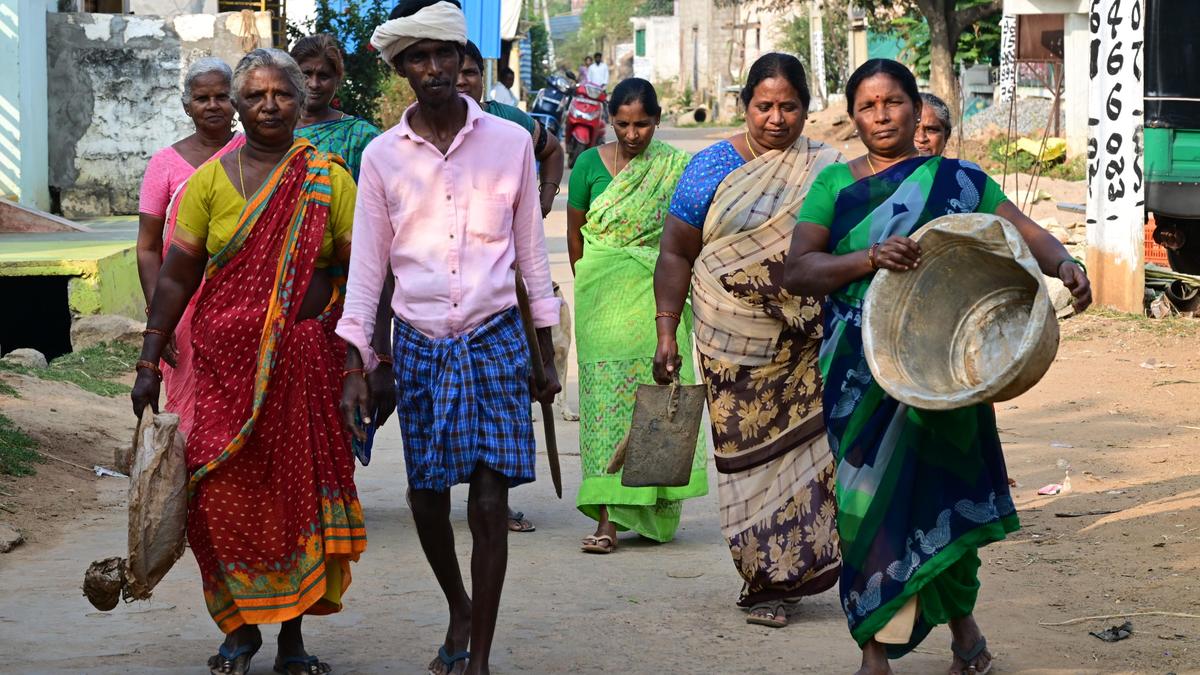
Elderly and middle-aged women in crumpled cotton saris walk along the lanes separating small, low-roofed houses in uneven rows, their talk punctuating the hum of rural living. Except for the occasional growl of two-wheelers, there is little to signal that the world beyond the village is changing rapidly.
It is in these quiet lanes that the debate over the future of rural employment has begun to echo. Sixty-year-old Barre Jayamma stands at the end of a street speaking animatedly with a group of women. “What good is the new scheme when we are unable to utilise the full benefits of the existing one?” she asks, referring to the Union government’s decision to replace the Mahatma Gandhi National Rural Employment Guarantee Act (MGNREGA) with the Viksit Bharat–Guarantee for Rozgar and Ajeevika Mission (Gramin) or VB-G RAM G.
Jayamma and most women around her are unfamiliar with the finer points of the new Act. Their understanding comes from what local officials have told them, that the guaranteed number of workdays has been increased from 100 to 125 and that payment delays are being addressed. For them, the question is not about legislative nuance but about work. MGNREGA’s mandate was simple and legally enforceable - at least 100 days of wage employment in a financial year to every rural household whose adult members were willing to do unskilled manual work. But in practice, the experience varied widely.
“My cousins in villages like Chavatipalli in Nellore district, Adavinekkalam in Eluru district and even in neighbouring Ampapuram get 100 days of paid employment every year. I have to fight with local officials to find work even for two weeks.”Medabalimi DhanalakshmiJob card holder at Bandarugudem village
Fifty-year-old Medabalimi Dhanalakshmi voices her frustration. “My cousins in villages like Chavatipalli in Nellore district, Adavinekkalam in Eluru district and even in neighbouring Ampapuram get 100 days of paid employment every year. I have to fight with local officials to find work even for two weeks,” she says. Her neighbour, Chintalapudi Aluvelamma (58), got 28 days of work last financial year. “I am healthy and willing to work, but there is no work around this village,” she laments.


PM Modi and President Murmu extend Eid-ul-Fitr greetings, promoting unity, harmony, and compassion for a progressive nation.

Security forces in Manipur seized 29 firearms and 50 IEDs during operations amid ongoing ethnic violence.

A data jam on March 28 by OpenCity will have participants studying how the Assembly constituencies in and around Chennai are faring on a set of parameters

Matheesha Pathirana will miss the start of IPL 2026, while Harshit Rana's participation remains uncertain for KKR.

Shashi Tharoor advocates for peace in the West Asia conflict, emphasizing the urgent need for de-escalation and international cooperation.

Assembly polls 2026: Follow updates from The Hindu on the upcoming elections in five States, on March 21, 2026

Maharashtra women's panel chief resigns amid controversy over ties to rape-accused godman, facing political pressure and public backlash.

India's Iran policy could be shaped by the evolving dynamics of the U.S.–Israel war

Will G. Sudhakaran's independent run disrupt the Left's stronghold in Ambalappuzha and reshape Kerala's political landscape?

The Hindu Morning Digest gives a select list of stories to start the day. Read the top news today on March 21, 2026

Manjeswaram gears up for a tightly contested Kerala Assembly election in 2026, featuring key candidates from UDF, NDA, and LDF.

Thirty-three detained Bangladeshi nationals from Tamil Nadu are being deported to Bangladesh via West Bengal with police escort.

Tree felling for a flyover and underpass on the Manikonda-Hitech City stretch sparks outrage as Hyderabad’s road expansion drives another green loss.