Unity Small Finance Bank enters T.N. with 8 branches
The Hindu
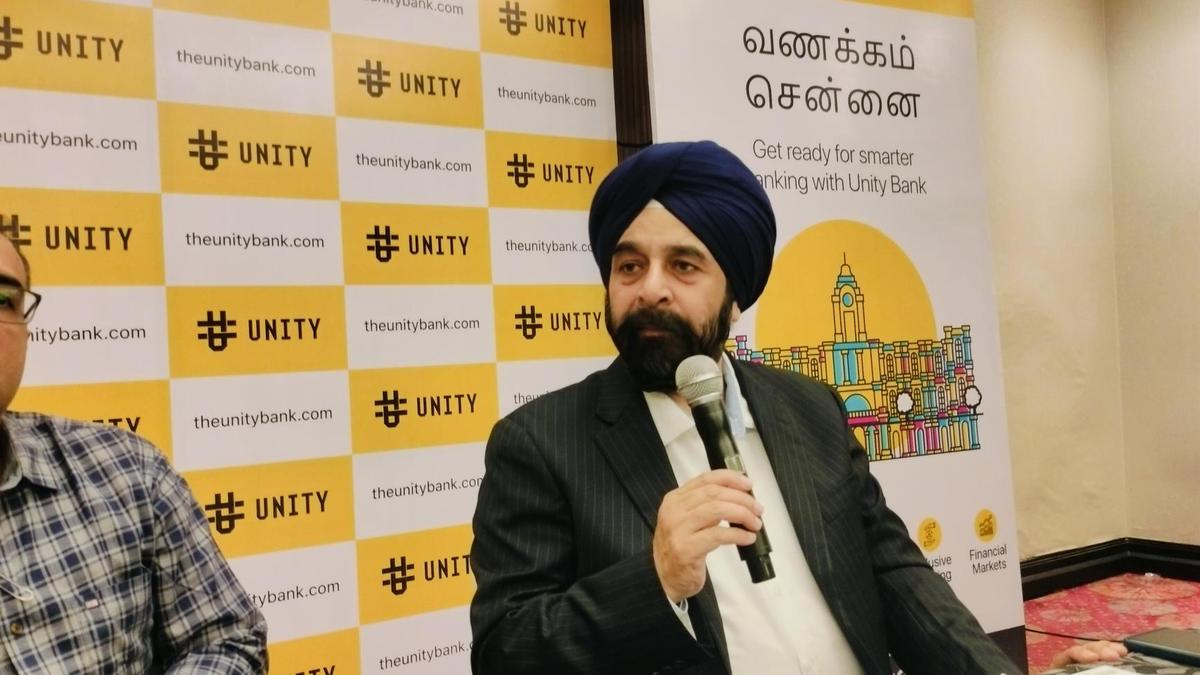
Unity Small Finance Bank Managing Director and CEO Inderjit Camotra says that their five year goal is to serve 10 million customers and build a loan book exceeding ₹50,000 crore.
Unity Small Finance Bank on Monday announced its entry into Tamil Nadu with the inauguration of six branches in Chennai and two in Coimbatore. The lender said it was also planning to enter tier-II cities such as Tiruchi, Madurai and Salem.
“Currently, we are present in 19 States with 187 branches. Our goal is to have 223 branches by March 2025. We will be entering more States such as Uttar Pradesh, Rajasthan, Haryana and Andhra Pradesh,” MD & CEO Inderjit Camotra said in a press meet.
Following its merger with the Punjab and Maharashtra Cooperative Bank (PMC), the New Delhi-based lender said it is gearing up to enter more States.
The merger with PMC was smooth, Mr. Camotra said adding that this brought along “1,100 efficient managers and 110 branches”. After the merger, the net non-performing assets of the bank stood at 1%.
Mr. Camotra said Unity Small Finance Bank had 2.1 million customers and was adding 35,000 customers per month. Its five-year rolling goal was to serve 10 million customers and build a loan book exceeding ₹50,000 crore.
In Tamil Nadu, the bank had built a loan book of ₹500 crore and in South India it stood at ₹2,400 crore.
Unity Bank is also on the verge of introducing credit cards to attract different types of customers by collaborating with BharatPe, Rupay and an international firm, he said.


The Indian rupee plummets 82 paise to a record low of 93.71 against the dollar due to rising crude prices and geopolitical tensions.

Power Minister highlights energy security and renewable transition during Bharat Electricity Summit 2026 amid global tensions.

The rupee hits a record low of 93.08 against the dollar, pressured by rising oil prices and FII outflows.

OpenAI said on Thursday it will buy Python toolmaker Astral, as the ChatGPT maker seeks to strengthen its portfolio against rival Anthropic to gain more share in the artificial intelligence coding tools market.

Crude oil prices drop over 2% as Netanyahu reassures investors amid ongoing Iran conflict and rising energy market concerns.

PPAC designated as nodal agency to enhance data collection on domestic fuel and energy stocks for improved mandate enforcement.

Indian markets plunged over 3% amid soaring crude prices, rupee depreciation, and escalating West Asia geopolitical tensions in March 2026.

Government launches ₹497 crore RELIEF scheme providing credit insurance to exporters affected by the West Asia crisis, focusing on MSMEs.

Crude oil futures rise amid Middle East attacks, pushing Brent above $116 on fears of tightening global supply.

West Asia conflict delays India’s FTA talks with GCC and Israel, while UK and EU agreements proceed as planned in 2024.

Russian Urals oil vessels will reach India on March 21 amid stable fuel prices and diversified LPG imports.

Warner Bros. dominated the Academy Awards, but Paramount’s looming acquisition of the studio signals the biggest restructuring of the industry in decades and a battle over the future of Hollywood itself

HDFC Bank board calls Atanu Chakraborty’s resignation baffling, affirms robust corporate governance and strong market confidence.