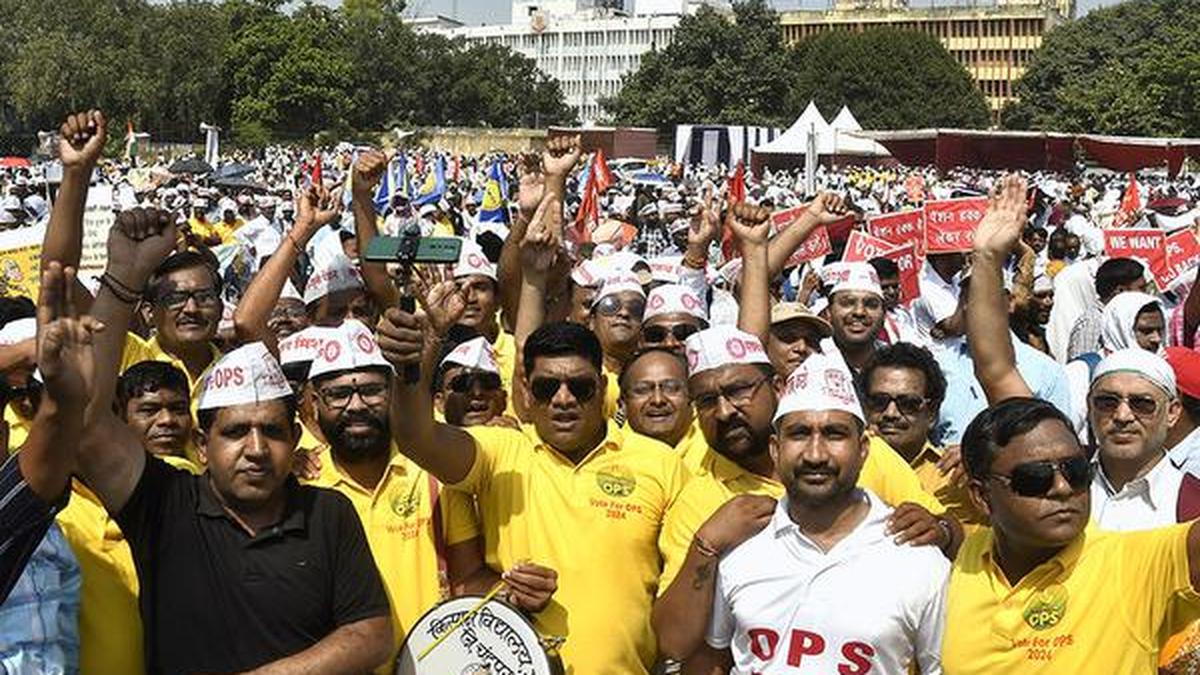
Unified Pension Scheme | How does it differ from the Old and New Pension Scheme? Premium
The Hindu
New Unified Pension Scheme (UPS) unveiled by Centre, evoking mixed responses from trade unions and political parties.
The story so far: Fulfilling a long-standing demand of government unions, the Centre on Saturday (August 24, 2024), unveiled a new ‘Unified Pension Scheme’ (UPS) assuring government employees half their last drawn salary as a lifelong monthly benefit.
The UPS, which has been approved by the Union Cabinet, has several other features benefiting pensioners, such as a periodic dearness relief hike in line with inflation and minimum pension of ₹10,000 a month for pensioners with at least 10 years of government service, to name a few.
The announcement has evoked mixed responses from trade unions across the political spectrum. The Bharatiya Mazdoor Sangh (BMS), which is affiliated to the Rashtriya Swayamsevak Singh (RSS) has welcomed the move but has sought more clarity on certain features of the UPS. However, trade unions like the Hindu Mazdoor Sangh, CITU and AITUC, which are affiliated to the Opposition, claimed that the UPS was meant to hoodwink employees.
Editorial | Middle path: On the Unified Pension Scheme
Most parties including the Congress have noted that the implementation of the UPS would be akin to reverting back to the Old Pension Scheme (OPS), implemented originally during the colonial reign. The move is also a surprising rollback by the NDA government as it was the original NDA – the Atal Bihari Vajpayee government – which had scrapped the OPS to establish the new pension scheme (NPS).
Here’s a comparative look at all three schemes.
Under the Pensions Act, 1871, the British established the system of offering pensions to government employees, empowering the Central and State governments to enact rules for disbursal of money. Based on a ‘Defined Benefit’ concept, this pension scheme assured the retiree of 50% of the last drawn basic salary as his pension. The scheme also introduced a ‘Dearness Allowance’ (DA), which was calculated as a percentage of the pensioner’s salary to cushion the effect of rising cost of living and was hiked by the government whenever necessary.


Meta Chief Executive Mark Zuckerberg is building a CEO agent to help him do his job, the Wall Street Journal reported

Insurance penetration and density are often misunderstood and do not reveal how many families are insured or whether they would be financially secure if the main earning member were to die. The real issue is not reach but adequacy, as households may have life insurance but not enough cover to replace lost income, leaving them financially vulnerable.

Five top firms lose ₹1 lakh crore in market value, with HDFC Bank experiencing the largest decline of ₹56,124.48 crore.

L&T confirms 95% of its West Asia project sites are safe, while addressing logistics challenges amid ongoing regional conflicts.

Mines Ministry to auction 19 critical mineral blocks on March 23, expanding strategic resources for clean energy and technology sectors.

Mines Ministry to auction 19 critical mineral blocks on March 23, expanding strategic resources for clean energy and technology sectors.

Five top firms lose ₹1 lakh crore in market value, with HDFC Bank experiencing the largest decline of ₹56,124.48 crore.

HDFC Bank terminates three senior officials over client onboarding issues at its DIFC branch amid ethical concerns following chairman's resignation.

Air India CEO warns of potential flight cuts and reduced travel demand due to rising fuel costs amid ongoing Gulf conflict.

Options are widely used by retail traders to speculate on the value of the stock for immediate gains and such behaviour in large scale can distort the market

India achieves 1 billion tonne coal production for the second consecutive year, ensuring stable energy supply and economic growth.

Generic drugmakers in India launch affordable Semaglutide versions, targeting a $1 billion diabetes and weight loss market.

Indian and Asian refiners eye Iranian oil purchases as U.S. waives sanctions amid energy crisis linked to the Iran-Israel war.