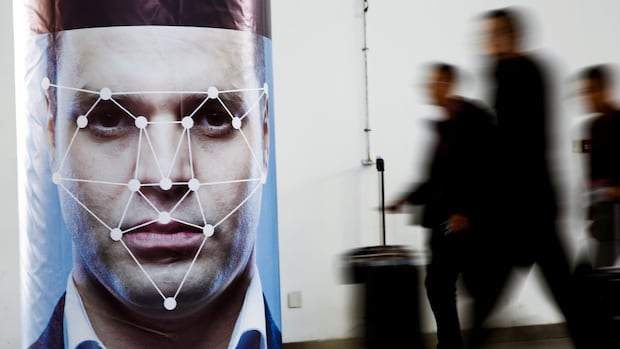
U.S. to photograph Canadian travellers when they enter and exit at all land borders, airports
CBC
Warren Shepell had an unsettling experience this month when boarding his flight from Cleveland heading home to Toronto.
Just before getting on the plane, he says two uniformed officers approached him on the boarding ramp (Jetway), and one took his photo.
“I was aghast. I felt ambushed,” said Shepell, a noted Canadian psychologist.
He says the men never explained who they were or why he was photographed.
“They didn't tell me anything, and I just feel violated.”
Being photographed when in transit is something that Canadians who visit the United States will need to get used to: the country is advancing a plan to photograph Canadian travellers when they enter and exit the country by all modes of transport.
For close to a decade, U.S. Customs and Border Protection (CBP) has been using facial biometrics to confirm the identities of international passengers arriving at U.S. airports. The process involves photographing travellers, and using biometric facial comparison technology to ensure their face matches the photo on their travel documents.
Now, CBP is expanding the program with the goal of collecting images of departing passengers at all international U.S. airports. The agency also plans to take photos of travellers when they enter and exit the country at all sea ports, and in vehicle lanes at land borders.
CBP told CBC News it expects to have facial biometric technology fully in place at land borders sometime next year. Full implementation at sea ports and airports is expected within the next three to five years.
Meanwhile, CBP is already laying the groundwork for its plan. The U.S. Department of Homeland Security (DHS) announced a new rule on Friday that makes it mandatory for non-U.S. citizens, including Canadians, to take part in its facial biometrics program. The regulation is set to take effect on Dec. 26 — even though full implementation of the program could take years.
According to the rule, photos taken of foreign travellers will remain on a DHS database for up to 75 years.
CBP spokesperson Jessica Turner said in an email that the expansion plan fulfills “a Congressional mandate to biometrically record the majority of foreign nationals who enter and exit the United States.”
Facial biometrics “is about ensuring accurate records, enhancing security, and enforcing immigration laws,” she said.
Tracking travellers’ exits also helps CBP pinpoint those who stayed in the country longer than allowed, according to the new DHS rule.


The Agricultural Producers Association of Saskatchewan (APAS) found some reasons to celebrate the 2026-27 provincial budget, but it takes issue with the amount designated for the province's Water Security Agency (WSA).

The family of an Edmonton woman who died in Honolulu last year is pushing for Hawaiian authorities to re-open the case.

It was around this time in 2020 that everything changed.

With its emergency shelter beds frequently running at 50 per cent over capacity and demand so great that it's forced to refer some women escaping domestic violence elsewhere, Gillian's Place in St. Catharines will soon be able to offer a broader range of services to more victims of gender-based violence.

The ceiling of the CAW Student Centre at the University of Windsor is decorated by flags of numerous nations — among them, Iran.

Turmoil in Iran, a major disruption in world oil markets, and stratospheric gasoline prices in Canada and beyond. What's racking motorists and governments in 2026 also faced them in 1979, sparked by the Iranian Revolution.

Five decades later, and Thunder Bay's Music World Academy remains a family-run business.

Dalton Dubois of Guelph, Ont., made history at the recent Paris Fashion Week when she became the first transgender model to walk the runway for Chanel Exclusive.

Work is scheduled to begin over the summer at the site of the former Clinton Creek asbestos mine, about 65 kilometres northwest of Dawson City, Yukon.

They may be bitter rivals in the House of Commons, but outside the chamber, recent events may have led to Conservative Leader Pierre Poilievre and Prime Minister Mark Carney forging a bond.

Local fans and industry insiders say the province’s move to ban the reselling of event tickets for more than their original value is a step in the right direction, but some say there are still larger issues that need to be addressed.

This First Person column is the experience of Mehdi M. Kashani, who lives in Toronto. For more information about CBC's First Person stories, please see the FAQ.

A very quiet queue has formed in Europe where some of Canada's long-standing, closest allies are seeking shelter under France's small but robust nuclear umbrella.