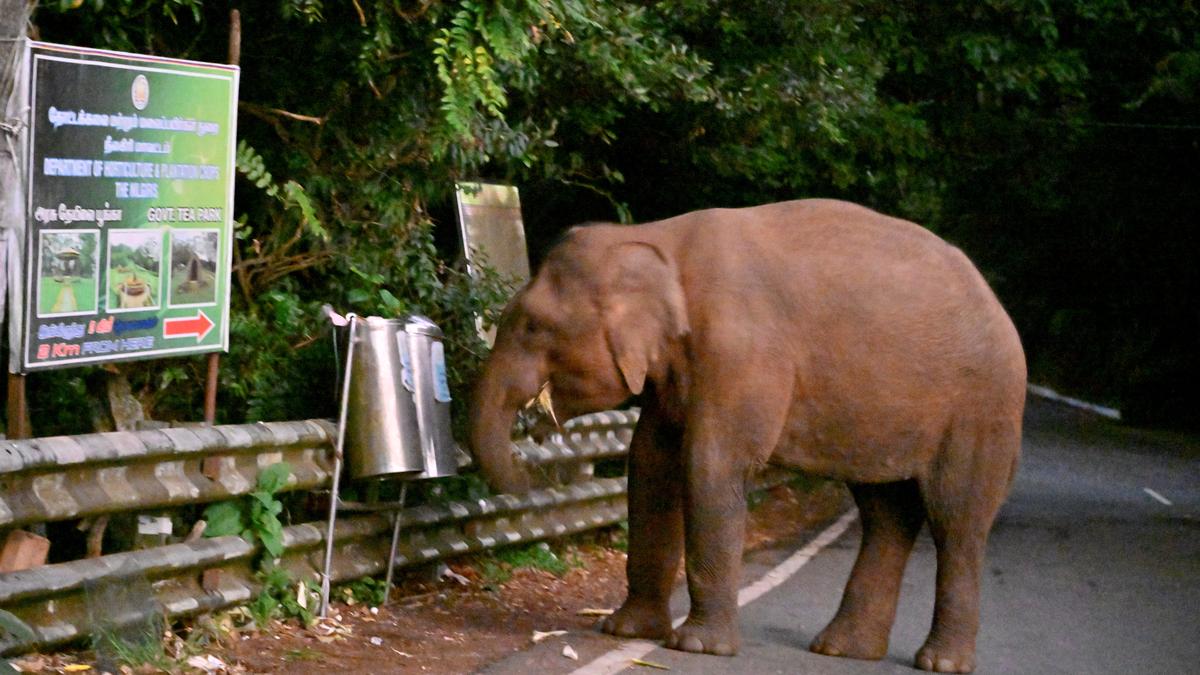
Two weeks on, elephant that reached Ooty continues to explore forests around town
The Hindu
Two weeks after a wild elephant made its way to the upper Nilgiris, the animal continues to evade the Forest Department, moving between forest patches in Thalaiyattimund, the Ketti Valley, and most recently, Lovedale.
Two weeks after a wild elephant made its way to the upper Nilgiris, the animal continues to evade the Forest Department, moving between forest patches in Thalaiyattimund, the Ketti Valley, and most recently, Lovedale.
The elephant, believed to be a male sub-adult, had found its way to Doddabetta where it was spotted on May 5. It was chased away from the area by the Forest Department and eventually descended into the Ketti Valley, where staffers expected it to return to its home range, along the Coonoor slopes. However, a few days ago, the animal once again ascended up to Udhagamandalam town, where it was spotted near Thalaiyattimund, and has since moved into a forest patch in Lovedale, said B. Srinivasan, Forest Range Officer, Kundah Range.
Mr. Srinivasan said that the Kundah and Udhagai South Ranges are keeping tabs on the animal and are trying to steer it towards Coonoor. “We do not want to be too forceful in our efforts as the animal has shown no signs of aggression towards people, and we do not want to alter its behaviour,” said Mr. Srinivasan. He added that while there we concerns about the animal not finding enough fodder, it had been seen eating on a number of occasions and that it was healthy.
When contacted, B. Ramakrishnan, a member of the IUCN’s Asian Elephant Specialist Group and head of the department of wildlife biology at the Government Arts College, said sub-adult male elephants separate from the herds into which they were born at around 10-15 years of age. They then strike out on their own to find their own home ranges and may associate with other male elephants, said Mr. Ramakrishnan.
He said that while it was rare for an elephant to make its way to the upper Nilgiris, he suspects that the elephant in question was trying to form a home range for itself when it made its way to Doddabetta. “Especially as the animal has displayed very little aggression, it should be closely monitored and kept away from human settlements, and it will eventually go back to a more suitable habitat,” he said.


Three doctors were arrested by the Mico Layout traffic police on Monday (March 23) after a video allegedly showing them triple-riding without helmets with one of the pillion riders seen drinking from a bottle went viral on social media.

Assembly protest ends in arrests as BJP targets Government over guarantees

Andhra Pradesh accelerates city gas distribution with streamlined approvals, enhancing access to cleaner energy and supporting sustainable urban development.

Sattankulam father-son custodial deaths case: Trial court convicts all nine accused police personnel
Nine police personnel convicted in Sattankulam custodial deaths; sentencing to be announced on March 30.

Minister Laxmi Hebbalkar supports local protests against a solid waste management plant in Turmuri, addressing residents' concerns.

Sattankulam father-son custodial deaths case: Trial court convicts all nine accused police personnel
Nine police personnel convicted in Sattankulam custodial deaths; sentencing to be announced on March 30.

Erode district conducts first EVM randomisation for April 23 Assembly elections, ensuring transparency and fairness in allocation.

TNCC conducts public consultation in Erode to gather community input for its upcoming election manifesto.

CID to investigate sexual assault allegations against suspended Moodbidri Police Inspector P.G. Sandesh, reveals Home Minister Parameshwara.

A 50-year-old woman was found dead in southwest Bengaluru’s Kengeri in the early hours of Monday, the police said.

Papanasam dam's water level reaches 66.15 feet, with inflow at 76 cusecs and discharge at 300 cusecs.

Development without impact: Coastal residents of Kanniyakumari and Nagercoil constituencies voice discontent

Rampant encroachments in Tiruchi threaten pedestrian safety and traffic flow, undermining smart pavement initiatives and exacerbating congestion.