Two Conservative backbenchers steal the show on budget week
CBC
Unfortunately, it can be easy for long stretches to forget about most of the 343 democratically elected members of the House of Commons — or to know next to nothing about them. But then, every so often, someone who is not the prime minister, the finance minister or the leader of the Opposition does something to steal the headlines.
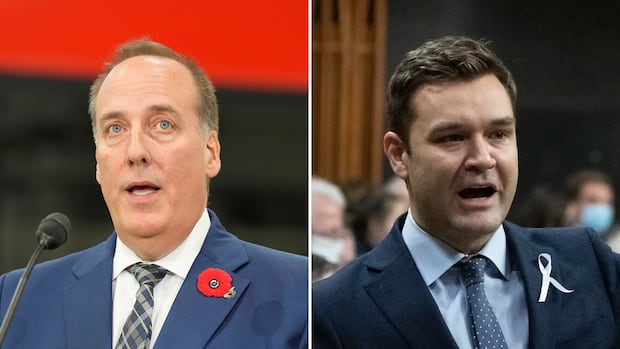
So it was, with all due respect to François Philippe-Champagne and his sizable budget, that this became the week of Chris d'Entremont and Matt Jeneroux, two Conservative backbenchers who stepped forward by leaving — d'Entremont departing his party to join the Liberals, Jeneroux announcing his intention to quit his office entirely.
In doing so, they might have at least reminded everyone that MPs are — or at least can be — important political actors. They also became potentially potent political symbols.
The pair of departures come two weeks after the release of an interview with Pierre Poilievre in which the Conservative leader said the leadership of the RCMP was "despicable" and alleged, without evidence, that the police force had covered up potentially criminal acts committed by Justin Trudeau.
In that same interview, Poilievre had boasted of how united the Conservative Party was under his leadership — "If you look at our party over the last three years, we've had very little dissent," he said — but Poilievre's latest line of attack brought out the doubters in his midst. Rumours of potential floor-crossers rolled around Ottawa.
Then, about a half hour before Champagne tabled his budget in the House, word slipped out of d'Entremont's impending departure to the Liberals.
"Over the last number of months, I wasn't feeling that I was aligned with the ideals of what the leader of the Opposition had been talking about. So I'd been sort of relooking at what my career is bringing and what I can do for my constituency," d'Entremont explained the next day.
"And understanding the point that we are in, in Canadian history, where it's time to actually try to lead a country to try to make it better and not try to knock it down, not to continue to be negative."
A day later, Jeneroux abruptly announced his intention to resign his seat.
These two moves matter in a few different ways.
First, there is the simple math. In a minority parliament where the governing party is just a few seats short of at least a bare majority, every vote matters that much more.
The addition of d'Entremont brought the Liberals up to 170 seats and Jeneroux's departure would, for at least a brief time, bring the total number of Opposition MPs in the House down to 172. Jeneroux's resignation would also open up a potentially winnable seat for the Liberals.
On Wednesday, d'Entremont described himself as a "red Tory." That moniker has come to describe moderate Canadian conservatives of the sort who could be associated with the old Progressive Conservative Party (which still exists in several provinces, including Nova Scotia, where d'Entremont was previously part of a PC government).
For Carney, d'Entremont's arrival helps underline the idea that his Liberal government is a little different than Justin Trudeau's Liberal government (the only opposition MP to join Trudeau's Liberals during his time as prime minister was, perhaps fittingly, a former Green MP). For Poilievre, d'Entremont's departure raises the obvious question of whether red Tories still have a home in the Conservative Party.


Ella Heyder is bracing for a breakup, even though she already moved out decades ago.

Shawne Hopkins never saw it coming.

Politicians return to Queen’s Park Monday for a shortened spring session, as Premier Doug Ford prepares to unveil his eight budget amid heightened global economic uncertainty.

Despite a recent announcement that a water supply pipeline will be build in Oneida Nation of the Thames, some members of the community say that's no excuse for taking water for granted.

As scandal has swirled around former prince Andrew Mountbatten-Windsor, questions and curiosity have also focused on his ex-wife, Sarah Ferguson, and their daughters, Princesses Beatrice and Eugenie.

Friday may have been the first day of spring, but winter storms are not over yet for Newfoundland.

While we officially welcomed spring last week, an incoming system will be a reminder that snow is still very much part of the new season, especially early on.

The future of a national historic site in Fredericton is up for discussion at meetings across New Brunswick in the next few weeks as the Anglican diocese considers what to do about costly repairs needed at Christ Church Cathedral.

Amanda Lathlin, the first First Nations woman to be elected to the legislative assembly in Manitoba's history, has died, the provincial NDP said on Saturday.

CBC's road trip series Land of Living Stories explores inspiring stories of community spirit from across Saskatchewan. In our latest visit, CBC-Radio Canada hit the road to La Ronge. This is the fifth of a multi-part series from that community.

Dozens of people filled Regina's Fresh and Sweet cafe on Saturday to paint, collage and craft their concerns about artificial intelligence by making zines — a type of self-published small booklet, typically created by hand.

Wildfire season has officially started in Alberta. As the snow starts to melt, people are starting to wonder: Will I have to evacuate this year?

Two hikers were rescued near Lions Bay, B.C., on Saturday after slipping down steep, treacherous terrain, according to search and rescue personnel.