Trump wants to take over some U.S. cities. It's unlikely — but he can make life hard for them
CBC
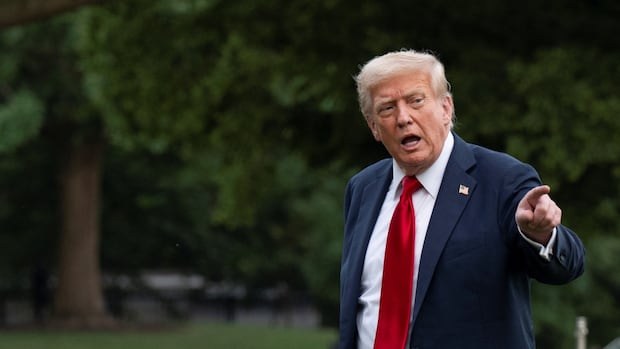
U.S. President Donald Trump is squaring off against American cities — and in the last few weeks, he's implied that he would use the powers of the presidency to order a federal takeover of New York City and Washington, D.C.
Spurred by his efforts to crack down on immigration and what he characterizes as high crime rates in urban areas, Trump's ongoing feud with several major U.S. cities has reached a boiling point in recent weeks.
"We're thinking about doing it, to be honest with you. We want a capital that's run flawlessly," he said of Washington, D.C., during a cabinet meeting a few weeks ago.
His threats have also extended to New York City, especially in reference to mayoral candidate Zohran Mamdani — a self-described socialist and rising star in the Democratic Party who Trump says would be a disaster if elected mayor in the country's biggest metropolis.
"We're going to straighten out New York.... Maybe we're going to have to straighten it out from Washington," the president said earlier this month.
Does he have the power to do that? It really depends on what — and where — Trump is referring to, according to experts who spoke with CBC News. But he could find ways to make life very difficult for city governments and their residents.
The Supreme Court has been "extraordinarily clear" that the federal government can't commandeer parts of state government, said David Schleicher, a lawyer and professor at Yale Law School who is an expert in state and city governments.
"That is, they can't tell state officials or local officials how to run government, and so they can't take them over and make them do stuff," he explained.
That's outlined in the U.S. Constitution's 10th Amendment, which delegates powers to the states that haven't been assigned to the federal government. Within that amendment, the federal government is forbidden from directing state or city officials to work toward its own objectives.
"If what [Trump] means is like, remove the mayor and replace him with Rudy Giuliani or something — that's not something that's within his authority," said Schleicher.
However, when Trump refers to having "tremendous power" at the White House to "run places when we have to" — as he did earlier this month, responding to a question about Mamdani's rise as a leading mayoral candidate — he could be referring to a few different outcomes.
There are several ways the federal government can "pick fights" with cities, according to Philip Wallach, a senior fellow at the American Enterprise Institute, a conservative think-tank in Washington, D.C.
That could include sending immigration officials or federal law enforcement into a city, not unlike what Trump did with the Immigration and Customs Enforcement (ICE) raids in Los Angeles earlier this summer, or dispatching the National Guard during the protests against the raids.
He could also threaten fiscal consequences through his own authority or with Congress's help — something he has done on several occasions to Chicago.


The government of Saskatchewan has announced plans to reduce the length of non-resident game bird hunting licences to combat illegal guiding.

An 87-year-old Alberta man is fighting extradition to the United Kingdom to stand trial for historical allegations of physical and sexual assault involving minors.

Eight casinos across southwest B.C. have been sold to First Nations in the last two years, with the province's gambling scene set to be reshaped as a result.

Hamilton hosts the Junos Sunday, and the musical awards show is bringing tourists, musicians, concerts and a ton of themed events to the city this week.

The multi-million-dollar deal at the heart of a high-profile fight between the Canadian government and one of the world’s biggest carmakers contains multiple clauses about the company’s footprint in Ontario, according to a copy obtained by CBC Windsor.

In recent months, Calgary police have carried out three day-long safety blitzes, parading out dozens of officers to flood an area with their increased presence — at least, temporarily.

A national organization is seeking people with experience in Canada's forestry sector as they put together a working group that will examine ways to improve forest recovery following wildfires.

Ella Heyder is bracing for a breakup, even though she already moved out decades ago.

Shawne Hopkins never saw it coming.

Politicians return to Queen’s Park Monday for a shortened spring session, as Premier Doug Ford prepares to unveil his eight budget amid heightened global economic uncertainty.

Despite a recent announcement that a water supply pipeline will be build in Oneida Nation of the Thames, some members of the community say that's no excuse for taking water for granted.

As scandal has swirled around former prince Andrew Mountbatten-Windsor, questions and curiosity have also focused on his ex-wife, Sarah Ferguson, and their daughters, Princesses Beatrice and Eugenie.

Friday may have been the first day of spring, but winter storms are not over yet for Newfoundland.