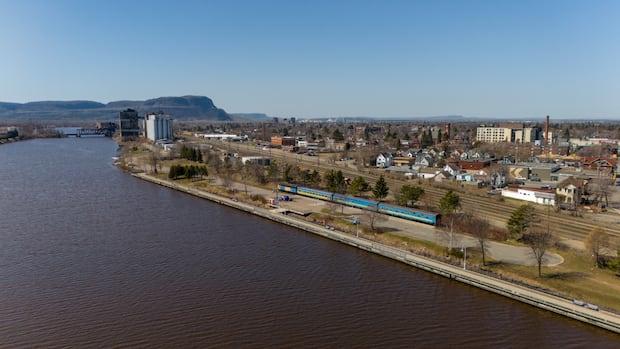
Thunder Bay City Council ratifies Kam River park as site for temporary shelter village
CBC
After months of debate, city council on Monday gave its final approval to Kam River Heritage Park as the site of a new temporary shelter village.
Construction of the village, which will include about 80 mini-cabins for use as transitional housing, is expected to start in July, with the first occupants moving in, in the fall.
Council voted to approve the site at its meeting last week; that decision was ratified on Monday.
"I think all members of council struggled with the decision," Current River Coun. Andrew Foulds said Tuesday. "It was an extraordinarily difficult decision, and listening to members of council both in open and closed session, what's very clear is every member of council, and I would also extend that to our administration, cares deeply about this community."
"There is a recognition that we have a segment of our population that is really struggling and vulnerable, and all members of council want what's best and and that was evident (Monday) night."
City administration was recommending the Kam River Heritage Park site for several reasons, including its proximity to other support services, and the fact that an encampment is already located near the park.
The city has budgeted $5.5 million for construction of the village, and $1.5 million annually for operational costs; if construction starts by July and is complete by December, the city is eligible for $2.8 million in external funding.
Now that the site has been approved and the decision ratified by council, the city will issue two requests for proposal: one for the construction of the village, and one for its operation.
"The city isn't going to be running this," Foulds said. "We will be ... looking for a third-party operator."
Carrie Anne Marshall, associate professor at Western University and director of the school's Social Justice in Mental Health Research Lab, said she has concerns with the use of mini-cabins.
"I'm deeply concerned about the proliferation of sleeping cabins across North America," she said. "There isn't enough evidence to support the use of tiny homes and sleeping cabins or particularly specifically sleeping cabins, and yet we're pouring millions of dollars into these approaches across North America."
Marshall said when it comes to mini-cabins and tiny homes, the latter is the better approach.
"Tiny homes to me are kind of like small homes that have all of the amenities of any home or an apartment, that any of us would live in," she said.
Mini-cabins, meanwhile, "don't have integrated amenities," Marshall said. "They usually have a bed, sometimes a fridge. They were insulated, often, but they're just basically a shed."


The N.W.T. Coroner Service has identified the Nunavut man who died in RCMP custody in Yellowknife last Thursday.

The Liberal government's nominee to be the next fiscal watchdog insists she'll run an independent and non-partisan ship — even though her candidacy has created a political rift.

Two years after Calgary city council held its longest public hearing in the city's history, another marathon session began on Monday to tackle the same contentious subject: blanket rezoning.

Quebec resident Antoine Forest was one of the pilots killed in the Sunday night crash at New York's LaGuardia airport, according to Radio-Canada sources.

Ontario Premier Doug Ford's cellphone records took centre stage as the provincial legislature resumed sitting Monday for the first time since December, with the opposition accusing the premier of having something to hide.

The P.E.I. Museum and Heritage Foundation hosted its annual heritage awards, recognizing Islanders who help maintain the island's culture and traditions.

A new independent review of Yukon’s education system is receiving pushback from advocates.

The RCMP has not recruited enough new officers or effectively assigned its members to meet its operational needs, according to a new report from the auditor general — raising concerns about public safety across the country.

Oil prices fell Monday morning after President Donald Trump said the U.S. would hold off on striking Iran’s energy infrastructure amid productive talks between the two countries.

Premier Doug Ford says his government plans to give Toronto's Billy Bishop Airport special designation that would allow the province to bypass municipal and provincial laws as it pushes to expand the runway downtown.

Jenelle Hughes says she worries every time her two older children take their car to get to Fanshawe College in London, Ont., from their home in Dutton.

Oil prices fell Monday morning after President Donald Trump said the U.S. would hold off on striking Iran’s energy infrastructure amid productive talks between the two countries.

While spring technically started late last week, Newfoundland and Labrador isn't free from winter weather just yet.