Thousands go from jail to being homeless in Ontario every year, report finds
CBC
When Dan was released from the Toronto South Detention Centre last December after serving about 60 days, he was given a TTC token and sent on his way. He walked to a bus stop, but he had nowhere to go.
"There's no plan," Dan said. "I'm a criminal, right? Nobody wants me."
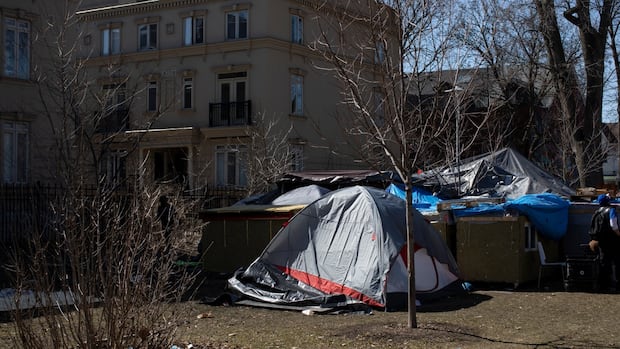
Dan, who was convicted of theft and failure to comply, wandered all night before going to an encampment. CBC Toronto isn't disclosing Dan's last name because he fears it could affect his chances of getting employment.
Since then, Dan has alternated between staying with friends and living outside. That means it is difficult to get his life organized, attend appointments and have a cell phone without it being stolen, he says. If he falls asleep while it is charging in a public place, it's gone when he wakes up.
"As soon as I caught a charge and was guilty, every sort of good thing going for me dried up," he said.
Dan, who was homeless before he went into jail, said supports such as provincial transitional housing similar to federal halfway houses, might have helped. He would have liked "just the stability of having somewhere to go" — a safe place to leave his belongings.
Not having a plan means "you are right back in the hole you started in," he said.
Dan is not alone. A new report released Thursday by the John Howard Society of Ontario says, in one year, thousands of people became homeless immediately upon release from Ontario jails. The society is a charity that works to build a safer Ontario.
The report, entitled From Incarceration to Encampment, found that provincial jails had 7,455 releases in 2023-2024 of people with no fixed address, meaning they had no housing. The number doesn't necessarily represent individual people because some people are admitted and released several times in one year, the report says.
The report calls on the Ontario government to set up a provincial transitional housing system for people released from its correctional facilities.
Safiyah Husein, the society's director of policy, said the report reveals a "deep link" between incarceration and homelessness in Ontario. She said it shows that people who spend time in jail need a "pathway" to help them reintegrate into society. And it puts a number on an urgent issue that requires a systemic government response, she said.
"A lot of people are flagged as having no fixed address or lacking stable housing upon admissions to correctional institutions. And then most of these people will be released straight onto the streets the day that they get out of jail. And with no supports, they might end up in shelters or encampments, but that's no place to rebuild a life," she said.
The report says people may be homeless upon release if they didn't have housing when they were admitted to jails, if they lost their housing while incarcerated, or if they were unable to return to their previous housing, sometimes due to release conditions.
"Housing is crucial to reintegration. And so with the lack of supports, a lack of housing, that increases the risk of reoffending and winding up right back in jail."


The U.S. government on Monday said electric vehicle (EV) maker Tesla and South Korea's LG Energy Solution had signed a supply agreement to build a $4.3 billion lithium iron phosphate (LFP) prismatic battery cell manufacturing facility in Lansing, Mich., with an expected production launch in 2027.

In one small town in Alberta, the assistant principal says teachers almost never meet alone with parents anymore.

Tens of thousands of customers are without power and four parts of Highway 401 are closed Tuesday morning as blasts of blowing snow hit the Ottawa-Gatineau area.

Melody Macsemchuk says volunteers at Grace Place in Thunder Bay, Ont., serve between 300 and 350 meals a day.

Groups of volunteers continue to search alongside police for a man who went missing in late January near Owen Sound, Ont., covering land on foot, and using drones for a view of the conservation area where his car was found.

Jessica Hay says her daughter Charlie loves to be included in everything — and a new accessible shopping cart at her local grocery store in Cornwall makes it possible for Charlie to come along for the ride.

The N.W.T. cabinet says it will review whether or not the territory needs an independent child and youth advocate after a motion by Range Lake MLA Kieron Testart calling on it to establish such a position was carried in the legislative assembly.

From affordable housing in Alberta to high taxes in Quebec, there are many widely accepted claims about the cost of living in different parts of the country. But are these preconceptions accurate?

An Ontario Provincial Police (OPP) report examining the conduct of investigators from a high-profile murder trial into the death of a Toronto police officer where a judge accused responding officers of lying and collusion is expected to be unveiled Tuesday.

While U.S. President Donald Trump tries to convince allies to help reopen the Strait of Hormuz, he is also sending 2,500 marines to the region — the first deployment of U.S. troops since it and Israel first attacked Iran on Feb. 28.

Management with the Southern Shore Breakers junior hockey team say the suspensions handed out following a March 7 rumble at the Goulds Arena in St. John's are excessive, and plan to appeal the discipline with Hockey NL.

On Hollywood's biggest night, newly crowned Oscar winner Tamara Deverell used her time in the spotlight to condemn the Nova Scotia government for cutting millions of dollars of support to the province's arts sector in this year's budget.

A campaign to convince the 17,000 New Brunswick households that have refused the installation of a smart meter to change their minds will likely be launched in June, the utility's ongoing rate hearing was told on Monday.