N.B. Power not taking no for an answer on smart meters just yet
CBC
A campaign to convince the 17,000 New Brunswick households that have refused the installation of a smart meter to change their minds will likely be launched in June, the utility's ongoing rate hearing was told on Monday.
N.B. Power vice-president Phil Landry said the utility is waiting for the New Brunswick Energy and Utilities Board to approve a proposed monthly meter reading fee of $4.65 on holdouts before trying one last time to win them over.
"We are waiting on the outcome of this proceeding before doing so," said Landry.
"In our communications with the customers we can share with them — this is the opt out or not opt out fee so they have the full understanding of what opting out actually means."
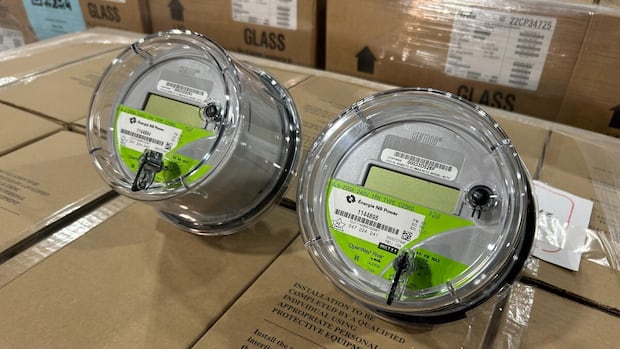
N.B. Power is in the final stages of adding up to 388,000 new "communicating" smart meters across the province as part of a multi-year effort to upgrade its electrical distribution grid.
The changes are meant to allow the utility to collect individual customer consumption data electronically in real time instead of once a month by a meter reader.
Landry told the hearing the utility ran up against a 4.6 per cent meter refusal rate among customers, about one in every 22 households.
Smart meters can be in constant communication with the power utility. That allows for instant identification and precise location of outages and lets customers track their own daily electrical consumption so they can make changes to head off large monthly bills if they choose.
In addition, the meters will eventually allow for pricing and service innovations, such as offering different electricity prices at different times of the day to match periods of low and high demand.
But the devices are not without controversy.
Online opponents allege a number of disputed health and safety threats posed by the meters. Some also question their accuracy and still others object to their constant farming of electrical consumption data as a privacy invasion
N.B. Power is proposing to manually read meters that have not been upgraded six times a year for customers who refuse a new device.
To pay that expense, it wants to charge those who opt out a special meter reading levy of $4.65 per month.
Landry told the hearing he believes that opposition to the devices have recently softened and is hoping that one-on-one discussions with refusers combined with a financial penalty for not switching might be enough to convince half or more of the holdouts to give in.


About that heartbreaking loss to the U.S. at the 2026 Olympic women's hockey final last month, Sarah Nurse says, “that was the most fun I’ve had in a hockey game in a very long time.”

The U.S. government on Monday said electric vehicle (EV) maker Tesla and South Korea's LG Energy Solution had signed a supply agreement to build a $4.3 billion lithium iron phosphate (LFP) prismatic battery cell manufacturing facility in Lansing, Mich., with an expected production launch in 2027.

In one small town in Alberta, the assistant principal says teachers almost never meet alone with parents anymore.

Tens of thousands of customers are without power and four parts of Highway 401 are closed Tuesday morning as blasts of blowing snow hit the Ottawa-Gatineau area.

Melody Macsemchuk says volunteers at Grace Place in Thunder Bay, Ont., serve between 300 and 350 meals a day.

Groups of volunteers continue to search alongside police for a man who went missing in late January near Owen Sound, Ont., covering land on foot, and using drones for a view of the conservation area where his car was found.

Jessica Hay says her daughter Charlie loves to be included in everything — and a new accessible shopping cart at her local grocery store in Cornwall makes it possible for Charlie to come along for the ride.

The N.W.T. cabinet says it will review whether or not the territory needs an independent child and youth advocate after a motion by Range Lake MLA Kieron Testart calling on it to establish such a position was carried in the legislative assembly.

From affordable housing in Alberta to high taxes in Quebec, there are many widely accepted claims about the cost of living in different parts of the country. But are these preconceptions accurate?

An Ontario Provincial Police (OPP) report examining the conduct of investigators from a high-profile murder trial into the death of a Toronto police officer where a judge accused responding officers of lying and collusion is expected to be unveiled Tuesday.

While U.S. President Donald Trump tries to convince allies to help reopen the Strait of Hormuz, he is also sending 2,500 marines to the region — the first deployment of U.S. troops since it and Israel first attacked Iran on Feb. 28.

Management with the Southern Shore Breakers junior hockey team say the suspensions handed out following a March 7 rumble at the Goulds Arena in St. John's are excessive, and plan to appeal the discipline with Hockey NL.

On Hollywood's biggest night, newly crowned Oscar winner Tamara Deverell used her time in the spotlight to condemn the Nova Scotia government for cutting millions of dollars of support to the province's arts sector in this year's budget.