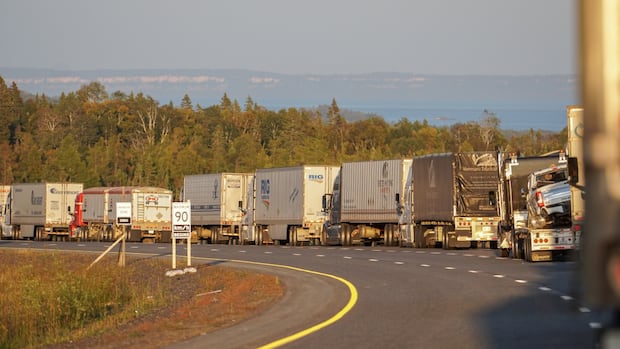
This trucking association is calling City of Thunder Bay 's designated route a major 'trade barrier'
CBC
The Ontario Trucking Association is calling on the province to intervene after Thunder Bay city council approved a new truck route bylaw that will restrict most transport trucks from using Dawson Road and Highway 102.
Council passed Bylaw 211-2025 on June 23 to take effect Oct. 1, 2025. Under the new rules, most heavy trucks will be restricted to Highways 61 and 11/17, the Harbour Expressway, Main Street, and Island Drive, unless making a delivery or pickup, or performing another service, in Thunder Bay. Enforcement will fall to the Thunder Bay Police Service.
The OTA warns the change will have unintended consequences, especially for Canada's supply chain.
"Let's call it $60 million a day of trade, primarily inter-provincial trade, that uses Highway 102. It's been a traditional bypass of the city for a long, long time," said Geoffrey Wood, senior vice-president of policy at the OTA.
Wood said the detour will force about 1,300 trucks per day onto Highway 17, adding 7.6 million kilometres of annual truck travel, consuming an additional 3 million litres of diesel and generating nearly 8,000 tonnes of carbon emissions each year.
"The goal from our perspective is to address truck safety everywhere. I think that's critical. We feel this isn't the way to do it," he said.
The OTA projects the added volume could result in five to six additional tractor-trailer collisions per year on Highway 17, which has more traffic signals and tighter intersections than Highway 102. Wood said implementing the bylaw in early October is especially concerning, as winter driving conditions typically begin around that time.
In a letter to Premier Doug Ford and several cabinet ministers, the OTA urged the province to explore whether the bylaw can be overturned or revised.
The association has proposed alternative safety measures, including 24/7 operation of truck inspection stations, automated speed enforcement and joint enforcement efforts involving provincial, municipal and federal agencies.
"We don't feel the enactment of this bylaw is the right way to address all the truck safety issues. And we do feel that it will add layers to inter-provincial trade at a time when we are trying to remove them and make our supply chain and our trucking industry as efficient as possible," Wood said.
The OTA says the bylaw may also reduce truck drivers' access to essential services in Thunder Bay, including grocery stores, rest stops and hotel parking.
"All of which are essential to the operation of the vehicles and critical for them to get the needed rest they're required every day for their hours of service," said Wood.
The bylaw has faced opposition from surrounding townships and municipalities. Conmee and Oliver Paipoonge, for example, have said the bylaw would double the number of heavy trucks travelling through their communities.
Kayla Dixon, Thunder Bay's commissioner of infrastructure and operations, defended the bylaw, saying it's based on years of public input.


The Swale Watchers plan to keep watching.

In a smaller city like Prince Albert, Ramadan can feel different.

About 125 people came out for a town hall meeting on health care in Charlottetown Monday night.

This is the second of two-part CBC News report on Taser use by Edmonton police. To read the previous story, click here.

A Merritt, B.C., father is urging parents to be on the lookout for ticks while the weather warms up, after his six-year-old son was partially paralyzed by a tick bite last week.

About that heartbreaking loss to the U.S. at the 2026 Olympic women's hockey final last month, Sarah Nurse says, “that was the most fun I’ve had in a hockey game in a very long time.”

The U.S. government on Monday said electric vehicle (EV) maker Tesla and South Korea's LG Energy Solution had signed a supply agreement to build a $4.3 billion lithium iron phosphate (LFP) prismatic battery cell manufacturing facility in Lansing, Mich., with an expected production launch in 2027.

In one small town in Alberta, the assistant principal says teachers almost never meet alone with parents anymore.

Tens of thousands of customers are without power and four parts of Highway 401 are closed Tuesday morning as blasts of blowing snow hit the Ottawa-Gatineau area.

Melody Macsemchuk says volunteers at Grace Place in Thunder Bay, Ont., serve between 300 and 350 meals a day.

Groups of volunteers continue to search alongside police for a man who went missing in late January near Owen Sound, Ont., covering land on foot, and using drones for a view of the conservation area where his car was found.

Jessica Hay says her daughter Charlie loves to be included in everything — and a new accessible shopping cart at her local grocery store in Cornwall makes it possible for Charlie to come along for the ride.

The N.W.T. cabinet says it will review whether or not the territory needs an independent child and youth advocate after a motion by Range Lake MLA Kieron Testart calling on it to establish such a position was carried in the legislative assembly.