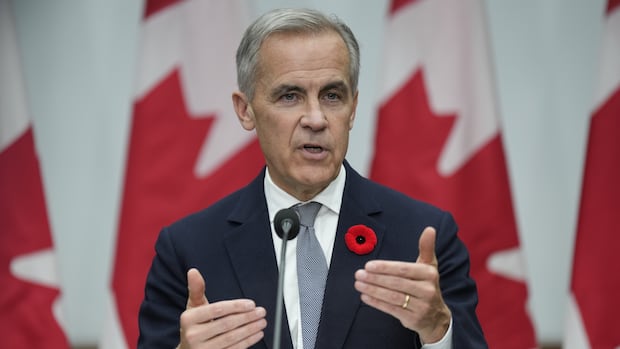
'This is not a game,' Carney says as he signals he's ready to fight election over federal budget
CBC
Prime Minister Mark Carney signalled on Saturday that he’s prepared to fight an election over his government’s upcoming budget should it come to that.
The fiscal plan will be tabled in the minority Parliament on Tuesday, but it is far from clear whether the governing Liberals have the support of opposition parties.
At the closing of the APEC summit in South Korea, he talked up the benefits of what his government is planning to invest in and do in the future, but he avoided directly answering whether he believes there are enough votes in the House of Commons to get it through.
“I am 100 per cent confident that this budget is the right budget for this country — at this moment,” Carney said before boarding the plane to return home.
“This is not a game. This is a critical moment in the global economy — or an important moment in the global economy. It's a critical one for our country."
Losing the budget vote would plunge the country into an election a little more than six months after the last campaign.
Carney was asked whether he was prepared to fight an election on the upcoming fiscal plan.
“I'm always prepared to stand up for the right thing,” he responded.
On Tuesday, Carney said the Liberals will begin the process of making what he calls "generational investments” in the Canadian economy and the country’s infrastructure. He plans to restructure the way federal finances are presented and promises to bring Canada's operating account back into balance within three years.
The Conservatives and the NDP are doing a lot of soul-searching this weekend.
For the Conservatives there’s the political optics of supporting an agenda they don’t like.
Even still, Conservative sources have told CBC News that they don't want to fight an election right now but will do it if they have to.
Conservative Leader Pierre Poilievre has made a series of demands, including scrapping the industrial carbon tax and keeping the deficit below $42 billion.
The Parliamentary Budget Officer estimates the shortfall in the current budget year will be $46 billion but will rise to $75 billion next year.


The government of Saskatchewan has announced plans to reduce the length of non-resident game bird hunting licences to combat illegal guiding.

An 87-year-old Alberta man is fighting extradition to the United Kingdom to stand trial for historical allegations of physical and sexual assault involving minors.

Eight casinos across southwest B.C. have been sold to First Nations in the last two years, with the province's gambling scene set to be reshaped as a result.

Hamilton hosts the Junos Sunday, and the musical awards show is bringing tourists, musicians, concerts and a ton of themed events to the city this week.

The multi-million-dollar deal at the heart of a high-profile fight between the Canadian government and one of the world’s biggest carmakers contains multiple clauses about the company’s footprint in Ontario, according to a copy obtained by CBC Windsor.

In recent months, Calgary police have carried out three day-long safety blitzes, parading out dozens of officers to flood an area with their increased presence — at least, temporarily.

A national organization is seeking people with experience in Canada's forestry sector as they put together a working group that will examine ways to improve forest recovery following wildfires.

Ella Heyder is bracing for a breakup, even though she already moved out decades ago.

Shawne Hopkins never saw it coming.

Politicians return to Queen’s Park Monday for a shortened spring session, as Premier Doug Ford prepares to unveil his eight budget amid heightened global economic uncertainty.

Despite a recent announcement that a water supply pipeline will be build in Oneida Nation of the Thames, some members of the community say that's no excuse for taking water for granted.

As scandal has swirled around former prince Andrew Mountbatten-Windsor, questions and curiosity have also focused on his ex-wife, Sarah Ferguson, and their daughters, Princesses Beatrice and Eugenie.

Friday may have been the first day of spring, but winter storms are not over yet for Newfoundland.