The world according to Marco Rubio Premium
The Hindu
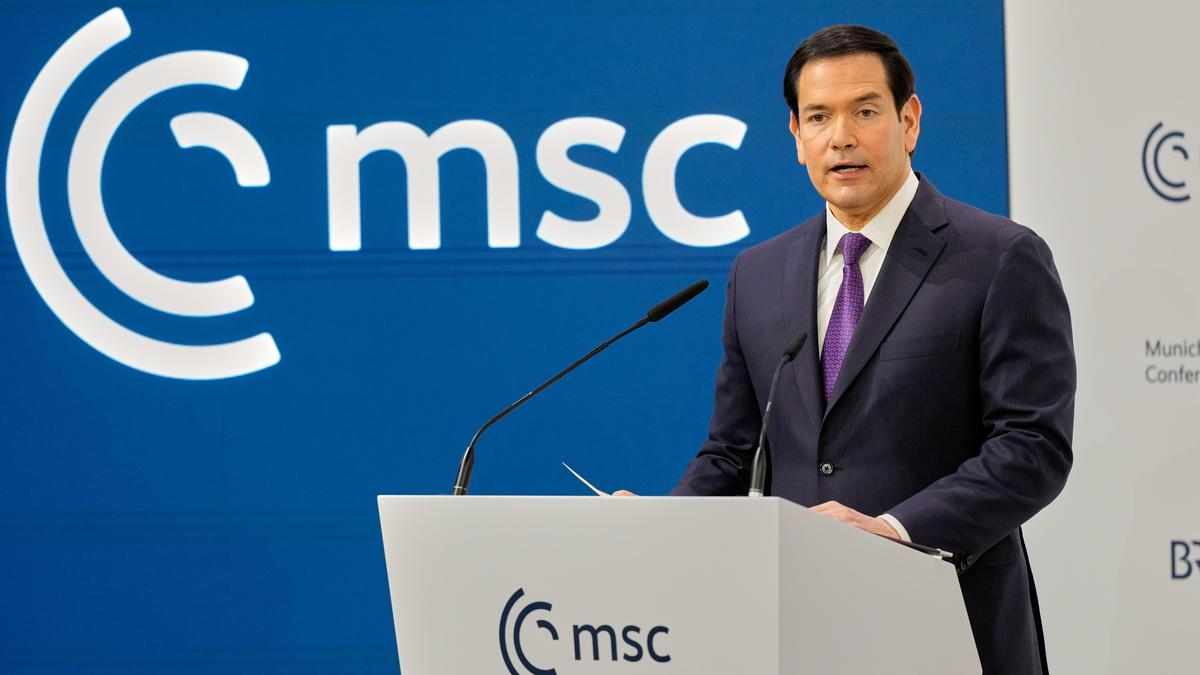
U.S. Secretary of State Marco Rubio, addressing the Munich Security Conference, hailed the colonial period as a phase of the West’s “expansion”.
“We live in a new era in geopolitics and it is going to require all of us to sort of re-examine what that looks like and what our role is going to be,” Marco Rubio, U.S. Secretary of State, said in Washington on February 13 before heading to attend the Munich Security Conference. “The old world is gone,” he said.
The old world Mr. Rubio referred to was one in which Western dominance prevailed unchallenged. On February 14, while addressing the conference, he hailed the colonial period as a phase of the West’s “expansion”.
“For five centuries, before the end of the Second World War, the West had been expanding — its missionaries, its pilgrims, its soldiers, its explorers pouring out from its shores to cross oceans, settle new continents, build vast empires extending out across the globe,” he said, with no reference to the crimes and loot of colonialism. “But in 1945, for the first time since the age of Columbus, it was contracting. Europe was in ruins... The great Western empires had entered into terminal decline, accelerated by godless communist revolutions and by anti-colonial uprisings that would transform the world,” added Mr. Rubio, just a few months ahead of the 250th anniversary of the United States’ independence from Britain.
Also Read | Rubio strikes constructive tone but persists in U.S. criticism of European allies
‘Managed decline’
This “managed decline”, in Mr. Rubio’s views, was accelerated by two things. First, “waves of mass migration” to the West from the rest that “threatens the cohesion of our societies and the continuity of our culture and the future of our people”. Second, the West embraced “a dogmatic vision” of free trade, which benefited its adversaries who protected their economies and took control of critical supply chains.


Shorts News:Watch: Smoke billows near Dubai airport after drone attack

West Asia conflict disrupts pharma air routes, threatening cancer drug supplies and forcing companies to find alternative shipping methods.

Trump accuses Iran of weaponising AI for disinformation, citing misleading claims about military successes and public support rallies.

Myanmar's Parliament convenes under military control, following a controversial election that reinforces the Army's grip on power.

Trump urges allies to secure the Strait of Hormuz, but Japan and Australia refuse to send naval support amid rising tensions.

AI-created videos circulating on Elon Musk's X depict American soldiers captured by Iran, an Israeli city in ruins, and US embassies ablaze; a surge of lifelike deepfakes despite a policy crackdown to curb wartime disinformation.

Explore the implications of "no quarter" in warfare, its legal prohibitions, and recent controversial remarks by U.S. officials.

Iran-Israel war: Follow live updates from The HIndu on the West Asia conflict on Marh 16, 2026

Trump warns NATO's future is at risk if allies don't assist in opening the Strait of Hormuz amid rising oil prices.

Nilufer Koc critiques U.S. colonial mindset on Kurdish issues, emphasizing the need for Kurdish rights in Iran's future political landscape.

Taiwan reports a resurgence of Chinese military flights, with 26 aircraft detected near the island after a recent decline.

Israel's Foreign Minister dismisses reports of imminent Lebanon talks, reaffirming alignment with the U.S. in the Iran conflict.

Sri Lanka implements a QR code system to ration fuel sales amid global supply challenges, limiting weekly quotas for vehicles.